










Nath Receivables Surge as Cottonseed Liquidation Is Planned
Key highlights
- Nath’s trade receivables rose to Rs 264.40 crore in September 2026 from Rs 83.80 crore in March 2026.
- Inventory declined to Rs 406.20 crore in September 2026 from Rs 444.60 crore in March 2026, but cottonseed stock remained elevated.
- H1 FY27 revenue rose 12.6% to Rs 360.10 crore, while EBITDA declined to Rs 41 crore from Rs 46.10 crore.
- Nath plans to liquidate excess cottonseed inventory over the next two to three years.
powered by IRIS
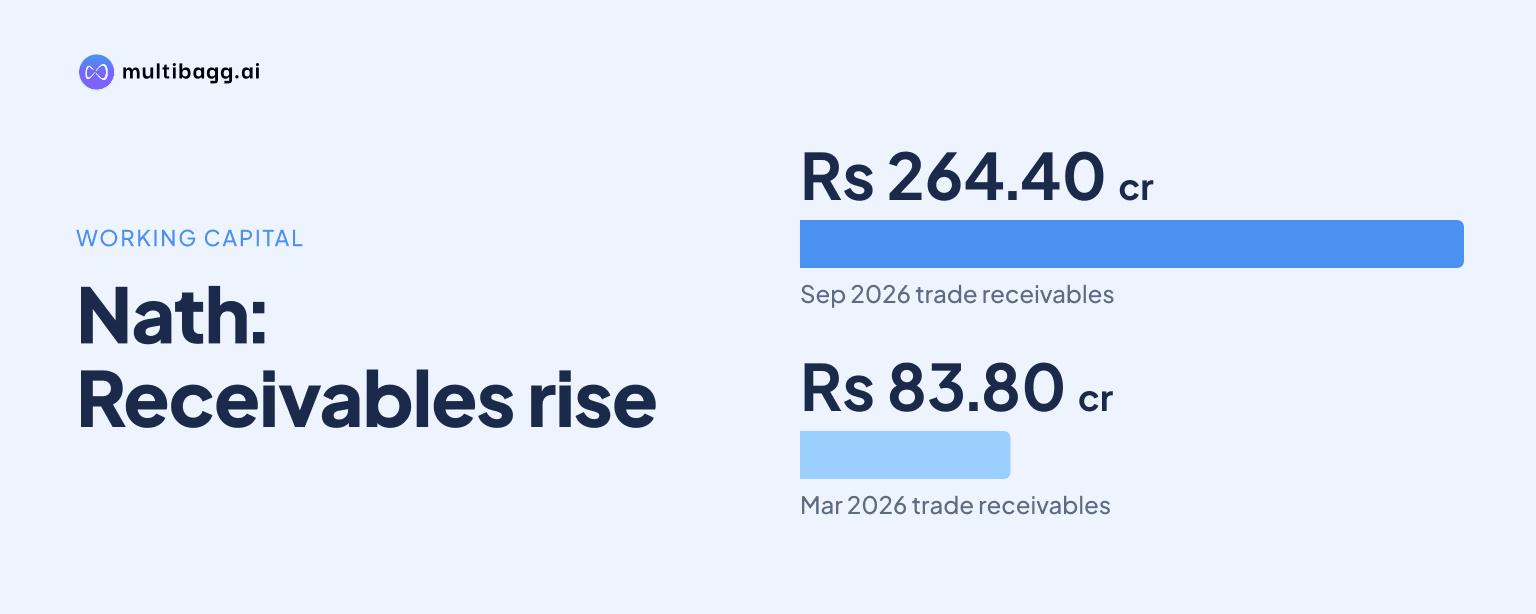
Nath Bio-Genes (India) Limited reported trade receivables of Rs 264.40 crore at September 2026, up Rs 180.60 crore from March 2026, while planning to liquidate excess cottonseed inventory over two to three years. The company linked the working-capital pressure to distributor liquidity constraints and lower-than-expected Kharif cottonseed sales.
Know Nath Bio-Genes (India) inside out
Results, valuation, peers and who's buying, in one view.
Why did Nath’s working capital rise in H1 FY27?
Nath’s working-capital requirement rose because receivables expanded sharply while inventory remained elevated after the Kharif season. Trade receivables reached Rs 264.40 crore at September 2026, compared with Rs 83.80 crore at March 2026. Management attributed the increase to the seasonal nature of seed sales and liquidity constraints across the agricultural distribution network, and said net cash flow from operating activities was negative at the end of H1 FY27.
Inventory stood at Rs 406.20 crore at September 2026, down from Rs 444.60 crore at March 2026, but management said cottonseed stock remained high. Improved production efficiency in selected cotton hybrids that had previously been difficult to produce enabled Nath to build volumes, while Kharif sales were lower than anticipated. Management said the stock build-up did not reflect a quality concern in cottonseed.
Nath said its distribution model requires stocks and receivables to be spread across dealers and distributors to maintain product availability and market presence. That approach supported sales during a season marked by uneven rainfall, but also tied more cash to the trade network. Management said collections are being monitored closely and working capital should improve gradually as receivables are recovered and inventory normalises.
How will Nath liquidate excess cottonseed inventory?
Nath plans to rationalise cotton production and gradually liquidate excess cottonseed inventory over the next two to three years. Management said cottonseed is sturdy in nature and that it does not expect quality issues in the stored stock. The stated timeline indicates that the inventory reduction is expected to extend beyond a single selling season.
The company expects the inventory to support demand when agricultural conditions improve. Management said its popular cotton hybrids performed well during the stressed Kharif season and identified Sanket, Jumbo and Rana as key products. Research lead Dr. Venkatesh Kulkarni said Sanket had performed in both high-rainfall and drought conditions, while Rana was also described as a well-performing hybrid.
Cotton accounted for about 26% of H1 FY27 sales, but volumes declined 2.29% year on year to approximately 10.6 lakh packets. Management attributed the decline mainly to adverse monsoon conditions in Maharashtra and other affected markets rather than product competition. It also estimated that illegal BT cotton accounted for 20% to 25% of total industry sales, while saying it could not measure any direct impact on Nath’s own sales.
Did Nath’s H1 FY27 revenue growth increase profit?
No, Nath’s H1 FY27 revenue growth did not increase profit because crop mix, product mix, trade schemes and operating costs reduced margins. Revenue rose 12.6% year on year to Rs 360.10 crore from Rs 319.90 crore in H1 FY26, but earnings before interest, tax, depreciation and amortisation, or EBITDA, declined to Rs 41 crore from Rs 46.10 crore. EBITDA margin fell to 11.4% from 14.4%.
Profit before tax decreased to Rs 36.50 crore from Rs 43.70 crore, while profit after tax fell to Rs 34.90 crore from Rs 42.40 crore. Management said it passed additional margin to the trade through schemes to sustain sales and protect market presence amid weak distributor liquidity. It told analysts that at least Rs 5 crore of additional support was provided to the market during the period, affecting EBITDA.
Interest expense also increased because Nath used more bank working-capital funding for the stock build-up. Management said its blended cost of capital remained around 9%, but stated that about Rs 3.50 crore to Rs 4 crore of additional interest affected net profit. An analyst cited interest expense of about Rs 6 crore in the quarter, compared with an average run rate of roughly Rs 3.50 crore to Rs 4 crore.
Got a follow-up? Ask IRIS
Which crop segments offset Nath’s weaker cotton season?
Paddy offset part of the weaker cotton season by becoming Nath’s largest H1 FY27 sales contributor at about 37% of total sales. Management linked paddy’s relative resilience to favourable rainfall in northern markets. Cotton contributed about 26%, Bajra about 13% and maize about 6%, meaning paddy, cotton and Bajra together accounted for nearly 76% of reported sales.
Nath has been expanding what management calls non-cotton, non-paddy crops, including maize, Bajra, jowar, wheat, mustard, vegetables and plant nutrient supplements. Management said maize delivered an uplift during H1 FY27 and Bajra had grown over the preceding two to three years. These segments are intended to diversify the crop portfolio while retaining cotton and paddy as major categories.
For the next season, sales lead Harish Pandey said management expects cotton to grow by 20% to 30%, citing commercial cotton prices of about Rs 9,500 to Rs 10,500 against around Rs 7,500 in the prior year. He also said management expects corn acreage to grow at least 20% in 2027-28 over 2026-27 and is appointing larger distributors while adding staff in corn, hybrid paddy and Bajra markets. These are management expectations, not reported sales guidance.
What is Nath’s plan for collections and margin recovery?
Nath’s stated priorities are stronger receivable collections, inventory management, cost discipline and disciplined production planning. Management expects working capital to improve gradually as distributors pay outstanding balances and inventory normalises. Converting the Rs 264.40 crore receivables balance at September 2026 into cash is therefore central to reducing its requirement for bank-funded working capital.
On margins, management said the additional trade schemes in H1 FY27 reflected difficult market conditions rather than a permanent policy. It expects trade support to return to around 26% to 28% next year, which management said could save about 4 percentage points. It also expects increased contributions from hybrid vegetables, maize and plant nutrient supplements, which management identified as relatively better-margin categories.
Management said Rabi crops were reasonably strong and expected EBITDA to recover by the end of the year, but it gave no numerical EBITDA-margin forecast. It also said reducing trade margins could risk revenue and market presence, making the timing of any recovery dependent on sales conditions, product mix and collections. The company’s immediate plan remains focused on managing cash tied up in cottonseed stock and distributor credit.
Conclusion
Nath maintained H1 FY27 revenue growth of 12.6% to Rs 360.10 crore, supported by paddy and other crop categories, but the result came with higher cash tied up in receivables and cottonseed inventory. Receivables rose Rs 180.60 crore from March to Rs 264.40 crore by September, while EBITDA declined Rs 5.10 crore year on year to Rs 41 crore as trade support, mix and interest costs weighed on profitability.
The next indicators are collections through the Rabi season, the pace of inventory reduction from the Rs 406.20 crore balance reported in September 2026, and cotton demand in the next Kharif cycle. Management’s two-to-three-year excess-inventory liquidation plan and its expectation that trade support will return to 26% to 28% next year provide the disclosed benchmarks for assessing progress.