










Jyoti Resins says new markets get 120-150 days credit terms
Key highlights
- Jyoti Resins said newer markets receive 120-150 days of credit versus 75-100 days in mature markets.
- Management said the consolidated debtor cycle was around 160 days, against a target of about 120 days.
- Jyoti Resins said five mature states generate about 85% of revenue, while newer markets generate about 15%.
- Jyoti Resins said its dealer base rose to 14,000 from 10,000 last year.
powered by IRIS
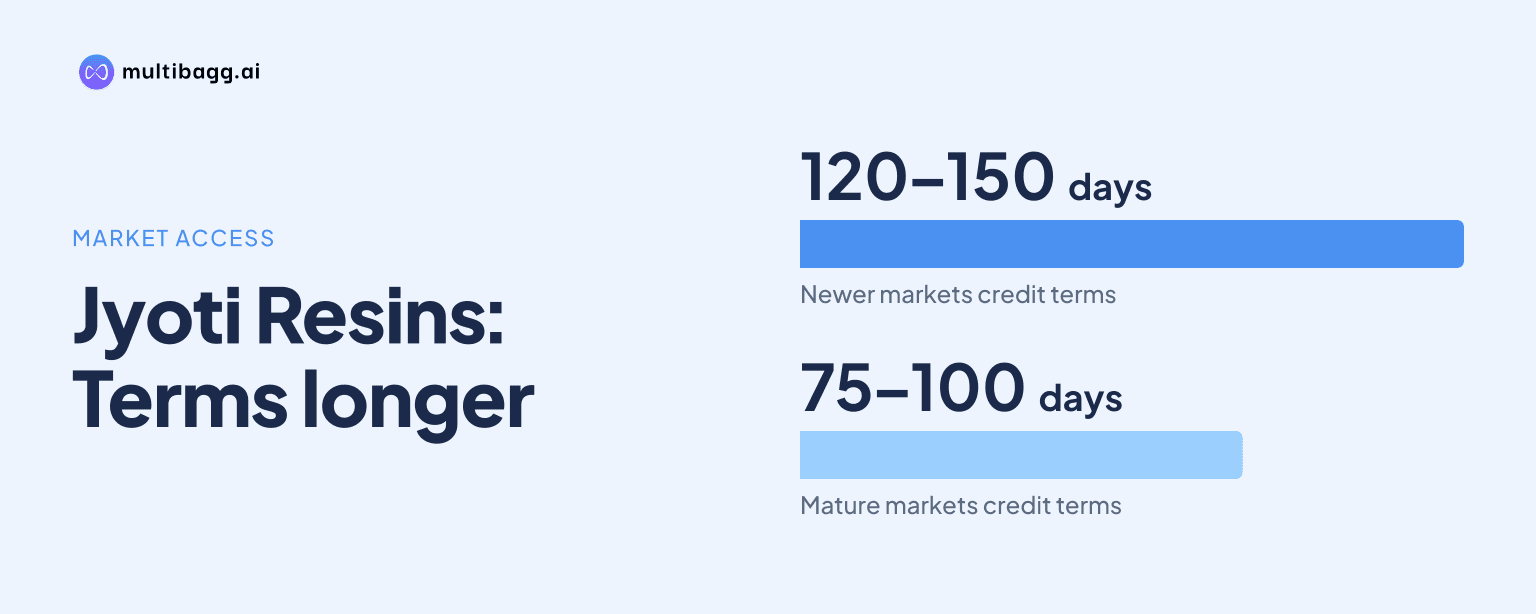
Jyoti Resins said newer markets receive 120-150 days of dealer credit, compared with 75-100 days in mature markets, as it builds distribution; management said the consolidated debtor cycle had reached around 160 days, above its target of about 120 days. The company plans recovery efforts and a smaller-market channel-financing rollout within one or two quarters.
Know Jyoti Resins and Adhesives inside out
Results, valuation, peers and who's buying, in one view.
Why does Jyoti Resins give newer markets longer credit?
Jyoti Resins gives newer markets longer credit because management is prioritising dealer relationships, initial product placements and expansion into new geographies. Management said mature markets generally operate at 75-100 credit days, while newer markets can require 120, 140 or 150 days. It described these terms as part of its ease-of-doing-business approach for dealers rather than a standard policy applied across India.
The company said its overall debtor cycle had climbed to around 160 days over the past one to two years. Management attributed the increase to sales growth in newer territories as well as competition in older territories, where some dealers also need longer payment terms. It said credit practices vary by pin code, including between Rajkot and Surat within Gujarat.
Jyoti Resins said about 85% of its revenue is generated in five mature states and the remaining 15% comes from newer markets. This mix means the newer-market credit range alone does not explain the consolidated debtor cycle. Management said it has also had to preserve dealer relationships in some mature-market territories where competition affects payment terms.
How will Jyoti Resins bring debtor days down?
Jyoti Resins is targeting a debtor cycle of around 120 days, which management said it maintained in FY23-FY24. The company said it has started discussions with channel-financing providers and plans to begin a channel-financing arrangement in a smaller market within one or two quarters. Management presented the mechanism as a way to support collections without abruptly reducing dealer credit.
The company has recruited back-office staff focused on recoveries, and management said the broader team is concentrating on receivables during the next one to two quarters. However, it said it does not intend to make forceful collection decisions because dealer relationships remain central to expansion. The company described its debtor base as spread across many customers rather than concentrated in a small group.
A dealer-led carpenter loyalty programme accounts for about 5% of the higher credit days, according to management. Under one programme, a dealer pays carpenter rewards and later receives reimbursement from Jyoti Resins; a separate programme allows carpenters to redeem rewards directly through an app. Management therefore indicated that commercial dealer credit, rather than loyalty reimbursements, accounts for most of the extended receivables cycle.
Got a follow-up? Ask IRIS
Is expansion increasing Jyoti Resins’ working-capital requirement?
Jyoti Resins said geographic expansion requires planned liquidity because new territories need dealer credit, field teams and distribution investment before volumes develop. Management agreed with an analyst that balance-sheet cash can support the working-capital needs of expansion. Before entering a territory, the company said it assesses market size, expected share, team requirements and investment needs over two, three or four years.
The company said it has expanded into 16 states and is pursuing pin-code-level penetration in tier-two and tier-three markets, along with hardware trade channels. It added 150 employees during the preceding four months and said its sales team had increased from 250 people three years earlier to 650 people. Management is targeting 20% annual volume growth and said it expected 15-17% volume growth in the current year.
Jyoti Resins said its dealer base had increased to 14,000 from 10,000 last year. In a new territory, management said about 50% of dealers receiving initial product placement generate repeat orders within six months, with a 75% repeat-order ratio targeted in the following year. It expects territories to reach a satisfactory break-even volume within two to three years, though it did not disclose territory-level revenue or profitability.
What evidence did Jyoti Resins give on receivables risk?
Jyoti Resins said bad debt has remained below 0.5% for 20 years, and management cited this history, repeat purchases and dispersed receivables as reasons it considers the current cycle manageable. The company also said it has funded expansion through internal accruals while remaining debt-free. These are management's indicators of collection quality, not a substitute for current-period receivables ageing data.
The company did not disclose a receivables ageing schedule, an absolute bad-debt charge, overdue balances by bucket or channel-financing costs. Those omissions leave the extent of overdue collections and the economic effect of the planned financing programme unquantified. Management nonetheless said it expects the debtor cycle can return to around 120 days when market conditions and collection efforts improve over one, two or three quarters.
Cash requirements also depend on inventory and capacity plans. Jyoti Resins said it generally keeps low inventory days but had raw-material contracts covering 60-90 days, including direct imports of vinyl acetate monomer, or VAM. Its completed brownfield expansion cost Rs 6-7 crore and increased capacity to 3,500 tonnes per month, which management said could support Rs 600-700 crore of revenue depending on demand and distribution execution.
Conclusion
Jyoti Resins is accepting longer dealer credit as part of its distribution push, with newer markets receiving up to 150 days compared with up to 100 days in mature markets. The trade-off is visible in a debtor cycle of around 160 days, versus management's 120-day benchmark from FY23-FY24. Management argues that the exposure is moderated by dispersed customers, repeat business and bad debt below 0.5% over 20 years.
The next point to watch is whether channel financing begins in a smaller market within one or two quarters and whether added recovery staff reduce the debtor cycle toward 120 days. Management is also expanding across 16 states, targeting 15-17% volume growth in the current year and 20% annual volume growth thereafter, while it plans a Gujarat greenfield facility requiring Rs 45-50 crore of investment.