










Kalyani Forge plans ₹30 crore FY27 capex for ramp-ups
Key highlights
- Kalyani Forge plans ₹30 crore of FY27 capex, compared with ₹23.44 crore spent in FY26.
- ₹20 crore of the FY27 plan is allocated to ramp-up and new-business programmes.
- Kalyani Forge deployed ₹8 crore in H1 FY27, including ₹1.09 crore in Q2 FY27.
- Machining utilisation was 85-90%, while truck sales reached ₹23.30 crore in Q2 FY27.
powered by IRIS
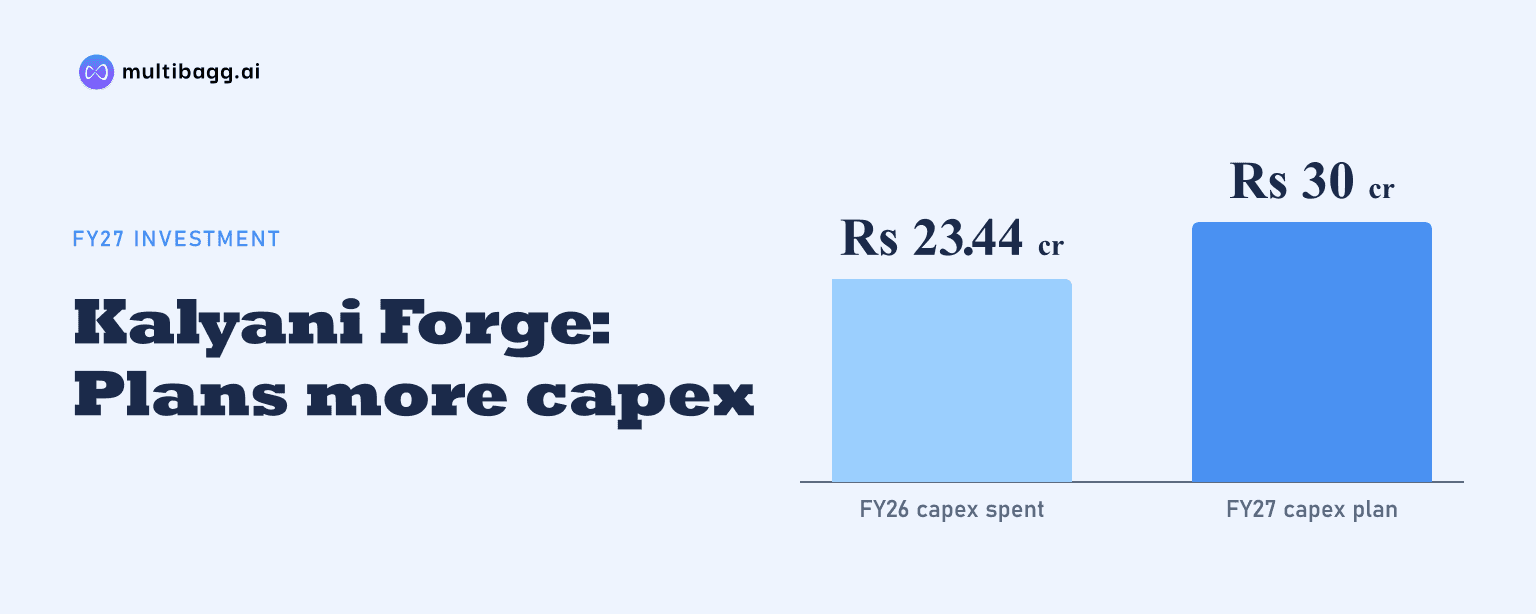
Kalyani Forge Ltd plans ₹30 crore of FY27 capital expenditure, directing ₹20 crore to ramp-up and new-business programmes while machining utilisation is 85-90%. Kalyani Forge had deployed ₹8 crore in H1 FY27 and says remaining outlay will be phased according to order conversion and funding availability, with commercial-vehicle original equipment manufacturer ramp-ups and machining de-bottlenecking identified as H2 priorities.
Know Kalyani Forge inside out
Results, valuation, peers and who's buying, in one view.
What is Kalyani Forge's FY27 capex plan?
Kalyani Forge has set an FY27 capital-expenditure plan of ₹30 crore, compared with ₹23.44 crore spent in FY26. The planned amount is also above ₹29 crore in FY25 and ₹23.22 crore in FY24, following ₹6.19 crore in FY23 and ₹3.34 crore in FY22. The FY27 figure is presented as a plan rather than completed spending.
Kalyani Forge divides the ₹30 crore programme into four business purposes: ₹10 crore for ramp-up business, ₹10 crore for new business, ₹5 crore for future business and ₹5 crore for existing business. This allocation puts ₹20 crore behind ramp-ups and new-business requirements, while ₹10 crore is assigned to existing and future business.
Where will Kalyani Forge deploy the FY27 capex?
Kalyani Forge plans to allocate ₹11.70 crore of FY27 capex to engine products, ₹10 crore to axle products and ₹8.30 crore to driveline products. Engine is the largest of the three disclosed product-group allocations, ahead of axle by ₹1.70 crore and driveline by ₹3.40 crore. The three product groups together account for the full ₹30 crore plan.
The immediate H2 priority is commercial-vehicle original equipment manufacturer, or OEM, ramp-up programmes. Truck sales reached ₹23.30 crore in Q2 FY27, up about 75% year on year from ₹13.30 crore in Q2 FY26 and 16% from ₹20 crore in Q1 FY27. Trucks represented 43% of sales in Q2 FY27, compared with 25% a year earlier, linking the stated ramp-up priority to the changed sales mix.
Kalyani Forge also reported a 10% increase in conrod machining capacity and installation of a new wheel-hub line up to 30% of its planned capacity. Its business-development update says further machining expansion is planned, while production of a large-engine conrod for an OEM's artificial-intelligence data-centre application has started. These disclosed programmes provide operating context for the engine, driveline and axle allocation.
Why is Kalyani Forge increasing machining capex?
Kalyani Forge says H2 FY27 machining capex will target de-bottlenecking and added capacity because machining utilisation is 85-90% and orders are ramping up. The company specifically identifies ramp-up spending and de-bottlenecking as the first calls on the remaining FY27 budget. It does not disclose a separate rupee amount solely for machining within the ₹30 crore plan.
The capacity requirement coincides with growth in OEM revenue, which rose to ₹41 crore in Q2 FY27 from ₹28.90 crore in Q2 FY26, a stated 41% year-on-year increase. OEM revenue also increased from ₹40.70 crore in Q1 FY27 to ₹41 crore in Q2 FY27, marking the fifth consecutive quarter of growth according to the presentation, despite planned reconstruction and machine shifting.
The capex programme is also aligned with Kalyani Forge's fourth phase of business-mix optimisation, which prioritises capacity for key customers and high-volume business. Cars, trucks and industrial products together generated ₹52.50 crore in Q2 FY27, up 20% year on year, and represented 97% of sales versus 82% in Q2 FY26. By contrast, agro and other products fell to 3% of sales from 18% a year earlier.
Got a follow-up? Ask IRIS
How much FY27 capex has Kalyani Forge spent so far?
Kalyani Forge deployed ₹8 crore in H1 FY27, comprising ₹6.92 crore in Q1 FY27 and ₹1.09 crore in Q2 FY27. The Q2 amount was below the ₹6.92 crore first-quarter deployment, meaning most reported H1 spending occurred in Q1. The company says the balance will be phased rather than committed on a fixed quarterly schedule.
The latest quarterly deployment also compares with ₹16.22 crore in Q4 26, ₹6 crore in Q3 26 and ₹5.50 crore in Q2 26. This sequence shows spending peaked in Q4 26 before dropping to ₹1.09 crore in Q2 27. The presentation does not provide a completed H2 FY27 capex timetable or a quarter-by-quarter forecast for the unspent part of the plan.
Kalyani Forge reported property, plant and equipment of ₹85.30 crore at Q2 27, compared with ₹86.80 crore at Q1 27 and ₹69.10 crore at Q2 26. Capital work-in-progress was ₹12.60 crore at Q2 27, down from ₹13.90 crore at Q1 27 but above ₹12 crore at Q2 26. These balance-sheet measures are reported alongside capex data without a stated reconciliation to the FY27 plan.
How will Kalyani Forge fund the remaining FY27 capex?
Kalyani Forge says the programme will be supported by new term loans, internal accruals and part of a Board-approved ₹45 crore funding plan. The presentation does not state how much of the ₹45 crore plan has been drawn, how much will be used for capex, or the terms of any new loans. Funding availability is expressly one of the factors governing the pace of deployment.
Order conversion is the other stated condition for phasing the unspent budget. Kalyani Forge therefore links its H2 allocation first to ramp-up and de-bottlenecking requirements, rather than committing the remaining amount to a calendar deadline. Truck sales of ₹23.30 crore in Q2 FY27 and machining utilisation of 85-90% are the operating indicators cited alongside that sequencing.
Conclusion
Kalyani Forge's ₹30 crore FY27 programme is directed primarily at a changed business mix: ₹20 crore is allocated to ramp-up and new business, while trucks contributed ₹23.30 crore and 43% of Q2 FY27 sales. The plan also assigns ₹11.70 crore to engine, ₹10 crore to axle and ₹8.30 crore to driveline products, alongside capacity additions intended to relieve machining constraints.
The next item to watch is order conversion and funding availability, since Kalyani Forge had deployed ₹8 crore by H1 FY27 and says the remaining spending will be phased on those conditions. Management's stated H2 priorities are commercial-vehicle OEM ramp-ups, machining de-bottlenecking and added capacity, financed through new term loans, internal accruals and part of the ₹45 crore funding plan.