










Kalyani Forge truck sales rise 75% as OEM mix shifts higher
Key highlights
- Kalyani Forge truck sales rose 75% year on year to Rs 23.3 crore in Q2 FY27.
- Trucks contributed 43% of Kalyani Forge’s Q2 FY27 sales, compared with 25% a year earlier.
- Kalyani Forge OEM revenue increased 41% year on year to Rs 41 crore in Q2 FY27.
- Kalyani Forge deployed Rs 8 crore of its Rs 30 crore FY27 capital-expenditure plan in H1.
powered by IRIS
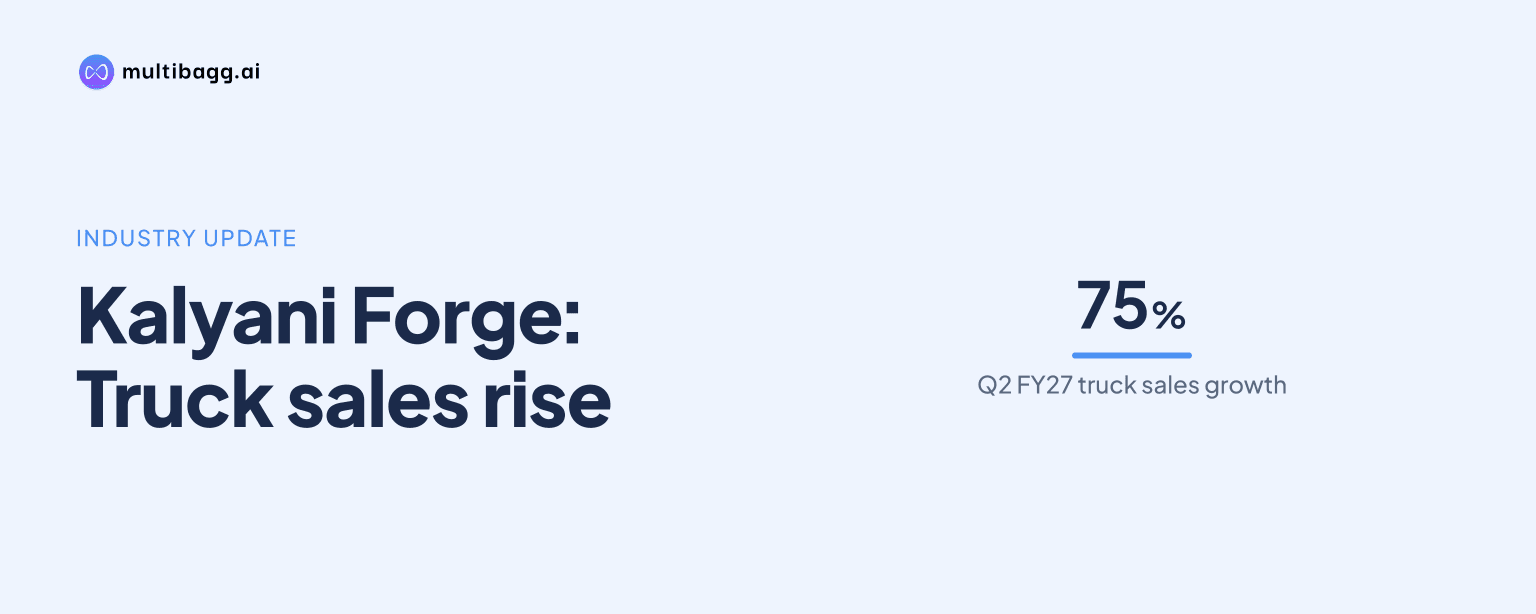
Kalyani Forge Limited reported truck sales of Rs 23.3 crore in Q2 FY27, up 75% year on year and equal to 43% of quarterly sales, versus 25% a year earlier. The increase accompanied a shift toward original equipment manufacturer (OEM) engine, axle and driveline programmes as legacy and non-core activity was phased out.
Know Kalyani Forge inside out
Results, valuation, peers and who's buying, in one view.
Why did Kalyani Forge truck sales rise in Q2 FY27?
Kalyani Forge said truck sales rose 75% year on year and 16% sequentially to Rs 23.3 crore in Q2 FY27 because of market pull in the segment. Trucks contributed 43% of quarterly sales, compared with 25% in Q2 FY26, while H1 FY27 truck sales increased 62% year on year. Management said it is prioritising truck-related investment, customer outreach and engineering resources.
The truck advance came during two planned operational disruptions. Kalyani Forge reconditioned a 2,500-ton press for two months and relocated its driveline machining plant from MCD3 to MCD1, reducing sequential revenue by about 18% from Q1 FY27 to Rs 54.4 crore. Management said the press and MCD lines had returned to operation, while truck demand continued to increase.
Cars generated Rs 15.8 crore in Q2 FY27 and were steady year on year, but declined from Rs 22.5 crore in Q1 FY27. Industrial sales fell 9% year on year to Rs 13.5 crore, which management attributed to the phase-out of some non-core industrial work. Cars, trucks and industrial products together accounted for Rs 52.5 crore, or 97% of sales, against 82% a year earlier.
How is Kalyani Forge changing its OEM product mix?
Kalyani Forge is reallocating resources to core OEM, high-volume product lines, with engine, driveline and axle products accounting for 96% of Q2 FY27 business. Legacy non-fit business fell to 4% of sales from 15% in Q2 FY26. Management described the work as phase four of its business-mix optimisation, focused on capacity ramp-up for key customers and closer management of strategic accounts.
OEM revenue reached Rs 41 crore in Q2 FY27, up 41% year on year and marking a fifth consecutive quarter of growth. Management said it chose not to compromise OEM revenue during the press reconditioning and machining-plant shift. Engine sales rose 46% year on year to Rs 40 crore and represented 73% of sales, compared with 55% a year earlier, with connecting rods identified as the core engine product.
Axle sales increased 16% year on year to Rs 5.9 crore, or 11% of sales, although output was affected by work on the 2,500-ton press. Driveline sales were Rs 6.6 crore after Kalyani Forge consolidated low-volume parts and moved machining from MCD3 to MCD1. Management said the more compact MCD1 layout offers room for additional capacity.
What legacy business is Kalyani Forge phasing out?
Kalyani Forge has reduced agro and other sales to 3% of Q2 FY27 revenue from 18% in the prior-year quarter as it exits non-core programmes. The lower industrial result of Rs 13.5 crore reflects part of that transition, according to management, rather than a stated retreat from all industrial applications. The company is retaining its focus on engine, driveline and axle programmes across commercial vehicles and passenger cars.
Exports were Rs 7.6 crore, or 14% of Q2 FY27 sales, compared with 15% a year earlier. Management said new export programmes are replacing phased-out legacy export business and have better growth potential and margins, but it did not disclose a revenue target or a production timetable for those replacement programmes. The planned mix change therefore remains dependent on execution of the new programmes.
Got a follow-up? Ask IRIS
Where will Kalyani Forge spend its FY27 capital expenditure?
Kalyani Forge plans to direct H2 FY27 capital expenditure toward commercial-vehicle OEM ramp-ups and machining de-bottlenecking. Management cited machining utilisation of 85% to 90% and truck sales of Rs 23.3 crore as reasons to give the segment priority. The company said its FY27 capital-expenditure plan totals Rs 30 crore, of which Rs 8 crore had been deployed in H1 FY27.
The plan allocates about Rs 10 crore to growth ramp-up programmes, Rs 10 crore to new business, Rs 5 crore to future business and Rs 5 crore to existing business. Connecting-rod machining capacity has already increased 10%, while the new wheel-hub line was installed to 30% of planned capacity in the previous quarter. Sample development for the wheel-hub orders was complete and samples were with customers.
Kalyani Forge also said production had begun on large engine connecting rods for an OEM serving artificial-intelligence data-centre applications. Management linked this programme to demand for power-generation equipment used by data centres. It said FY27 capital expenditure will be supported by term loans, internal accruals and partly by the board-approved funding plan.
What do the mix shift and funding plan mean for Kalyani Forge earnings?
Kalyani Forge reported earnings before interest, tax, depreciation and amortisation (EBITDA) of Rs 7.79 crore and an EBITDA margin of 14.2% in Q2 FY27, up 158 basis points from 12.7% in Q2 FY26. The margin remained above 14% despite the planned production disruption, while profit after tax was Rs 2.17 crore. H1 FY27 EBITDA rose 38.8% year on year to Rs 18.67 crore and the H1 EBITDA margin was 15.3%, versus 11.1% a year earlier.
The board approved a Rs 45 crore funding plan to strengthen liquidity and support order-book ramp-up. Its indicative components include around Rs 10 crore of equity, Rs 20 crore of debt and up to Rs 20 crore from non-core asset and inventory monetisation. Management said receivables had risen because of delayed remittances during a banking changeover and slower legacy last-time lifting, but collections and export credit lines were being normalised.
Kalyani Forge had about Rs 60 crore of remaining new-product orders to execute after Rs 30 crore from an earlier Rs 90 crore order book moved into production over the preceding three quarters. Management also estimated that volume increases in existing parts for existing customers could be worth around Rs 20 crore annually, although that amount was not included in the stated new-business order book.
Conclusion
Kalyani Forge’s Q2 FY27 results show a business mix increasingly led by truck and OEM programmes. Truck revenue reached Rs 23.3 crore, OEM revenue rose to Rs 41 crore, and legacy non-fit activity fell to 4% of sales. The company maintained a 14.2% EBITDA margin while completing plant work that reduced quarterly revenue.
The next point to watch is whether the restored press and consolidated MCD1 layout lift H2 revenue toward Q1 FY27 levels. Management said its endeavour is to deliver 10% to 20% H2 growth, while the Rs 30 crore FY27 capital-expenditure plan, Rs 45 crore funding plan and wheel-hub programme ramp-up will determine how quickly commercial-vehicle capacity expands.