










Kalyani Forge Keeps 14.2% Margin Despite Q2 Revenue Drop
Key highlights
- Kalyani Forge reported a 14.2% Q2 FY27 EBITDA margin, its fourth consecutive quarter above 14%.
- Sequential revenue fell 18.5% to Rs 54.4 crore after two months of 2,500-ton press reconditioning and a machining-plant relocation.
- H1 FY27 EBITDA rose 38.8% year-on-year to Rs 18.67 crore, while margin increased to 15.3% from 11.1%.
- Truck sales increased 75% year-on-year to Rs 23.3 crore and reached 43% of Q2 FY27 sales.
powered by IRIS
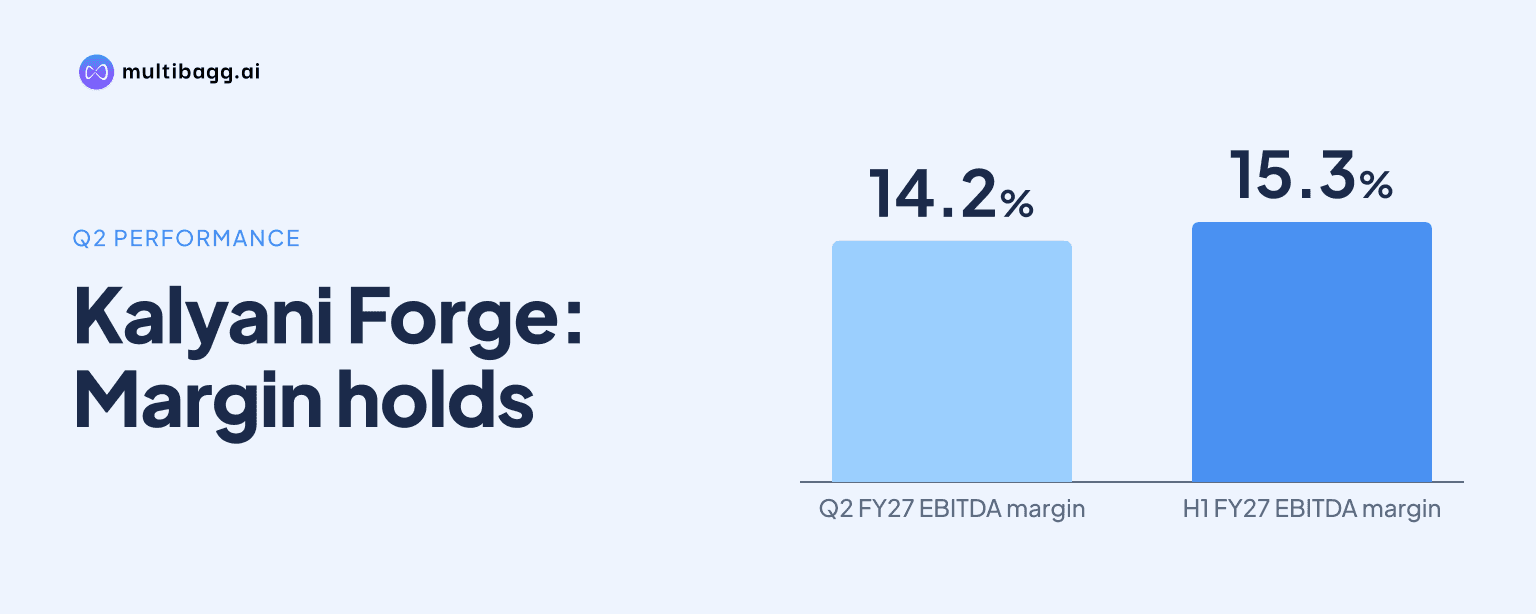
In the second quarter of financial year 2026-27 (Q2 FY27), Kalyani Forge Limited reported a 14.2% earnings before interest, tax, depreciation and amortisation (EBITDA) margin even as planned reconditioning of a 2,500-ton press and relocation of its driveline machining plant reduced sequential revenue 18.5% to Rs 54.4 crore.
Know Kalyani Forge inside out
Results, valuation, peers and who's buying, in one view.
Why did Kalyani Forge revenue fall in Q2 FY27?
Kalyani Forge said planned operational disruption, rather than a stated demand shortfall, reduced Q2 FY27 sequential revenue 18.5% to Rs 54.4 crore. The company spent two months reconditioning a 2,500-ton press and moved the driveline machining plant from MCD3 to MCD1, reducing available production capacity during the quarter.
Reported total income was Rs 54.69 crore in Q2 FY27, while EBITDA was Rs 7.79 crore and profit after tax was Rs 2.17 crore. Management said the MCD1 consolidation released shop-floor space, made machining lines more compact and placed operations under one roof for easier coordination and control.
The disruption was most apparent in driveline and axle production. Driveline sales moderated to Rs 6.6 crore because of low-volume-parts consolidation and the two-month plant relocation, while axle sales of Rs 5.9 crore were affected by the press reconditioning. Engine sales, however, reached Rs 40 crore, up 46% year-on-year and steady sequentially, according to management.
Kalyani Forge also linked higher receivables to its banking transition and slower legacy last-time lifting. Management said remittances were delayed while it changed its cash-credit bank account, although collections and export credit lines were being normalised after the transition, with some facility-related processes still pending.
How did Kalyani Forge preserve its Q2 FY27 EBITDA margin?
Kalyani Forge preserved a 14.2% Q2 FY27 EBITDA margin, up 158 basis points from 12.7% in Q2 FY26, despite the lower sequential revenue. Management attributed the outcome to cost optimisation and operating-efficiency work through its Vriddhi Council initiatives, which it said absorbed disruption on a largely fixed-cost base.
The Q2 result was the fourth consecutive quarter with EBITDA margin above 14%. In the first half of FY27 (H1 FY27), EBITDA rose 38.8% year-on-year to Rs 18.67 crore, and the margin increased to 15.3% from 11.1% in H1 FY26. H1 FY27 profit before tax was Rs 9.39 crore, up 118%, while profit after tax was Rs 6.64 crore, up 86%.
Management said it is tracking material, power, employee and indirect manufacturing costs to support margins. It said steel-price increases resulted in almost three customer price revisions in the quarter, while internal projects are focused on material yield, power-load optimisation and shifting manual processes into machines through programming, fixtures and tooling.
Management said it aims to maintain a 15% EBITDA-margin level and work towards 18% during FY27, but did not guarantee that outcome. It also said it would consider a 20% margin from the following year after sustaining the current level for at least six quarters; these are management objectives rather than reported results.
Got a follow-up? Ask IRIS
Which businesses supported Kalyani Forge sales in Q2 FY27?
Kalyani Forge's engine products and truck exposure supported Q2 FY27 sales while press work and the machining move constrained driveline and axle output. Engine revenue of Rs 40 crore represented 73% of sales, compared with 55% a year earlier, and management identified connecting rods as the core engine product.
Truck sales rose 75% year-on-year and 16% sequentially to Rs 23.3 crore, reaching 43% of Q2 FY27 sales against 25% a year earlier. H1 FY27 truck sales increased 62%, while cars, trucks and industrial activity together generated Rs 52.5 crore, up 20% year-on-year.
The business mix changed as legacy activity was phased out. Legacy non-fit business fell to 4% of Q2 FY27 sales from 15% in Q2 FY26, while engine, driveline and axle accounted for 96% of the business. Management separately said cars, trucks and industrials represented 97% of sales, compared with 82% a year earlier.
Not all end-markets increased. Car sales were Rs 15.8 crore, steady year-on-year but below Rs 22.5 crore in Q1 FY27, while industrial sales fell 9% year-on-year to Rs 13.5 crore following the phase-out of non-core industrial work. Exports were Rs 7.6 crore, or 14% of sales, versus 15% a year earlier.
What is Kalyani Forge planning for H2 FY27?
Kalyani Forge said its H2 FY27 priorities are commercial-vehicle original equipment manufacturer (OEM) ramp-ups, machining de-bottlenecking and capacity expansion after the press and consolidated MCD1 lines returned to operation. Management said new engine and wheel-hub orders were ramping up to rebuild volumes and margins towards Q1 levels.
The company has a Rs 30 crore capital-expenditure plan for FY27 and had deployed Rs 8 crore in H1 FY27. Management allocated about Rs 10 crore to growth ramp-up programmes, Rs 10 crore to new business, Rs 5 crore to future business and Rs 5 crore to existing business, while stating that machining utilisation was 85% to 90%.
Connecting-rod machining capacity had increased 10%, and the new wheel-hub line was installed to 30% of its planned capacity. Kalyani Forge also said it had started large-engine connecting-rod production for an OEM serving artificial-intelligence data-centre applications, alongside a long-term industrial and defence-product roadmap.
The board approved a Rs 45 crore funding plan to strengthen liquidity and support order-book ramp-up. Management described an indicative mix of around Rs 10 crore of equity, Rs 20 crore of debt, and up to Rs 20 crore from non-core asset and inventory monetisation, with capital expenditure also supported by term loans and internal accruals.
Conclusion
Kalyani Forge's Q2 FY27 revenue reduction was tied to a two-month press overhaul and a driveline-plant relocation, while its 14.2% EBITDA margin remained above the 12.7% reported a year earlier. The 15.3% H1 FY27 margin, compared with 11.1% in H1 FY26, coincided with higher engine and truck sales and a reduced share of legacy business.
The next results will show whether restored press and MCD1 operations lift volumes, and whether new engine and wheel-hub orders rebuild sales towards Q1 levels. Management's Rs 30 crore FY27 capital-expenditure plan, of which Rs 8 crore was deployed in H1, and the board-approved Rs 45 crore funding plan are the disclosed measures to watch alongside normalisation of collections and banking facilities.