










Kalyani Forge Holds 14.2% Margin Through Q2 Disruptions
Key highlights
- Kalyani Forge reported a 14.2% EBITDA margin in Q2 FY27, 158 basis points above Q2 FY26.
- Q2 FY27 total income was Rs 54.69 crore, down 18.5% sequentially from Rs 67.08 crore in Q1 FY27.
- H1 FY27 EBITDA was Rs 18.67 crore, up 38.8% year on year, with a 15.3% margin.
- Cash conversion cycle increased to 231 in Q2 FY27 from 148 in Q1 FY27.
powered by IRIS
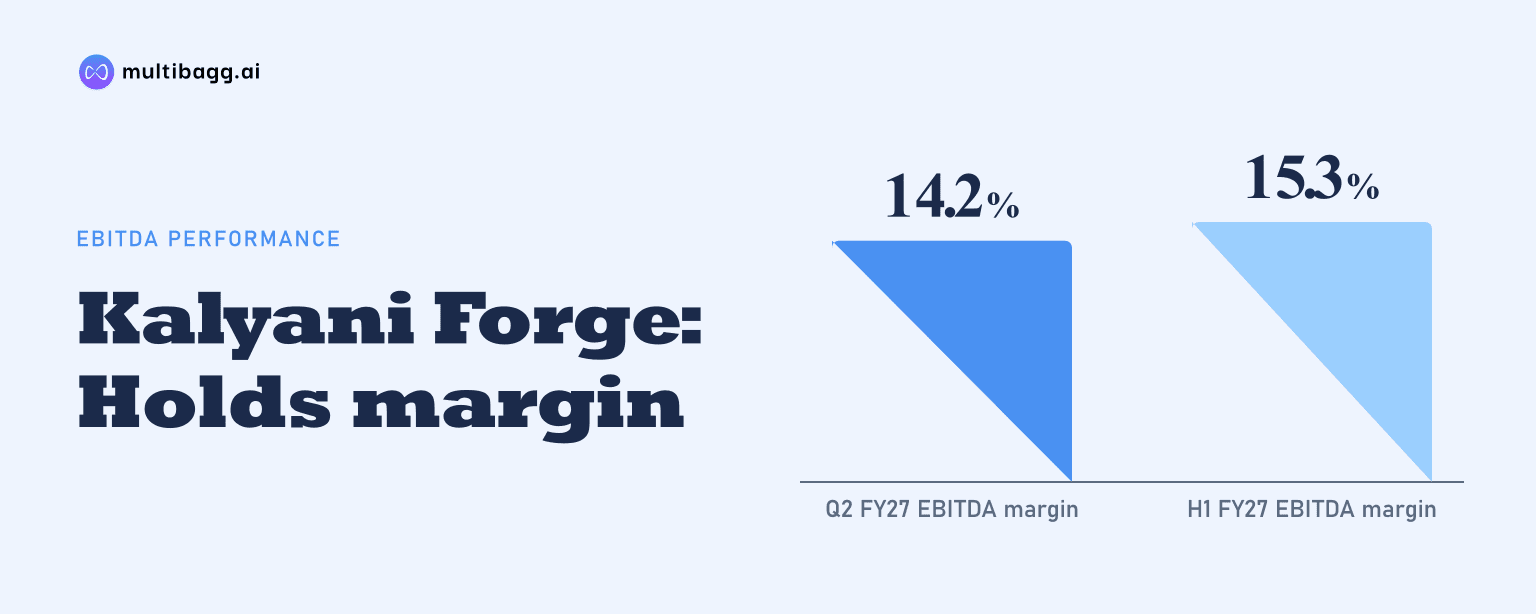
Kalyani Forge Ltd. retained a 14.2% EBITDA margin in Q2 FY27, its fourth consecutive quarter above 14%, although total income fell 18.5% sequentially to Rs 54.69 crore during planned 2500T press reconditioning and driveline machining-plant relocation. EBITDA was Rs 7.79 crore, compared with Rs 10.89 crore in Q1 FY27.
Know Kalyani Forge inside out
Results, valuation, peers and who's buying, in one view.
What were Kalyani Forge's Q2 FY27 financial results?
Kalyani Forge reported total income of Rs 54.69 crore, EBITDA of Rs 7.79 crore and profit after tax of Rs 2.17 crore in Q2 FY27. Total income declined from Rs 67.08 crore in Q1 FY27, while EBITDA declined from Rs 10.89 crore and profit after tax from Rs 4.48 crore over the same sequential comparison. The presentation attributes the revenue shortfall to planned production downtime.
Kalyani Forge's Q2 FY27 profit after tax was broadly level with Rs 2.16 crore in Q2 FY26, despite total income being lower than Rs 56.23 crore a year earlier. Profit before tax rose 42.9% year on year to Rs 3.24 crore, while earnings per share were Rs 5.94. The sequential comparison includes profit after tax of Rs 5.88 crore in Q4 FY26 and Rs 4.48 crore in Q1 FY27.
How did Kalyani Forge preserve its EBITDA margin?
Kalyani Forge reported a 14.2% Q2 FY27 EBITDA margin while citing cost optimisation, Vriddhi Council initiatives and operating-efficiency improvements. EBITDA, defined in the presentation as profit before tax plus finance costs plus depreciation and amortisation, is measured against total income. The margin was 158 basis points higher than 12.7% in Q2 FY26 despite the Rs 12.39 crore sequential reduction in total income.
The Q2 FY27 margin was below the preceding quarter's 16.2% but remained above the 14% level reported for four consecutive quarters. EBITDA margins were 15.7% in Q3 FY26, 15.2% in Q4 FY26, 16.2% in Q1 FY27 and 14.2% in Q2 FY27. Management describes the efficiency measures as structural gains, although the presentation does not quantify savings from individual initiatives.
How large was Kalyani Forge's first-half profitability improvement?
Kalyani Forge expanded its H1 FY27 EBITDA margin to 15.3% from 11.1% in H1 FY26, an increase of 420 basis points. H1 FY27 EBITDA rose 38.8% year on year to Rs 18.67 crore, while profit before tax rose 118.8% to Rs 9.39 crore. Profit after tax increased 86.7% to Rs 6.64 crore and earnings per share were Rs 18.25.
Kalyani Forge's H1 FY27 profit-after-tax margin was 5.5%, compared with 3.0% in H1 FY26. This six-month comparison includes Q1 FY27, when total income was Rs 67.08 crore and EBITDA margin was 16.2%, as well as the planned disruption in Q2 FY27. The H1 figures therefore show the margin improvement across the first six months despite lower Q2 income.
Got a follow-up? Ask IRIS
What operational changes reduced Kalyani Forge's Q2 FY27 revenue?
Kalyani Forge said two months of 2500T press reconditioning and relocation of its driveline machining plant reduced Q2 FY27 revenue sequentially by 18.5%. The company said the disruption was absorbed on a largely fixed cost base, while the 14.2% EBITDA margin remained above 14%. The press and machining lines were back in operation at the time of the presentation.
Kalyani Forge said the restored press and consolidated machining plant would support volume and margin recovery toward Q1 FY27 levels. Its disclosed H2 priorities include commercial-vehicle original equipment manufacturer ramp-up programmes and machining de-bottlenecking within a Rs 30 crore FY27 capital-expenditure plan, of which Rs 8 crore had been deployed in H1. New engine and wheel-hub orders representing about Rs 20 crore of annual business were also ramping up.
What working-capital and funding effects followed the disruption?
Kalyani Forge's cash conversion cycle increased to 231 in Q2 FY27 from 148 in Q1 FY27, while debt to EBITDA rose to 3.94 from 2.51. The presentation links these changes to the production-related revenue shortfall, delayed customer remittances during a banking changeover and slower lifting of legacy last-time-buy orders. Kalyani Forge said collections and export credit lines were being normalised.
Kalyani Forge reported return on capital employed, or ROCE, of 13% on annualised Q2 FY27 earnings, down from 22% in Q1 FY27; annualised H1 FY27 ROCE was 17%. Its board approved a Rs 45 crore funding plan to strengthen liquidity and fund the order ramp-up, with an indicated mix of about Rs 10 crore of equity, about Rs 20 crore of debt, and up to Rs 20 crore from non-core asset and inventory monetisation. The presentation does not specify completion dates for the funding components.
Conclusion
Kalyani Forge maintained a margin above 14% despite a planned 18.5% sequential reduction in Q2 FY27 income, while its year-on-year EBITDA margin increased by 158 basis points. The 15.3% H1 FY27 EBITDA margin, compared with 11.1% a year earlier, is the broader evidence cited alongside cost optimisation and operating-efficiency measures, although Q2 EBITDA declined to Rs 7.79 crore from Rs 10.89 crore in Q1.
The next disclosures to watch are the volume recovery from the restored 2500T press and consolidated machining operations, the ramp-up of approximately Rs 20 crore of annual engine and wheel-hub orders, and deployment of the remaining FY27 capex plan after Rs 8 crore in H1. Collections and bank-facility normalisation also remain relevant after the Q2 cash conversion cycle reached 231 and debt to EBITDA reached 3.94.