










Kalyani Forge Limited Reports 14.2% Q2 EBITDA Margin Growth
Key highlights
- Kalyani Forge reported Q2 FY27 sales revenue of ₹54.4 crore, down 18.5% sequentially after planned production downtime.
- Q2 FY27 EBITDA was ₹7.79 crore, with a 14.2% margin that was 158 basis points higher year-on-year.
- Trade receivables rose to ₹141 crore, including ₹10 crore to ₹15 crore associated with legacy customers.
- Kalyani Forge has initiated a ₹45 crore funding plan and retained FY27 capital expenditure of ₹30 crore.
powered by IRIS
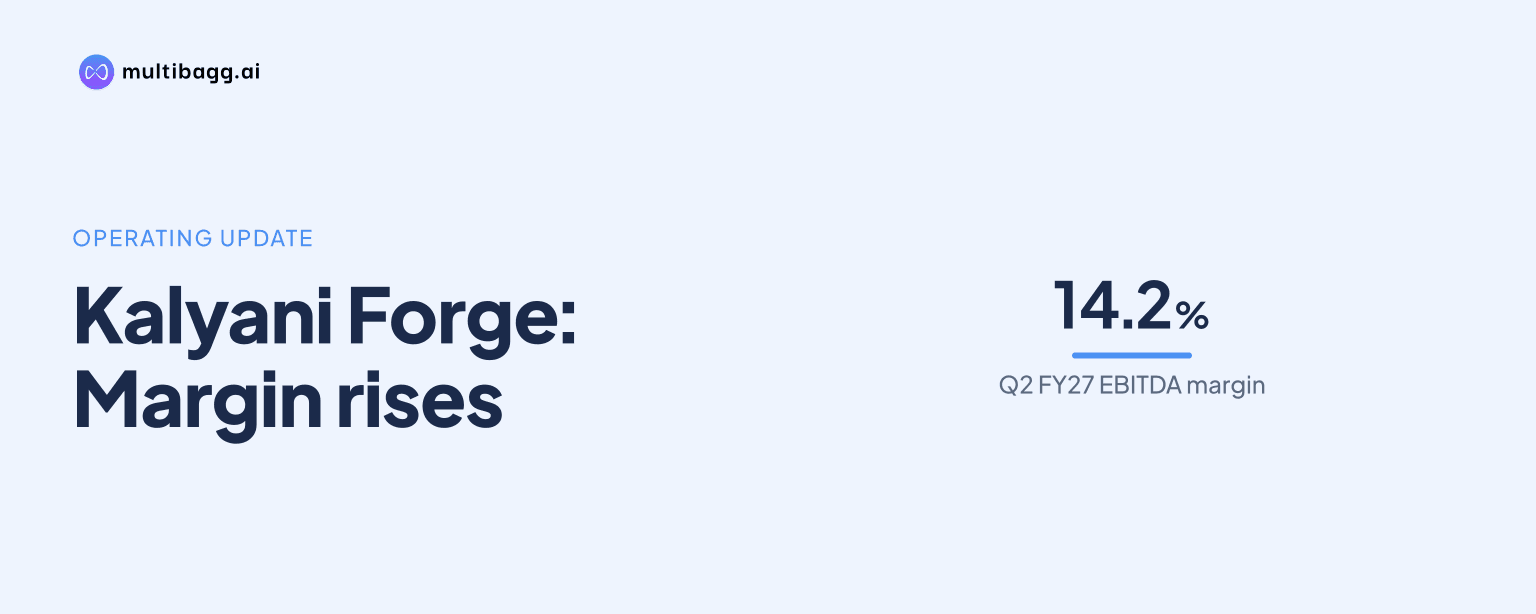
Kalyani Forge Limited reported a 14.2% EBITDA margin in Q2 FY27, up 158 basis points year-on-year, even as planned operational downtime reduced quarterly revenue 18% sequentially to ₹54.4 crore. The quarter highlighted improved cost control and product mix, while working-capital collections and production normalisation remained key near-term priorities.
Know Kalyani Forge inside out
Results, valuation, peers and who's buying, in one view.
Why did Kalyani Forge's Q2 FY27 revenue decline?
Kalyani Forge's Q2 FY27 revenue declined because the company undertook planned reconditioning of its 2,500-ton press and relocated its driveline machining plant. These activities disrupted production and lowered total sales revenue to ₹54.4 crore, a sequential decline of 18.5% according to the investor presentation.
Management said the work had been completed, although part of the operational transition continued into Q3. The disruption was therefore linked to planned manufacturing actions rather than a stated fall in underlying customer demand. Management's stated objective is to bring quarterly revenue back to the Q1 level, which implies roughly 10% to 20% growth in the second half.
The company reported total income of ₹54.69 crore for the quarter. EBITDA stood at ₹7.79 crore, while profit before tax was ₹3.24 crore, up 42.9% year-on-year. Profit after tax was reported at ₹2.16 crore, with earnings per share of ₹5.94.
How did Kalyani Forge maintain its EBITDA margin?
Kalyani Forge maintained a 14.2% Q2 EBITDA margin through material-cost management, power-cost optimisation, manpower productivity measures and a more focused business mix. The margin was 158 basis points higher than the 12.7% reported in Q2 FY26 and marked the fourth consecutive quarter above 14%.
Managing Director Viraj Kalyani said the company is assessing EBITDA through material, power, employee and overhead costs. Kalyani Forge passed through three steel-price revisions to customers, according to management, while also working to consolidate and optimise power sanctions. Automation of manual processes is intended to support labour productivity.
For H1 FY27, EBITDA was ₹18.67 crore and the EBITDA margin was 15.3%. Management described the current margin range as sustainable and said it would like to treat a level above 14% as a floor. However, it did not guarantee that the business would reach an 18% margin during FY27.
What is Kalyani Forge's margin and growth outlook?
Kalyani Forge is targeting a 15% EBITDA margin for FY27 and has identified 18% as an aspirational nearer-term level, followed by a 20% margin target from the next year onwards. Management said each incremental margin improvement needs sustained operational work and should not be treated as assured.
The company wants to hold current margin levels for at least six quarters before pursuing further expansion. This approach reflects the need to demonstrate that gains from cost control, automation and business mix can be maintained across periods without operational disruption.
On revenue, management is tracking performance at the customer-account level rather than giving a company-wide top-line forecast. It is targeting 15% to 20% growth in strategic customer accounts and said this range has already been achieved for around 30% of those customers. The planned sources of growth are existing product-line ramp-ups, new launches and market-share gains in core areas.
Got a follow-up? Ask IRIS
What are the main working-capital and funding issues?
Kalyani Forge's main near-term financial issue is elevated working capital, with trade receivables rising to ₹141 crore at the end of Q2 FY27. Management attributed the increase to delayed collections during a banking changeover and slower lifting of legacy customers' last-time-buy orders.
The company said ₹10 crore to ₹15 crore of receivables were connected with legacy customers. The revenue shortfall and delayed receipts also affected the cash conversion cycle and debt-to-EBITDA ratio. Management expects normalised cash-conversion days to be about 140 to 150 before moving toward 120.
Kalyani Forge has initiated a ₹45 crore funding plan to strengthen liquidity and support the ramp-up of its order book. FY27 capital expenditure remains ₹30 crore, with second-half spending focused on commercial-vehicle original equipment manufacturer programmes and machining de-bottlenecking. Management cited machining utilisation of 85% to 90%, indicating that capacity availability is relevant to future execution.
How is Kalyani Forge changing its business mix?
Kalyani Forge is increasing its focus on core engine, driveline and axle products, which accounted for 96% of sales in the period discussed by management. The shift reduces the relative exposure to legacy and non-core business while directing resources towards areas where the company sees customer-account growth opportunities.
Truck-segment revenue grew 75% year-on-year and accounted for 43% of sales, according to the call highlights. Management also outlined a longer-term approach to defence and aerospace opportunities without heavy upfront investment. The immediate capital-allocation priority, however, remains commercial-vehicle OEM ramp-ups and manufacturing bottlenecks.
For investors, the Q2 result presents two separate developments. Margin performance improved despite lower production, but revenue recovery, receivable collections and the use of the ₹45 crore funding plan will influence the quality of cash generation. Management's refusal to provide a direct company-wide revenue forecast leaves customer-account delivery and quarterly execution as the more relevant disclosed indicators.
Conclusion
Kalyani Forge delivered a higher 14.2% EBITDA margin in Q2 FY27 despite an 18.5% sequential revenue decline caused by planned press reconditioning and plant relocation. The result supports management's view that cost actions and core-product mix are helping profitability, while the ₹141 crore receivable balance shows that liquidity and working capital remain material areas of attention.
Investors will next watch whether quarterly revenue returns to the Q1 level during H2, whether receivable days move from the stated 140 to 150 range toward 120, and how the ₹45 crore funding plan supports operations. Management has also set FY27 capex at ₹30 crore and continues to target a 15% EBITDA margin, with 18% and 20% remaining longer-term operating milestones.