










Kansai Nerolac Paints Q2 Revenue Rises 18.9%, Margins Ease
Key highlights
- Kansai Nerolac Paints' Q2 FY27 standalone revenue rose 18.9% to Rs 2,268.77 crore.
- Standalone Q2 FY27 PBDIT increased 4.9% to Rs 223.23 crore, while margin fell to 9.8% from 11.2%.
- Standalone H1 FY27 revenue grew 14.2% to Rs 4,601.60 crore.
- Raw-material inflation of about 25% exceeded the 7-8% price increases cited during the earnings discussion.
powered by IRIS
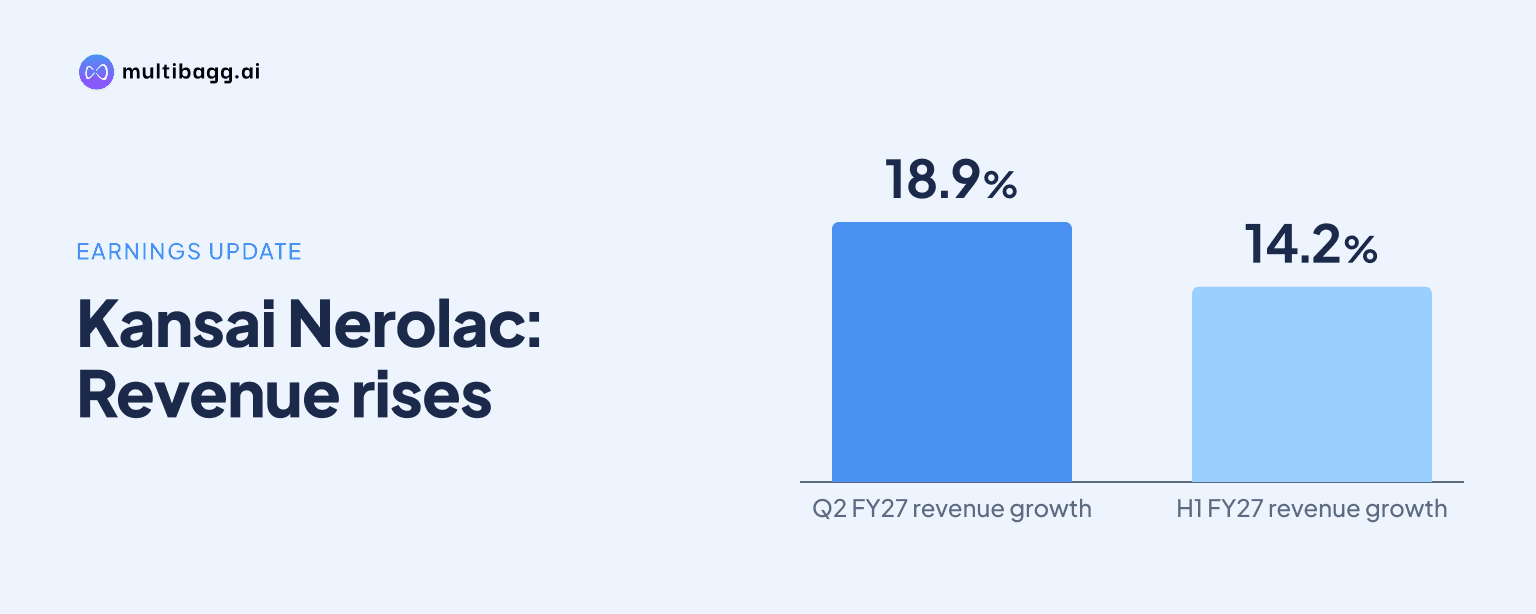
Kansai Nerolac Paints Limited reported Q2 FY27 standalone revenue growth of 18.9% to Rs 2,268.77 crore, but its PBDIT margin declined to 9.8% from 11.2% a year earlier as raw-material inflation outpaced price increases.
Know Kansai Nerolac Paints inside out
Results, valuation, peers and who's buying, in one view.
How did Kansai Nerolac Paints perform in Q2 FY27?
Kansai Nerolac Paints recorded growth across its Decorative and Industrial coatings businesses in the quarter ended September 2026. Standalone revenue from operations rose 18.9% year-on-year to Rs 2,268.77 crore, providing the main driver of the quarter's financial performance.
Profit growth, however, trailed revenue growth. Standalone PBDIT increased 4.9% to Rs 223.23 crore, while profit before tax rose 4.3% to Rs 191.88 crore. The investor presentation reported standalone profit after tax of Rs 148.64 crore, up 8.8% year-on-year.
On a consolidated basis, revenue from operations increased 18.6% to Rs 2,317.38 crore. Consolidated PBDIT rose 4.1% to Rs 224.09 crore and consolidated profit before tax rose 3.6% to Rs 188.28 crore. Consolidated profit after tax was reported at Rs 143.99 crore.
Why did Kansai Nerolac Paints' operating margin decline?
Kansai Nerolac said input-cost pressure limited the conversion of revenue growth into operating-profit growth. Commentary linked the margin decline to raw-material inflation of about 25%, which was higher than the 7-8% price increases referred to during the earnings discussion.
Standalone PBDIT margin fell to 9.8% from 11.2% in the corresponding quarter of the previous year. Material costs rose to 70.1% of standalone revenue, according to the results summary. Consolidated PBDIT margin was 9.7%, compared with 11.0% a year earlier, while material costs represented 69.9% of consolidated revenue.
Management referred to sequential improvement and indicated that price pass-through and lower input-cost pressure would be relevant to any margin recovery. The available earnings-call material did not quantify a specific recovery path, although one call summary said management would try to reach a 13-14% EBITDA margin by Q4 FY27.
What was Kansai Nerolac Paints' first-half FY27 performance?
Kansai Nerolac's standalone revenue from operations for the first half of FY27 rose 14.2% year-on-year to Rs 4,601.60 crore. The six-month numbers show that revenue growth remained ahead of operating-profit and pre-tax-profit growth, consistent with the cost pressures seen in the second quarter.
Standalone EBITDA for H1 FY27 increased 5.8% to Rs 553.11 crore. Profit before tax rose 4.0% to Rs 510.41 crore. The divergence between sales and profit growth reflects the impact of higher material costs during the period.
The reported consolidated H1 performance also showed a similar pattern. Consolidated revenue grew 14.0%, PBDIT increased 6.6%, and profit before tax rose 4.9%. These figures underline that the input-cost issue affected the broader consolidated business as well as the standalone operations.
Got a follow-up? Ask IRIS
What changes is Kansai Nerolac Paints making in its paint portfolio?
Kansai Nerolac expanded its decorative offering by introducing VT Soft Sheen across India under its Accessible Luxury portfolio. The launch adds a new product to the company's decorative paints range while it pursues growth in that business.
The earnings-call material also referred to Excel Everlast 20, positioned as an exterior paint with a 20-year warranty, nano-silica durability and crack-bridging capability of up to 2 mm. These product references indicate continued activity in the decorative portfolio alongside growth in the industrial coatings business.
For customers, product additions widen the available range in the decorative category. For investors, the key reported financial point remains that revenue growth was robust, while higher raw-material costs compressed the operating margin during the quarter.
How does the quarter affect investors and the coatings sector?
The Q2 outcome shows the importance of raw-material movements for coatings companies. Kansai Nerolac delivered double-digit revenue growth, but its standalone PBDIT rose only 4.9% because input inflation was materially higher than the price actions described by management.
The results also provide a measurable view of the pressure: the 1.4 percentage-point fall in standalone PBDIT margin occurred despite revenue expansion in both major business segments. Investors assessing subsequent quarters will be able to compare price increases, material-cost trends and reported operating margins against the Q2 FY27 base.
Conclusion
Kansai Nerolac Paints delivered 18.9% standalone revenue growth in Q2 FY27 and 14.2% growth for the first half, supported by Decorative and Industrial coatings. Yet operating profitability grew at a slower pace, with standalone PBDIT margin falling to 9.8% as raw-material inflation exceeded the price hikes cited in the earnings discussion.
The next disclosed marker is management's stated effort to touch a 13-14% EBITDA margin by Q4 FY27. Progress will depend on price pass-through and the direction of input-cost pressure, while the national launch of VT Soft Sheen remains part of the company's decorative portfolio activity.