










Kansai Nerolac targets 13%-14% EBITDA margin recovery by Q4
Key highlights
- Kansai Nerolac said industrial price increases of 7%-8% lagged input inflation above 25%.
- Kansai Nerolac is seeking a 13%-14% EBITDA margin by quarter four, subject to settlement timing.
- Standalone quarter-two net revenue rose 18.9%, while PBDIT increased 4.9%.
- Kansai Nerolac said a further dealer-segment industrial price increase taken at September-end should flow through in quarter three.
powered by IRIS
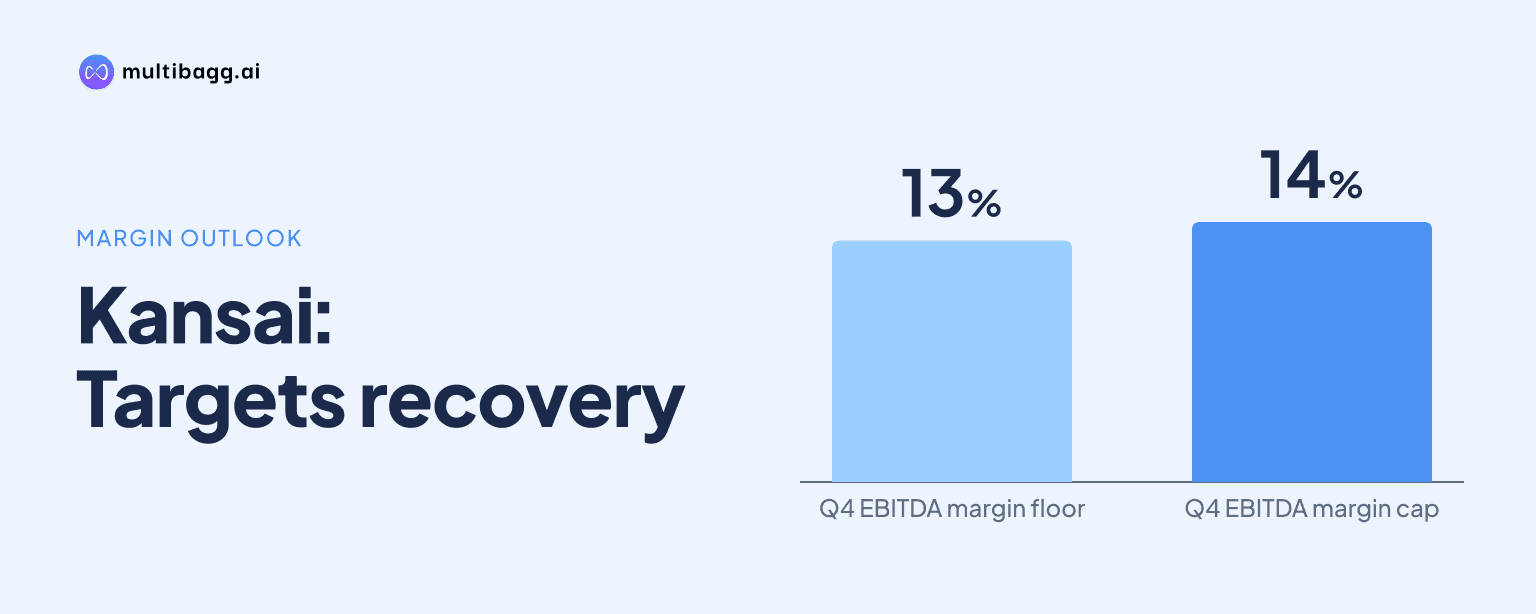
Kansai Nerolac Paints Limited is seeking to reach a 13%-14% earnings before interest, tax, depreciation and amortisation (EBITDA) margin by quarter four, but industrial price increases of about 7%-8% remain far below input inflation exceeding 25%. Management said further settlements with original equipment manufacturers (OEMs) are needed to close the gap.
Know Kansai Nerolac Paints inside out
Results, valuation, peers and who's buying, in one view.
How much industrial pricing has Kansai Nerolac secured?
Kansai Nerolac has secured industrial price increases of broadly 7%-8%, with some customer settlements effective retrospectively from April 1 and others from June 1. Management said additional increases are under discussion in selected categories directly affected by crude-linked inputs. The achieved rise therefore does not represent a full recovery of the input-cost increase above 25%.
Kansai Nerolac said OEM agreements are normally concluded in one or two stages rather than through a single full pass-through. Automotive OEMs and some OEM accounts in general industrial coatings are taking longer to settle, according to management. Dealer- and distribution-led industrial segments were described as relatively better placed, reflecting a different route to implementing price changes.
For dealer-based industrial business, Kansai Nerolac said it had announced price hikes and took another increase at the end of September. Management expects that increase to flow through in quarter three. The next OEM-negotiation round has reset from October 1 after settlements covering the April-to-September period, creating a separate timetable for further recovery.
Why has Kansai Nerolac's margin not yet recovered?
Kansai Nerolac said margins have not fully recovered because input inflation is above 25%, while industrial pricing gained so far is only about 7%-8%. The difference leaves a material part of higher raw-material costs uncovered until further customer settlements are completed. Management did not disclose separate gross-margin or EBITDA-margin figures for decorative and industrial operations.
The reported profit-and-loss comparison shows revenue growing faster than operating profit in both periods disclosed. Profit before depreciation, interest and tax (PBDIT) is the company’s reported operating-profit measure.
On a consolidated basis, quarter-two net revenue rose 18.6%, against PBDIT growth of 4.1% and profit-before-tax growth of 3.6%. In H1, consolidated net revenue increased 14%, PBDIT rose 6.6% and profit before tax increased 4.9%. These figures do not isolate industrial profitability, but they show profit growth trailing revenue growth during the period of incomplete price recovery.
What does crude volatility mean for Kansai Nerolac's pricing plans?
Kansai Nerolac said crude-price volatility makes raw-material procurement and customer pricing difficult to plan, particularly in categories where crude has a direct input-cost effect. Management said its working view for margin improvement was based on crude remaining in a safer range, while agreeing that further price increases could be required if crude rises above that level.
Management said pricing discussions had started when crude was at a much higher level than at the November 5, 2026 call. It identified sustained high crude and derivative prices, along with currency volatility, as risks to input costs and procurement planning. Kansai Nerolac did not offer a formula linking any change in crude to a specified customer price increase.
The company said its team was progressing discussions in directly linked categories, but did not give a closing date for individual OEM agreements. This means the crude reference cited by management is a working assessment rather than formal commodity-price guidance. The timing and extent of settlements remain the operating variables for margin recovery.
Got a follow-up? Ask IRIS
When does Kansai Nerolac expect to reach its margin target?
Kansai Nerolac said it should be trying to touch its 13%-14% sustainable EBITDA-margin range by quarter four. Management qualified that expectation because the timing of settlements is difficult to predict. The statement is a management objective, not a reported margin result or a formal earnings forecast.
Management expects sequential margin improvement as industrial pricing progresses quarter by quarter. Retrospective effective dates can influence when a settlement is recognised: the completed round covered April to September, while the next round begins from October 1. Kansai Nerolac did not quantify the potential benefit from future retrospective settlements.
OEM discussions are the main source of delay, according to management, while dealer and distribution channels are relatively better positioned. That distinction matters for the quarter-four objective because automotive and certain general-industrial OEM accounts remain under negotiation. Kansai Nerolac did not provide revenue, margin or profitability splits between its industrial and decorative businesses.
Which industrial businesses are supporting Kansai Nerolac's growth?
Kansai Nerolac reported robust automotive growth in passenger vehicles, two- and three-wheelers, and commercial vehicles. Its liquid performance-coating business recorded very robust growth, with construction equipment and infrastructure cited as strong areas. In powder coatings, all segments grew strongly, led by auto ancillary and construction equipment applications.
The industrial strategy combines premiumisation, technology and market expansion alongside pricing actions. In automotive coatings, Kansai Nerolac cited water-based, high-solids and low-bake technologies, as well as seam sealers, underbody black, alloy wheels, pretreatment and booth chemicals. It also implemented a next-generation polyurethane clear coat for a leading two-wheeler OEM and commercialised anti-rust clear technology for tractor applications.
In performance coatings, Kansai Nerolac cited fluoropolymer, anti-carbonation, direct-to-metal and water-based systems. A fluoropolymer-based coating was approved for bullet-train station projects, while the company developed a water-based polyurethane-dispersion coating for pump applications. Its powder-coating work includes liquid-to-powder conversion, a mechanism intended to help customers reduce volatile organic compound emissions.
Conclusion
Kansai Nerolac’s quarter-two standalone revenue rose 18.9%, but PBDIT increased only 4.9% as industrial price gains of 7%-8% lagged input inflation above 25%. The central issue is not demand alone: further recovery depends on the pace and terms of OEM settlements, particularly in automotive and some general-industrial accounts.
The next reported indicator is quarter-three, when the end-September dealer-segment price increase is expected to begin flowing through. Management is seeking a 13%-14% EBITDA margin by quarter four, while negotiations for the October 1 pricing round remain unresolved and crude-related input volatility continues to affect procurement and pricing plans.