










Kaytex Fabrics Limited short-term borrowings nearly tripled in H1 FY27
Key highlights
- Kaytex Fabrics’ short-term borrowings rose to Rs 39.15 crore at 30 September 2026 from Rs 13.18 crore at 31 March 2026.
- Kaytex Fabrics reported net debt of Rs 44.14 crore at 30 September 2026, compared with Rs 16.58 crore six months earlier.
- Inventory days increased to 130 from 120, while debtor days rose to 105 from 93.
- Kaytex Fabrics’ H1 FY27 revenue rose 34.42% to Rs 100.26 crore, while finance costs fell 19.24% to Rs 1.72 crore.
powered by IRIS
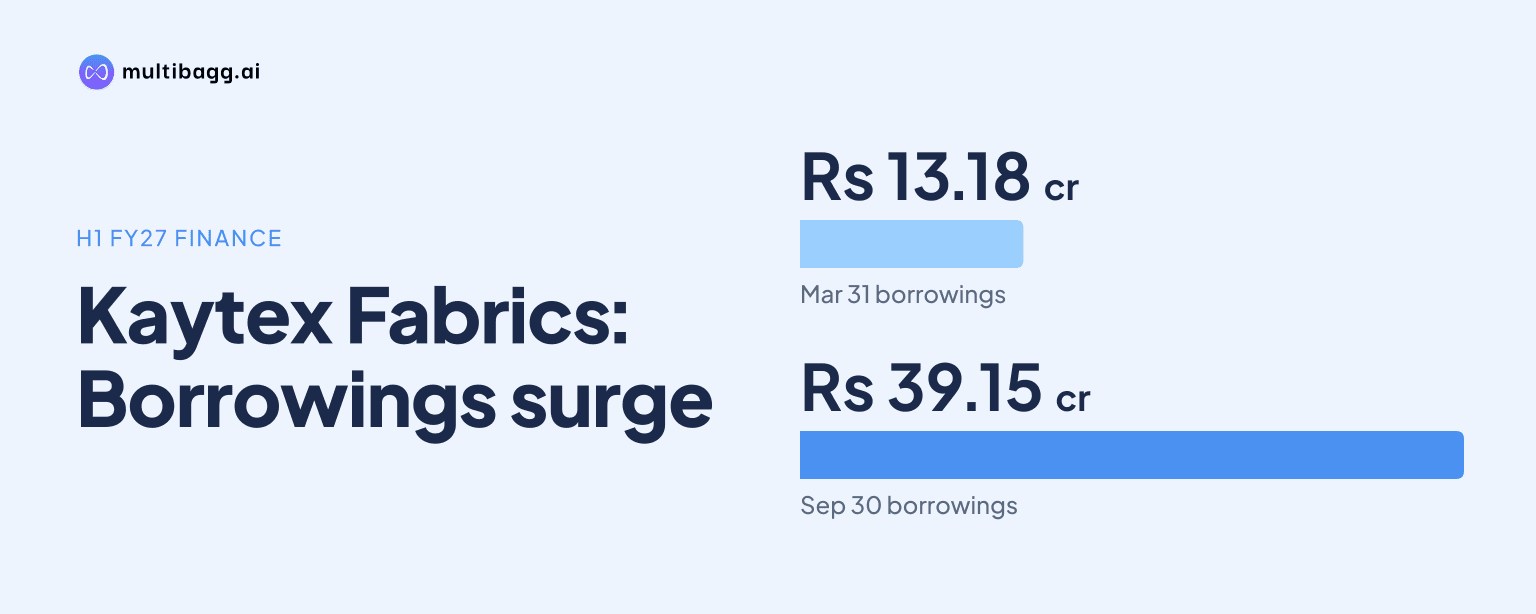
Kaytex Fabrics’ short-term borrowings nearly tripled to Rs 39.15 crore at 30 September 2026 from Rs 13.18 crore six months earlier, as H1 FY27 revenue rose 34.42% year on year to Rs 100.26 crore and inventory and debtor days increased to 130 and 105 days.
Know Kaytex Fabrics inside out
Results, valuation, peers and who's buying, in one view.
How much did Kaytex Fabrics’ short-term borrowing increase?
Kaytex Fabrics’ short-term borrowings increased to Rs 39.15 crore at 30 September 2026 from Rs 13.18 crore at 31 March 2026. Long-term borrowings also rose to Rs 12.68 crore from Rs 11.07 crore, increasing total borrowings during the first six months of FY27.
Kaytex Fabrics reported net debt of Rs 44.14 crore at 30 September 2026, compared with Rs 16.58 crore at 31 March 2026. The company defines net debt as total borrowings less cash and cash equivalents, which were broadly unchanged at Rs 7.69 crore from Rs 7.67 crore.
Kaytex Fabrics’ debt-to-equity ratio rose to 0.41 times at 30 September from 0.21 times at the March year-end. Net worth increased to Rs 126.53 crore from Rs 116.52 crore, supported by H1 FY27 profit after tax of Rs 10.00 crore, while borrowings increased by more than the equity base over the period.
What caused Kaytex Fabrics’ working-capital funding need?
Kaytex Fabrics said inventories and receivables rose with higher sales and that short-term borrowings increased to fund them. Inventories stood at Rs 79.46 crore at 30 September 2026 versus Rs 63.91 crore at 31 March, while trade receivables increased to Rs 68.72 crore from Rs 46.85 crore.
The company’s working-capital timing measures also increased. Inventory days rose to 130 from 120 days, and debtor days increased to 105 from 93 days between 31 March and 30 September 2026. Kaytex Fabrics calculates both measures using average opening and closing balances over revenue from operations, annualised for the half year.
The larger stock and receivables balances coincided with a Rs 25.67 crore year-on-year increase in H1 FY27 revenue from operations, to Rs 100.26 crore from Rs 74.59 crore. Trade payables rose by Rs 0.90 crore to Rs 22.00 crore, while other liabilities and provisions increased to Rs 12.92 crore from Rs 10.07 crore.
Kaytex Fabrics’ current ratio declined to 2.47 times at 30 September 2026 from 3.36 times at 31 March 2026. Total assets increased to Rs 213.28 crore from Rs 171.95 crore, including increases of Rs 15.55 crore in inventories and Rs 21.87 crore in trade receivables.
Got a follow-up? Ask IRIS
Did Kaytex Fabrics’ sales growth translate into higher earnings?
Kaytex Fabrics increased H1 FY27 revenue, earnings before interest, tax, depreciation and amortisation, or EBITDA, and profit after tax, although its reported margins were lower than a year earlier. Revenue from operations rose 34.42% to Rs 100.26 crore, EBITDA rose 17.24% to Rs 17.39 crore, and profit after tax rose 16.36% to Rs 10.00 crore.
Cost of materials consumed increased 39.60%, faster than revenue, and gross margin declined to 29.59% from 32.20%. EBITDA margin fell to 17.34% from 19.88%, a decrease of 254 basis points, where one basis point is one-hundredth of a percentage point.
Finance costs fell 19.24% to Rs 1.72 crore in H1 FY27 from Rs 2.13 crore in H1 FY26, despite higher debt balances at 30 September 2026. The presentation reports both movements but does not give a specific reason for the lower half-year finance cost; basic earnings per share were Rs 6.81 against Rs 6.84 a year earlier.
How do Kaytex Fabrics’ operating plans relate to working capital?
Kaytex Fabrics reported H1 FY27 production of 82.83 lakh metres and capacity utilisation of 75.90%, compared with FY26 production of 132.60 lakh metres and utilisation of 63.62%. Digital printing capacity was unchanged at 141.52 lakh metres per annum at 30 September 2026, the same level reported at 31 March 2026.
Domestic revenue rose to Rs 95.38 crore in H1 FY27 from Rs 70.99 crore in H1 FY26, while export revenue increased to Rs 4.87 crore from Rs 3.60 crore. Exports represented 4.86% of revenue from operations, compared with 4.83% a year earlier, so the reported sales increase was principally in domestic revenue.
Kaytex Fabrics had fully used the Rs 30.00 crore of fresh-issue proceeds allocated to incremental working capital by 31 March 2026, and that amount remained fully utilised at 30 September 2026. Total use across disclosed public-issue objects reached Rs 43.12 crore by September, against planned net proceeds of Rs 49.35 crore.
Management said a Rs 3.20 crore digital printing machine bought in September 2026 was being installed at the existing Amritsar unit and was not part of the public-issue objects. The corporate and sales office and an additional warehouse in Amritsar, both funded from public-issue proceeds, are due for completion by March 2027, while management said it has efforts in place to optimise working capital.
Conclusion
Kaytex Fabrics paired 34.42% H1 FY27 revenue growth with higher inventories and receivables, alongside short-term borrowings of Rs 39.15 crore and net debt of Rs 44.14 crore at 30 September 2026. Profit after tax rose to Rs 10.00 crore, while gross margin, EBITDA margin and the current ratio declined and both inventory and debtor days increased.
The next disclosed milestones are the March 2027 completion targets for the Amritsar corporate and sales office and additional warehouse, plus the installation of the Rs 3.20 crore digital printing machine acquired in September 2026. Future disclosures can show whether management’s stated working-capital optimisation efforts change inventory days from 130 and debtor days from 105 as revenue expands.