










Kaytex H1 revenue rose 34% as EBITDA margin fell 254 basis points
Key highlights
- Kaytex's H1 FY27 revenue from operations rose 34.42% year on year to ₹100.26 crore.
- Kaytex's EBITDA increased 17.24% to ₹17.39 crore, while EBITDA margin fell 254 basis points to 17.34%.
- Kaytex reported domestic revenue of ₹95.38 crore and export revenue of ₹4.87 crore in H1 FY27.
- Kaytex's net debt increased to ₹44.14 crore at 30 September 2026 from ₹16.58 crore at 31 March 2026.
powered by IRIS
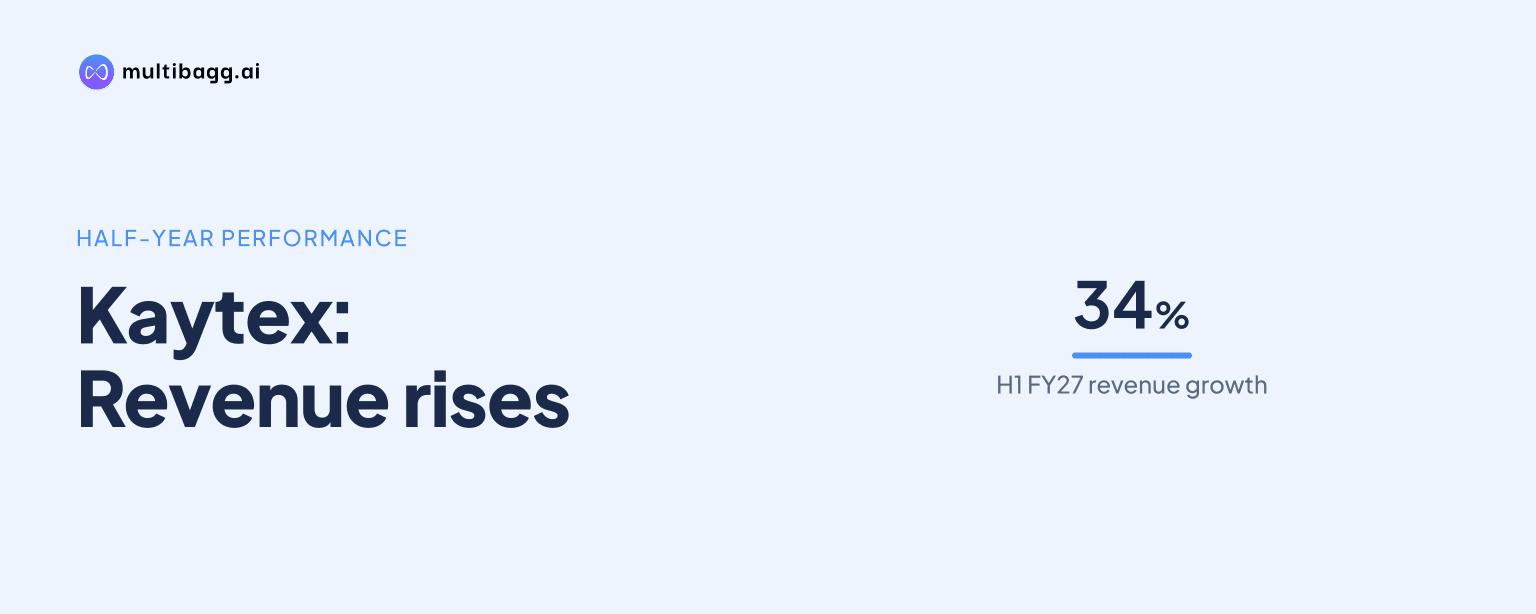
Kaytex Fabrics Limited reported H1 FY27 revenue from operations of ₹100.26 crore, up 34.42% year on year, but earnings before interest, tax, depreciation and amortisation (EBITDA) margin fell 254 basis points to 17.34% as material costs and other expenses increased faster than sales. EBITDA nevertheless rose 17.24% to ₹17.39 crore.
Know Kaytex Fabrics inside out
Results, valuation, peers and who's buying, in one view.
How did Kaytex perform in H1 FY27?
Kaytex increased revenue, EBITDA and profit after tax (PAT) in H1 FY27, though profit growth was lower than revenue growth. Revenue from operations rose from ₹74.59 crore in H1 FY26 to ₹100.26 crore, while total income increased 33.78% to ₹100.67 crore. EBITDA rose from ₹14.83 crore to ₹17.39 crore, and PAT increased 16.36% to ₹10.00 crore from ₹8.60 crore.
H1 FY27 also exceeded the immediately preceding H2 FY26 on the main reported profit measures. Revenue increased by ₹13.61 crore from ₹86.65 crore in H2 FY26, EBITDA rose from ₹15.16 crore, and PAT increased from ₹8.83 crore. However, the 17.34% EBITDA margin was below both the 17.49% reported in H2 FY26 and the 19.88% reported in H1 FY26.
Basic earnings per share (EPS) was ₹6.81 in H1 FY27, compared with ₹6.84 in H1 FY26; Kaytex states that half-year EPS is not annualised. Profit before tax increased 21.93% to ₹13.37 crore, but tax expense rose 42.13% to ₹3.37 crore. That tax increase accompanied PAT growth of 16.36%, compared with revenue growth of 34.42%.
Why did Kaytex's EBITDA margin decline in H1 FY27?
Kaytex's EBITDA margin declined because materials consumed and other expenses increased faster than revenue in H1 FY27. Cost of materials consumed, including changes in inventories, rose 39.60% to ₹70.59 crore, exceeding the 34.42% increase in revenue. Gross profit consequently grew 23.51% to ₹29.67 crore, while gross margin fell 261 basis points to 29.59% from 32.20%.
Other expenses rose 51.44% to ₹8.71 crore from ₹5.75 crore, the fastest-growing major cost line in the half-year statement. Employee benefit expenses increased 3.80% to ₹3.57 crore, below the rate of revenue growth. These movements limited EBITDA growth to 17.24% and reduced the EBITDA margin from 19.88% to 17.34%.
Management said a rising share of value-added products, particularly digital printing, partially offset raw-material inflation during the period. EBITDA excludes other income, which declined 37.90% to ₹0.41 crore; expressed in the required Indian unit, this was ₹41 lakh, compared with ₹66 lakh in H1 FY26. Finance costs fell 19.24% to ₹1.72 crore, while depreciation and amortisation rose 13.00% to ₹2.71 crore.
Where did Kaytex's H1 FY27 revenue growth come from?
Kaytex's H1 FY27 revenue growth came mainly from domestic sales, while exports also increased. Domestic revenue rose by ₹24.39 crore to ₹95.38 crore from ₹70.99 crore in H1 FY26. Export revenue increased by ₹1.27 crore to ₹4.87 crore from ₹3.60 crore, and management attributed domestic growth to a deeper presence in regional markets across northern India.
Exports accounted for 4.86% of revenue from operations in H1 FY27, nearly unchanged from 4.83% in H1 FY26 and below the FY26 share of 5.86%. The smaller export share of the total compared with FY26 indicates that domestic revenue remained the principal driver of the ₹25.67 crore year-on-year sales increase. Management said its own brands, led by Rasiya, remained the business focus.
Total production was 82.83 lakh metres in H1 FY27, against 132.60 lakh metres for the full FY26, while capacity utilisation reached 75.90%, compared with 63.62% in FY26. Digital printing capacity was unchanged at 141.52 lakh metres per annum at 30 September 2026 and 31 March 2026. Management identified digital printing as its largest and fastest-growing fabric line.
Got a follow-up? Ask IRIS
What changed in Kaytex's working capital and borrowings?
Kaytex's inventories, trade receivables and short-term borrowings rose by 30 September 2026 as sales expanded. Inventories increased to ₹79.46 crore from ₹63.91 crore at 31 March 2026, while trade receivables rose to ₹68.72 crore from ₹46.85 crore. Management said higher inventory and receivable balances accompanied higher sales.
Short-term borrowings increased to ₹39.15 crore at 30 September 2026 from ₹13.18 crore at 31 March 2026, while long-term borrowings rose to ₹12.68 crore from ₹11.07 crore. Net debt, defined by Kaytex as total borrowings less cash and cash equivalents, increased from ₹16.58 crore to ₹44.14 crore. Debt-to-equity rose from 0.21 times to 0.41 times over the same period.
Working-capital indicators also changed during the half year. Inventory days increased from 120 to 130, debtor days rose from 93 to 105, and the current ratio declined from 3.36 times to 2.47 times. Net worth increased by ₹10.01 crore to ₹126.53 crore, while cash and cash equivalents were broadly unchanged at ₹7.69 crore from ₹7.67 crore.
What projects is Kaytex pursuing after H1 FY27?
Kaytex is installing a digital printing machine bought in September 2026 and is building an Amritsar corporate and sales office and warehouse. The machine cost ₹3.20 crore, is being installed at the existing Amritsar unit, and was not part of the public-issue objects. Management said it would add capacity in the digital printing line.
The corporate and sales office and additional warehouse facility are due for completion by March 2027, according to management. Both are funded from public-issue proceeds: ₹2.23 crore had been used on the ₹3.73 crore sales-office object by 30 September 2026, while work had started on the ₹2.56 crore warehouse project. Kaytex also plans dealer and distributor meet-ups and exhibitions across the region.
Public-issue proceeds allocated to incremental working capital and the advanced fabric processing system had each been fully utilised at ₹30.00 crore and ₹5.01 crore, respectively, by 30 September 2026. Total reported utilisation was ₹43.12 crore of ₹49.35 crore in net fresh-issue proceeds. Management said efforts to optimise working capital were in place following the rise in inventories, receivables and short-term borrowings.
Conclusion
Kaytex delivered a ₹25.67 crore year-on-year increase in H1 FY27 revenue, but EBITDA rose by ₹2.56 crore and PAT by ₹1.40 crore as gross margin declined 261 basis points and EBITDA margin fell 254 basis points. Domestic revenue supplied ₹24.39 crore of the increase, while materials consumed and other expenses rose 39.60% and 51.44%, respectively.
The next disclosed milestones are installation of the ₹3.20 crore digital printing machine and completion of the Amritsar corporate and sales office and additional warehouse by March 2027. The reported working-capital plan will also be relevant after inventory days rose to 130, debtor days reached 105 and debt-to-equity increased to 0.41 times at 30 September 2026.