










Kaytex Fabrics digital capacity rose 3.25x as utilisation fell
Key highlights
- Kaytex Fabrics increased digital-printing capacity to 141.52 lakh metres per annum in FY26 from 43.53 lakh metres in FY24.
- Kaytex Fabrics’ total capacity utilisation declined to 63.62% in FY26 from 79.58% in FY24.
- Digital printing represented 68% of Kaytex Fabrics’ 208.44 lakh metres of installed capacity in FY26.
- Kaytex Fabrics reported H1 FY27 production of 82.83 lakh metres and capacity utilisation of 75.90%.
powered by IRIS
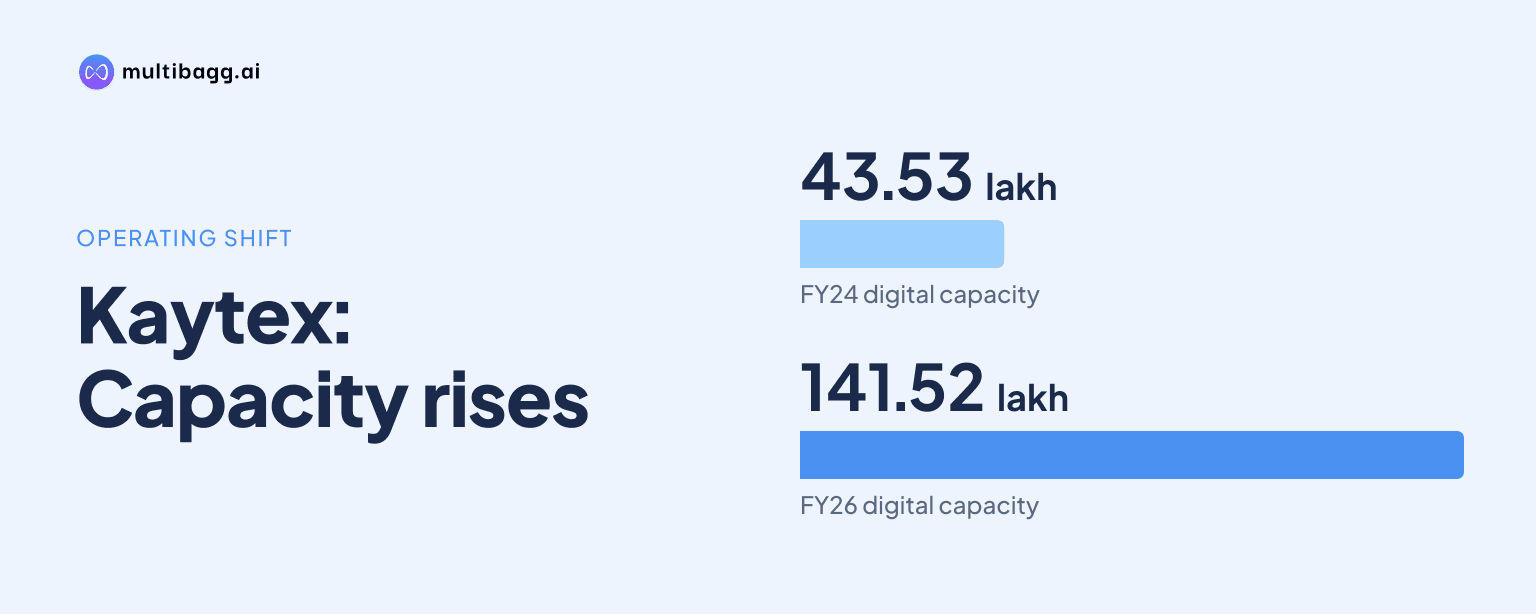
Kaytex Fabrics Limited increased digital-printing installed capacity 3.25 times to 141.52 lakh metres per annum in FY26 from 43.53 lakh metres in FY24, while total installed capacity grew to 208.44 lakh metres and overall capacity utilisation declined to 63.62% from 79.58%.
Know Kaytex Fabrics inside out
Results, valuation, peers and who's buying, in one view.
How quickly did Kaytex Fabrics expand digital printing?
Kaytex Fabrics expanded digital-printing capacity by 97.99 lakh metres per annum from FY24 to FY26, taking the line from 43.53 lakh metres to 141.52 lakh metres. The increase was staged, with capacity reaching 92.16 lakh metres in FY25 before a further 49.36 lakh-metre addition in FY26.
Kaytex Fabrics’ 141.52 lakh-metre digital line was unchanged at 30 September 2026, the end of H1 FY27. Kaytex Fabrics bought a new digital-printing machine for Rs 3.20 crore in September 2026 and said it was being installed; the purchase was not part of the initial public offering, or IPO, objects.
Digital printing began at Kaytex Fabrics in 2020 with capacity of 3 lakh metres per annum, according to the operating history in the presentation. By FY26, the digital line had become its largest fabric line and accounted for 68% of 208.44 lakh metres of total installed capacity, compared with 40% in FY24.
Why did Kaytex Fabrics’ overall capacity utilisation fall?
Kaytex Fabrics’ reported overall capacity utilisation fell because installed capacity increased faster than production from FY24 through FY26. Total production rose from 87.65 lakh metres in FY24 to 132.60 lakh metres in FY26, while total installed capacity rose from 110.14 lakh metres to 208.44 lakh metres over the same period.
The utilisation rate moved from 79.58% in FY24 to 68.85% in FY25 and 63.62% in FY26. Production increased by 21.66 lakh metres in FY25 and by a further 23.29 lakh metres in FY26, but those additions were smaller than the corresponding capacity increases of 48.63 lakh metres in FY25 and 49.67 lakh metres in FY26.
The disclosed H1 FY27 operating figures show a different partial-period measure: Kaytex Fabrics produced 82.83 lakh metres and reported capacity utilisation of 75.90%. This figure should not be read as a full-year comparison with FY26’s 63.62%, because H1 FY27 covers six months while the FY26 measure covers the full financial year.
The change was concentrated in digital printing. Digital printing added 97.99 lakh metres between FY24 and FY26, whereas jacquard capacity remained at 44.03 lakh metres in each of the three years and other woven capacity increased by only 0.31 lakh metres to 22.89 lakh metres.
Got a follow-up? Ask IRIS
How does digital printing fit Kaytex Fabrics’ manufacturing model?
Kaytex Fabrics positions digital printing as the largest and fastest-growing fabric line, with higher value addition than its other lines. The company produces digitally printed, jacquard, dobby and corduroy fabrics, alongside ready-to-stitch womenswear and accessories, with production stages conducted in its own units.
The manufacturing chain runs from yarn sourcing and sizing through weaving, dyeing, processing, digital printing, value addition and dispatch. The FY26 addition of an aari embroidery line broadened the value-addition stage, while the digital-printing operation uses high-capacity machines and low-impact inks, according to the presentation.
Kaytex Fabrics reported EBITDA, or earnings before interest, tax, depreciation and amortisation, margin of 18.60% in FY26, compared with 19.29% in FY25 and 17.67% in FY24. For H1 FY27, EBITDA was Rs 17.39 crore on revenue from operations of Rs 100.26 crore, producing a 17.34% margin, compared with 19.88% in H1 FY26.
The sales channels give the enlarged capacity several routes to market. Own brands represented 60% of FY26 revenue, apparel-brand supply represented 20%, non-branded bulk supply represented 12%, and services made up the remaining 8%; Kaytex Fabrics says bulk trade helps keep capacity used.
What projects will Kaytex Fabrics complete next?
Kaytex Fabrics had used Rs 43.12 crore of Rs 49.35 crore in net IPO proceeds by 30 September 2026. Of the planned amount, Rs 5.01 crore for an advanced fabric processing system had been commissioned and Rs 30.00 crore for incremental working capital had been utilised.
The Amritsar corporate and sales office had received Rs 2.23 crore of its Rs 3.73 crore planned allocation by 30 September 2026 and was under construction. The presentation schedules the facility for March 2027 and says it is intended to improve customer service and support future sales.
The additional warehouse facility at Village Balakan, Majitha, had a planned IPO allocation of Rs 2.56 crore, with no funds reported used by 30 September 2026. Construction started after the monsoon, and the presentation identifies March 2027 for the warehouse project.
Kaytex Fabrics has identified Jammu, Chandigarh, Haryana and Delhi as next domestic markets using its expanded printing capacity. Its distributor and dealer network rose to 178 at 31 March 2026 from 154 at 31 March 2025, an addition of 24 over the year.
Conclusion
Kaytex Fabrics has materially reshaped its manufacturing base around digital printing: the line grew 3.25 times in two years and rose to 68% of FY26 installed capacity. Production also increased, from 87.65 lakh metres in FY24 to 132.60 lakh metres in FY26, but capacity growth was faster, reducing total utilisation by 15.96 percentage points to 63.62%.
The next disclosed milestones are the March 2027 corporate and sales office and additional warehouse projects, alongside installation of the Rs 3.20 crore digital-printing machine bought in September 2026. The operating matter to watch is whether production and sales through the identified domestic markets rise sufficiently to use the 141.52 lakh-metre digital-printing base.