










KEL H1 FY27 EBITDA Margin Fell to 18.9% as Orders Delayed
Key highlights
- KEL's consolidated H1 FY27 EBITDA margin was 18.9%, compared with 27.2% in H1 FY26.
- KEL's H1 FY27 EBITDA declined to Rs 52.12 crore from Rs 78.24 crore a year earlier.
- KEL's consolidated order book was Rs 470.96 crore on 30 September 2026.
- KEL is pursuing a standalone enquiry pipeline exceeding Rs 2,500 crore and a group pipeline exceeding Rs 4,000 crore.
powered by IRIS
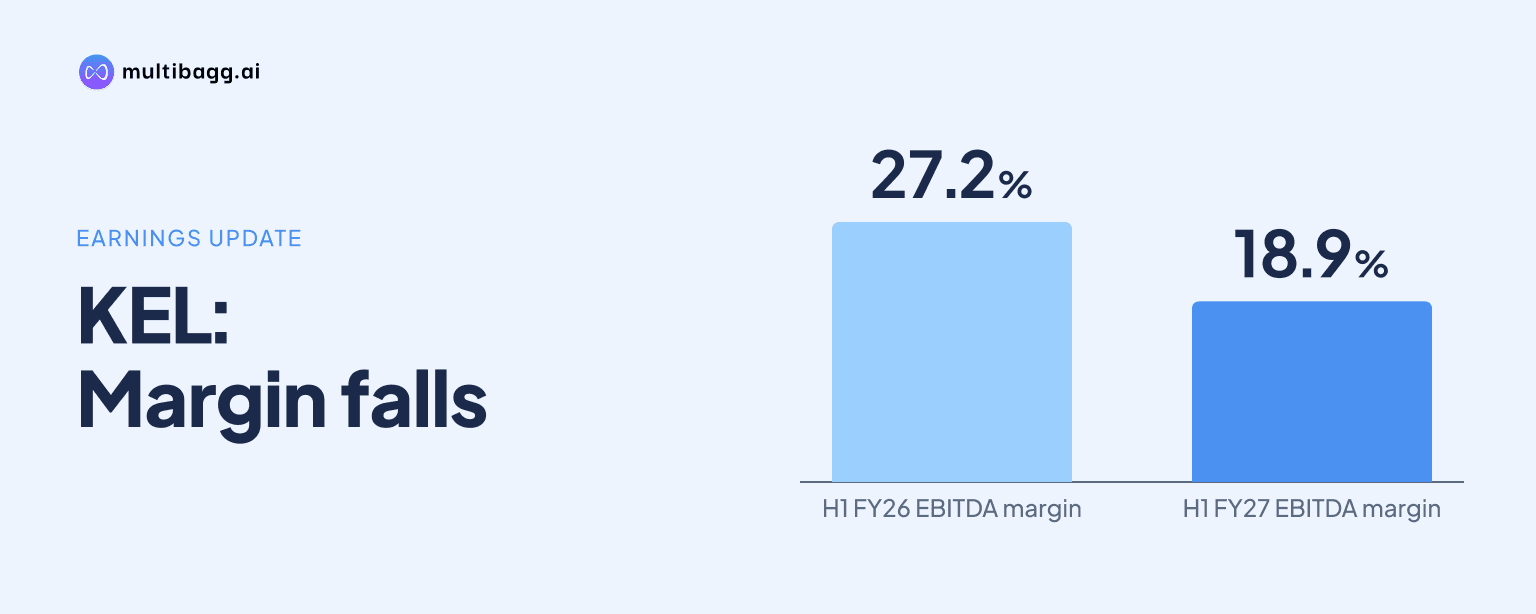
Kilburn Engineering Limited (KEL) reported an earnings before interest, tax, depreciation and amortisation (EBITDA) margin of 18.9% in H1 FY27, down 8.3 percentage points from H1 FY26, as delayed large standalone orders, lower operating leverage and the absence of a comparable high-margin export order affected profitability.
Know Kilburn Engineering inside out
Results, valuation, peers and who's buying, in one view.
Why did KEL's H1 FY27 EBITDA margin fall?
KEL said its margin decline reflected delayed finalisation of several large standalone orders, which reduced standalone business volumes and spread fixed costs over lower revenue. Management also said a significant carbon-black order had been received, but the customer put execution on hold; execution is now expected in FY28, subject to the customer’s schedule. The presentation reports a consolidated H1 FY27 EBITDA margin of 18.9%, versus 27.2% a year earlier.
Product mix was the second stated factor. KEL said Q2 FY26 benefited from a high-margin export order for which there was no comparable order in Q2 FY27, affecting the current quarter’s EBITDA margin. This explanation concerns standalone operating conditions, while the financial measures reported by KEL are consolidated and include the group’s subsidiaries.
The figures show the operating-leverage effect described by management. Total consolidated expenditure in H1 FY27 was Rs 224.10 crore, compared with Rs 209.53 crore in H1 FY26, while total income from operations declined to Rs 276.22 crore from Rs 287.77 crore. The higher expenditure base and lower revenue reduced EBITDA by Rs 26.12 crore year on year.
How did KEL's H1 FY27 financial results change?
KEL’s consolidated EBITDA fell 33.4% year on year to Rs 52.12 crore in H1 FY27 from Rs 78.24 crore in H1 FY26, while total income from operations declined 4.0% to Rs 276.22 crore. Profit after tax (PAT) fell to Rs 29.59 crore from Rs 48.19 crore, and reported earnings per share fell to Rs 5.35 from Rs 9.77.
KEL’s earnings decline continued below EBITDA. Interest expense increased to Rs 7.26 crore in H1 FY27 from Rs 6.67 crore in H1 FY26, while depreciation rose to Rs 6.02 crore from Rs 5.71 crore. Profit before tax consequently fell to Rs 38.83 crore from Rs 67.07 crore, while tax expense decreased to Rs 9.24 crore from Rs 18.88 crore alongside the lower pre-tax profit.
What does KEL's Q2 FY27 performance show?
KEL’s Q2 FY27 EBITDA margin was 17.9%, below both Q1 FY27’s 20.1% and Q2 FY26’s 27.1%, showing that H1 margin pressure continued through the September quarter. Q2 FY27 total income from operations was Rs 155.70 crore, broadly level with Rs 155.99 crore in Q2 FY26 and above Rs 120.52 crore in Q1 FY27.
Despite revenue being nearly unchanged from the prior-year quarter, Q2 EBITDA fell to Rs 27.89 crore from Rs 42.29 crore. That movement is consistent with management’s stated comparison: Q2 FY26 included a high-margin export order, whereas Q2 FY27 did not. Q2 total expenditure was Rs 127.81 crore, compared with Rs 113.70 crore a year earlier.
Quarterly PAT was Rs 16.51 crore in Q2 FY27, against Rs 26.88 crore in Q2 FY26, and PAT margin was 10.6%, compared with 17.2%. Sequentially, PAT increased from Rs 13.09 crore in Q1 FY27, but PAT margin edged down from 10.9% as Q2 revenue increased.
Got a follow-up? Ask IRIS
What order book did KEL have at September 2026?
KEL closed Q2 FY27 with a consolidated order book of Rs 470.96 crore as of 30 September 2026, after receiving Rs 136.94 crore of orders and executing Rs 151.21 crore during the quarter. The closing book was Rs 14.25 crore lower than the Rs 485.21 crore opening order book on 1 July 2026 because quarterly execution exceeded order intake.
Fertilisers were the largest closing-order-book sector at Rs 81.81 crore, or 17.4% of the total, followed by carbon black at Rs 73.49 crore, or 15.6%, and iron and steel at Rs 67.18 crore, or 14.3%. Nuclear power accounted for Rs 56.51 crore, or 12.0%, giving these four sectors combined backlog of Rs 278.99 crore.
New orders in Q2 FY27 were led by fertiliser at Rs 30.58 crore, representing 22.3% of orders received. Carbon black contributed Rs 20.92 crore and artificial intelligence data centres contributed Rs 14.79 crore, equal to 15.3% and 10.8%, respectively. The order-book data gives a consolidated sector breakdown but does not specify the timing of conversion into revenue.
What recovery measures has KEL disclosed?
KEL is pursuing a standalone enquiry pipeline exceeding Rs 2,500 crore and a group pipeline exceeding Rs 4,000 crore, with management focused on converting qualified opportunities into executable orders. Management said greater standalone volumes could improve capacity utilisation and restore operating leverage, but the presentation gives no FY27 revenue, margin or order-conversion target.
The board has approved investment of up to Rs 25 crore for Monga Strayfield’s Pune expansion, targeting data-centre infrastructure and critical-power applications. Management said M.E. Energy is benefiting from strong order intake in steel and ferro-alloy sectors, while Monga Strayfield is scaling its enclosures and cabinets business in response to demand enquiries.
These initiatives sit alongside the carbon-black order whose execution is expected in FY28, subject to the customer’s schedule. KEL presents subsidiary momentum, the enquiry pipeline and additional enclosure capability as recovery drivers, while acknowledging that the timing of large standalone-order finalisations affected H1 FY27 performance.
Conclusion
KEL’s H1 FY27 results show that a 4.0% decline in consolidated operating income to Rs 276.22 crore had a larger effect on earnings, with EBITDA falling 33.4% to Rs 52.12 crore and margin contracting to 18.9%. Management attributes the operating-leverage effect to delayed standalone orders and a less favourable Q2 product mix than the prior year’s high-margin export order.
The next disclosed matters to watch are conversion of the more than Rs 2,500 crore standalone and more than Rs 4,000 crore group enquiry pipelines, progress on Monga Strayfield’s up-to-Rs 25 crore Pune investment, and the customer-led schedule for carbon-black order execution expected in FY28. The consolidated order book of Rs 470.96 crore at 30 September 2026 was below the Rs 485.21 crore opening balance on 1 July 2026, making subsequent order intake and execution relevant measures.