










Kilburn Engineering Ltd plans Rs 150 crore precision capacity
Key highlights
- Kilburn has disclosed a Rs 25 crore investment to expand Monga Strayfield’s Pune precision-engineering capacity.
- Kilburn expects Rs 50-60 crore of precision-engineering revenue in FY27 on current capacity.
- Kilburn’s comparison table states Rs 150 crore of annual post-expansion revenue potential.
- A key data-centre customer has indicated a Rs 90 crore requirement for 2027.
powered by IRIS
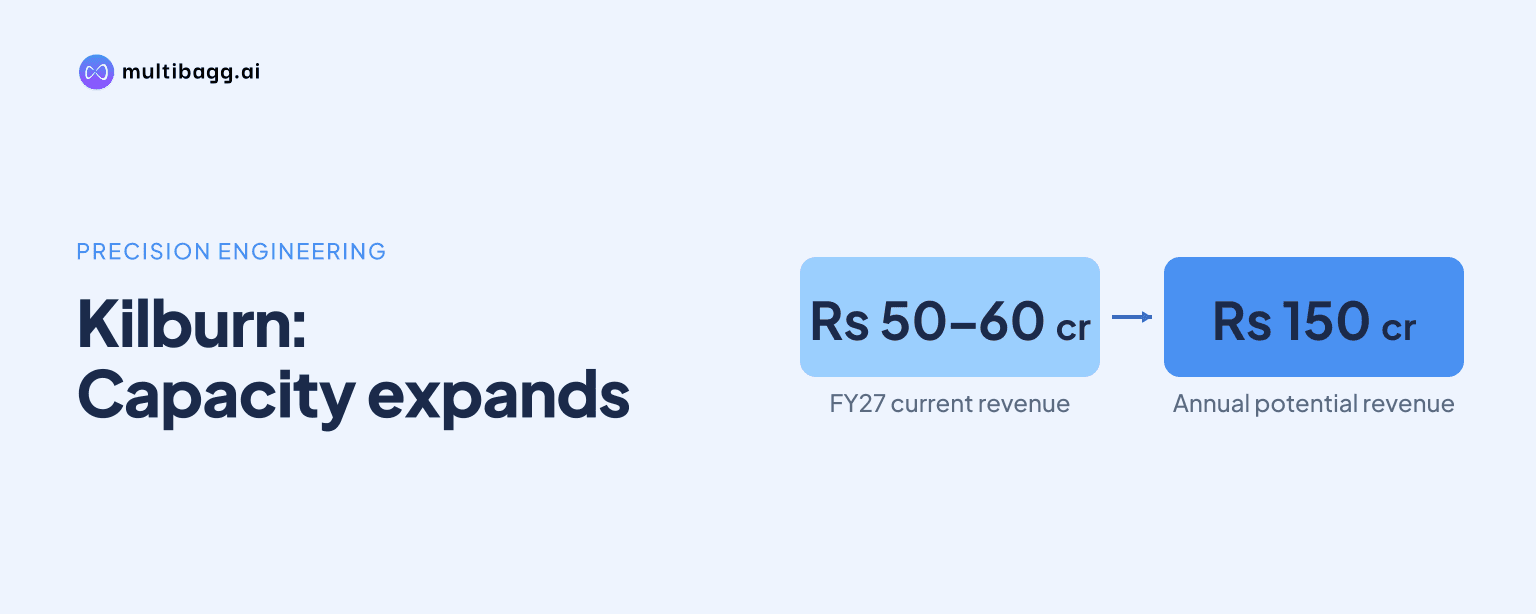
Kilburn Engineering Ltd plans a Rs 25 crore expansion of Monga Strayfield’s Pune facility that the company says can support Rs 150 crore of annual precision-engineering revenue potential, compared with Rs 50-60 crore expected from current capacity in FY27; implementation is stated at six to nine months.
Know Kilburn Engineering inside out
Results, valuation, peers and who's buying, in one view.
What will Kilburn’s Rs 25 crore investment add?
Kilburn says its Rs 25 crore capital investment will enhance precision fabrication and manufacturing at Monga Strayfield’s Pune facility within six to nine months. The planned capacity is for enclosures, cabinets and engineered assemblies used in data-centre infrastructure, transformers and critical-power applications, using a combination of in-house manufacturing and selective outsourcing.
The project concerns Monga Strayfield’s precision-engineered enclosure business, which the presentation says has operated since 1982. Its products serve data centres, uninterruptible power supply (UPS) systems, power infrastructure and industrial applications, while the Pune location is also identified in the group footprint for radio frequency (RF) drying and heating systems, precision manufacturing, and research and development.
Kilburn presents precision sheet-metal engineering as the route from its established RF technology business to global power-infrastructure customers and data-centre opportunities. The company says orders from global power and data-centre infrastructure original equipment manufacturers validate its enclosure capabilities, but the presentation does not disclose the value, timing or customer mix of those orders.
How much revenue potential does Kilburn disclose?
Kilburn expects Rs 50-60 crore of FY27 revenue from current precision-engineering capacity, while its post-expansion table states annual revenue potential of Rs 150 crore. This makes the stated post-expansion ceiling Rs 90 crore above the upper end of expected FY27 revenue using current capacity.
The investment page also describes the project as unlocking approximately Rs 120-150 crore of annual revenue potential. That range differs from the same page’s comparison table, which gives Rs 150 crore as the post-expansion annual potential; Kilburn describes both figures as potential at scale rather than reported revenue or confirmed future sales.
Kilburn says the expansion is designed to support approximately 2.5-3.0 times the precision-engineering business’s current expected annual revenue at scale. The Rs 150 crore figure is 2.5 times the Rs 60 crore upper end of the FY27 range and three times its Rs 50 crore lower end, matching the company’s stated multiple.
What customer and product evidence supports the expansion?
Kilburn identifies a key data-centre customer’s indicated 2027 requirement from Monga Strayfield at Rs 90 crore. That amount exceeds the Rs 60 crore upper end of FY27 revenue expected on current capacity by Rs 30 crore, but Kilburn labels it an indicated requirement rather than a booked order or contracted revenue.
The presentation also cites Monga Strayfield’s long-standing relationship with Vertiv, which it says predates Kilburn’s acquisition of the business. Kilburn says existing relationships with Vertiv and a diversified industrial and power-infrastructure customer base provide a foundation for the expansion, without stating a specific revenue contribution from Vertiv.
Monga Strayfield’s product evidence includes UPS, battery and power-distribution cabinets that the presentation says are being built consistently at volume. Kilburn also states that NEMA 4, NEMA 4X and Type 3R enclosures are already in service with United States customers, linking the Pune expansion to existing applications as well as potential international-market growth.
The presentation lists UL and cUL certified designs, including UL 508A Type 1 and Type 3R, alongside IP65 and IP66 sealing specifications. It also states that every enclosure is made under an ISO 9001:2015 quality system audited by TÜV Austria, while the investment itself is directed at additional fabrication capacity rather than a newly disclosed certification programme.
Got a follow-up? Ask IRIS
How does the Pune project fit Kilburn’s wider manufacturing plan?
Kilburn places the Pune enclosure expansion within three data-centre and critical-power capabilities: precision fabrication and enclosures at Monga Strayfield, thermal management at M.E. Energy, and engineering and manufacturing at Kilburn. The company says it is exploring additional solutions across data centres, critical power, transformers and thermal management alongside its existing enclosure and cabinet opportunities.
The group’s process-drying and thermal-systems business serves sectors including chemicals, fertilisers, pharmaceuticals, oil and gas, nuclear, power, tea and food. Kilburn cites more than 50 years of specialised process-engineering and critical-application experience, while M.E. Energy’s stated capabilities include waste-heat recovery, thermal-process engineering and industrial heating for steel, power, cement, chemicals, paper and refineries.
Kilburn says its wider manufacturing scale-up is expected to be completed by the third quarter of FY27. In addition to the Monga Strayfield enclosure expansion, the programme includes ongoing expansion at the Saravali plant and phase-two expansion at M.E. Energy’s Pune plant.
Management says the group manufacturing infrastructure is being built to support more than Rs 1,000 crore of annual revenue capacity. The presentation connects that capacity roadmap to process drying, energy-efficiency and RF technology solutions, as well as precision-engineered enclosures, but does not allocate the more than Rs 1,000 crore figure by plant, business or end market.
Conclusion
Kilburn’s disclosed plan gives a defined financial and operating rationale for the Pune project: Rs 25 crore of capital is intended to increase precision-engineering revenue potential from Rs 50-60 crore expected in FY27 on current capacity to as much as Rs 150 crore annually. The Rs 90 crore indicated 2027 requirement from a key data-centre customer is above the current-capacity revenue range, while the addressable applications include cabinets and enclosures for data centres, UPS systems, transformers and critical power.
The next disclosed milestones are implementation of the Monga Strayfield project within six to nine months and completion of the wider manufacturing scale-up by the third quarter of FY27. The presentation leaves unresolved how much of the Rs 90 crore indicated customer requirement will become revenue, the eventual split between in-house production and selective outsourcing, and the allocation of the group’s more than Rs 1,000 crore capacity objective across its businesses.