










Kilburn targets Rs 1,000 crore capacity, expansions due Q3 FY27
Key highlights
- Kilburn expects its Saravali and Pune expansion programmes to be completed by Q3 FY27.
- Kilburn says its expanded manufacturing infrastructure is intended to support more than Rs 1,000 crore of annual revenue capacity.
- Monga Strayfield’s Pune investment is Rs 25 crore and targets Rs 150 crore of annual revenue potential.
- Monga Strayfield expects Rs 50 crore to Rs 60 crore of FY27 revenue on current capacity, versus a Rs 90 crore indicated 2027 customer requirement.
powered by IRIS
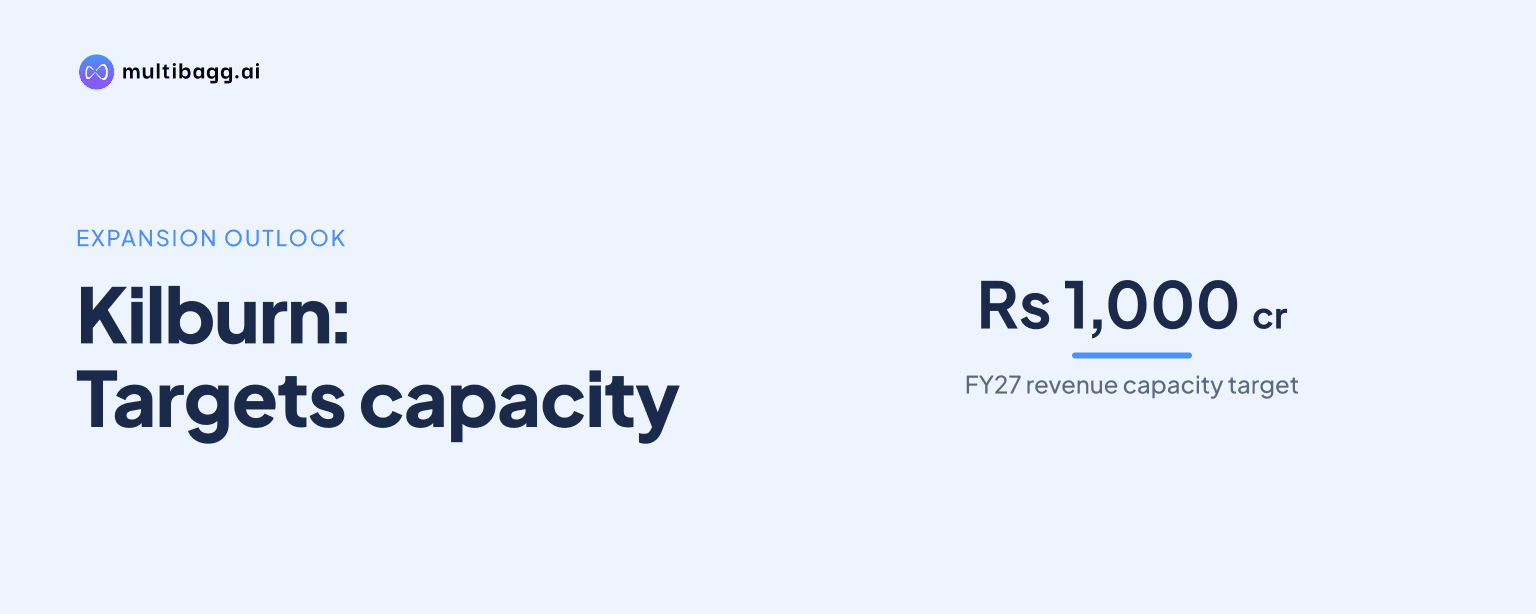
Kilburn says its Saravali and Pune expansions, expected to be completed by Q3 FY27, are being built to support more than Rs 1,000 crore of annual revenue capacity. The plan combines process equipment, thermal systems, radio frequency (RF) technology and precision-engineered enclosures across the group’s Indian and United Kingdom manufacturing base.
Know Kilburn Engineering inside out
Results, valuation, peers and who's buying, in one view.
How will Kilburn build annual capacity above Rs 1,000 crore?
Kilburn will pursue the stated capacity through an ongoing Saravali plant expansion, Phase 2 at M.E. Energy’s Pune plant and a significant expansion of precision-engineered enclosures at Monga Strayfield’s Pune plant. The presentation says these three programmes are underway and expected to be completed by Q3 FY27, while group manufacturing infrastructure is being built to support more than Rs 1,000 crore of annual revenue capacity.
The more-than-Rs-1,000-crore figure is an annual revenue-capacity objective, not reported revenue, an order-book figure or a plant-specific target. Kilburn links the programme to manufacturing capabilities in drying systems, waste-heat recovery equipment, industrial heating packages, RF drying and heating systems, and precision-engineered enclosures, spreading the roadmap across process and infrastructure equipment categories.
Kilburn does not disclose how much of the more-than-Rs-1,000-crore capacity objective will come from Saravali, M.E. Energy’s Pune plant or Monga Strayfield’s Pune operation. It does, however, disclose a separate Rs 25 crore precision-engineering investment and a Rs 150 crore post-expansion annual revenue potential for that Pune business, providing the clearest numerical component of the wider plan.
Where does Kilburn manufacture its different technologies?
Kilburn lists five manufacturing-location entries: Saravali in Bhiwandi, Thane; Ambernath; two Pune operations; and Theale in Berkshire, United Kingdom. Saravali handles core process equipment, heavy fabrication, drying systems, pressure vessels and heat exchangers, while Ambernath manufactures process equipment, drying systems, pressure vessels and heat exchangers.
The two Pune entries cover thermal systems, waste-heat recovery equipment and industrial heating packages at one operation, and RF drying and heating systems, precision manufacturing, and research and development (R&D) at the other. Theale provides RF technology manufacturing and support for international markets, giving Kilburn a manufacturing and support location outside India for its RF technology offering.
Kilburn says the group’s combined capabilities include heavy and precision fabrication, specialised material handling, titanium clean-room capability, machining, rolling, welding, assembly and testing. Its stated design-to-commissioning engineering support is intended to enable both large critical process packages and high-precision specialty systems rather than only standalone equipment supply.
The Saravali and Ambernath sites have overlapping process-equipment, drying-system, pressure-vessel and heat-exchanger activities, whereas the Pune entries add thermal, waste-heat, RF and precision-manufacturing technologies. That mix is relevant to the Q3 FY27 build-out because the expansion programme covers Saravali and Pune rather than an announced Ambernath project.
Got a follow-up? Ask IRIS
What does the Pune precision-engineering expansion add?
Kilburn says the Pune precision-engineering expansion is designed to raise annual revenue potential to Rs 150 crore, compared with expected FY27 revenue of Rs 50 crore to Rs 60 crore on current capacity. The programme involves Rs 25 crore of capital investment, a six-to-nine-month implementation period, and enhanced fabrication and manufacturing capability for enclosures, cabinets and engineered assemblies.
The expansion is intended to serve data-centre infrastructure, transformers and critical-power applications through a combination of in-house manufacturing and selective outsourcing. Kilburn says a key data-centre customer has indicated a 2027 requirement of Rs 90 crore from Monga Strayfield, exceeding the upper end of its Rs 50 crore to Rs 60 crore expected FY27 revenue on current capacity.
Kilburn describes Rs 150 crore of post-expansion potential as approximately 2.5 to 3.0 times the precision-engineering business’s expected annual revenue on current capacity. On the disclosed figures, the Rs 90 crore indicated customer requirement is Rs 30 crore above the top of the current-capacity FY27 range, while Rs 150 crore of planned potential is Rs 60 crore above that indicated requirement.
How does Kilburn plan to use the broader manufacturing base?
Kilburn plans to use the manufacturing base for integrated project delivery across process drying, energy-efficiency and RF technology solutions. Its commercial plan identifies cross-selling RF drying, thermal drying, heat recovery and precision-enclosure solutions, with the ability to offer integrated process lines rather than standalone equipment.
The operational mechanisms identified are shared engineering resources, shared design capabilities, combined manufacturing and fabrication strength, and group-level cost efficiencies. Kilburn also identifies entry into data-centre and electrical-infrastructure verticals as a strategic outcome, supported by enclosures, cabinets and assemblies for uninterruptible power supply, battery and power-distribution applications.
Kilburn presents Monga Strayfield as a sheet-metal enclosure manufacturer established in 1982, with a long-standing relationship with Vertiv that predates Kilburn’s acquisition of Monga Strayfield. The presentation says NEMA 4, NEMA 4X and Type 3R enclosures are in service with United States customers, while designs include UL and cUL certification and ingress-protection sealing to IP65 and IP66.
Management’s longer-term framework includes a 20% to 25% revenue compound annual growth rate target for FY26 to FY28. The stated priorities are to scale energy-transition and higher-engineering-content projects, accelerate cross-selling across three technology platforms, maintain domestic and international market focus, and pursue selective technology acquisitions; the presentation does not disclose an annual capacity ramp for each plant.
Conclusion
Kilburn’s manufacturing plan connects three projects expected by Q3 FY27 with an aggregate objective of more than Rs 1,000 crore in annual revenue capacity. The most detailed component is the Pune precision-engineering project, where Rs 25 crore of investment is intended to support Rs 150 crore of annual potential, against Rs 50 crore to Rs 60 crore of expected FY27 revenue on current capacity.
The next disclosed milestone is completion of the Saravali expansion, M.E. Energy’s Pune Phase 2 and Monga Strayfield’s Pune enclosure expansion by Q3 FY27. Management’s FY26-to-FY28 revenue growth target of 20% to 25%, its cross-selling plan across RF, thermal and precision-engineering technologies, and any later plant-level capacity disclosure will indicate how the stated roadmap is progressing.