










Kheria Autocomp’s FY26 investment outpaced operating cash
Key highlights
- Kheria Autocomp generated ₹26.03 crore of operating cash flow in FY26, up from ₹8.40 crore in FY25.
- FY26 investing activities used ₹26.64 crore, exceeding operating cash inflow by ₹61.52 lakh.
- Financing activities added ₹85.59 lakh, lifting cash and cash equivalents by ₹24.07 lakh to ₹56.83 lakh.
- Current liabilities of ₹36.65 crore exceeded current assets of ₹29.97 crore in FY26, resulting in a current ratio of 0.82 times.
powered by IRIS
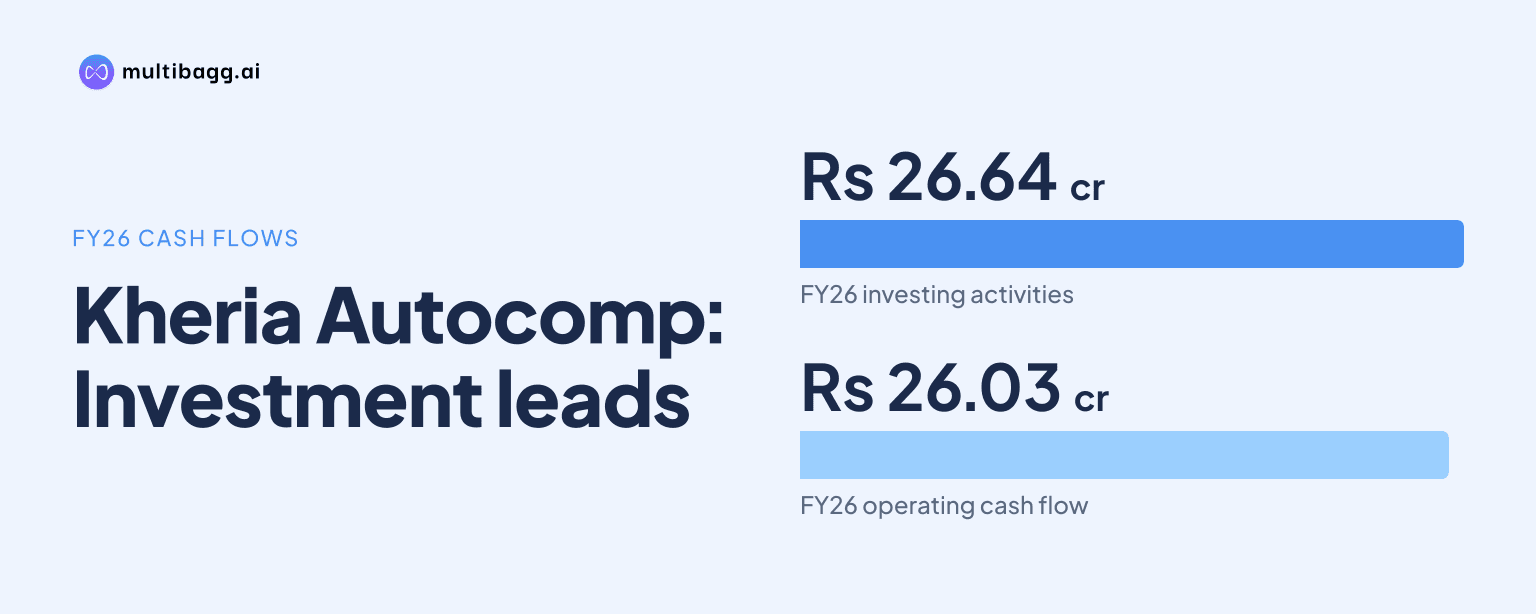
Kheria Autocomp Limited generated ₹26.03 crore of operating cash flow in FY26, but investing activities used ₹26.64 crore, exceeding the operating inflow by ₹61.52 lakh. Kheria Autocomp added ₹85.59 lakh from financing activities, lifting closing cash and cash equivalents by ₹24.07 lakh to ₹56.83 lakh. Its FY26 current ratio was 0.82 times.
Know Kheria Autocomp inside out
Results, valuation, peers and who's buying, in one view.
What did Kheria Autocomp’s FY26 cash flow show?
Kheria Autocomp’s FY26 cash flow showed that investment outflows exceeded cash generated from operations. Net cash from operating activities was ₹26.03 crore, while net cash used in investing activities was ₹26.64 crore, creating a ₹61.52 lakh gap before financing flows. Net cash from financing activities was ₹85.59 lakh, producing a ₹24.07 lakh overall increase in cash and cash equivalents.
Closing cash and cash equivalents were ₹56.83 lakh in FY26, compared with ₹32.76 lakh in FY25 and ₹21.62 lakh in FY24. The company recorded a ₹11.14 lakh increase in cash equivalents in FY25 after a ₹11.89 lakh decrease in FY24. The FY26 cash-flow closing balance differs from the ₹2.73 crore cash and bank balance reported on the balance sheet, and the presentation does not reconcile the two labels.
Operating cash flow increased from ₹8.40 crore in FY25 to ₹26.03 crore in FY26, while the investing outflow rose from ₹17.98 crore to ₹26.64 crore. In FY24, Kheria Autocomp generated ₹9.82 crore from operations and used ₹15.33 crore in investing activities. Investing outflows therefore exceeded operating inflows in all three years shown, although the FY26 gap was substantially smaller than in FY25 and FY24.
How did Kheria Autocomp’s balance sheet change in FY26?
Kheria Autocomp’s total assets increased to ₹106.23 crore in FY26 from ₹81.79 crore in FY25. Non-current assets rose to ₹76.26 crore from ₹56.65 crore, while current assets increased to ₹29.97 crore from ₹25.13 crore. The balance-sheet expansion coincided with FY26 investing cash outflows of ₹26.64 crore.
Property, plant and equipment rose to ₹55.52 crore in FY26 from ₹52.75 crore in FY25, while capital work-in-progress was ₹18.41 crore, against no reported balance a year earlier. Other non-current assets declined to ₹2.31 crore from ₹3.88 crore. The cash-flow statement does not identify which assets or projects accounted for its investing outflow.
Shareholders’ equity increased to ₹39.52 crore in FY26 from ₹28.24 crore in FY25, including share capital of ₹11.25 crore versus ₹4.50 crore. Long-term borrowings rose to ₹26.66 crore from ₹25.08 crore, and current borrowings increased to ₹8.37 crore from ₹5.82 crore. Total liabilities reached ₹106.23 crore in FY26, compared with ₹81.79 crore in FY25.
Got a follow-up? Ask IRIS
What does Kheria Autocomp’s FY26 current ratio indicate?
Kheria Autocomp reported a current ratio of 0.82 times in FY26, down from 0.99 times in FY25 but above 0.72 times in FY24. The FY26 balance sheet recorded current assets of ₹29.97 crore and current liabilities of ₹36.65 crore, meaning reported short-term liabilities exceeded reported short-term assets at the year-end.
Current assets grew by ₹4.84 crore in FY26, but current liabilities rose by ₹11.22 crore. Trade payables increased by ₹6.93 crore to ₹23.63 crore, and current borrowings rose by ₹2.55 crore to ₹8.37 crore. That faster growth in current liabilities explains the fall in the current ratio from FY25.
Inventories increased to ₹7.94 crore in FY26 from ₹4.28 crore in FY25, while trade receivables changed to ₹17.20 crore from ₹17.08 crore. Loans and advances fell to ₹1.88 crore from ₹3.39 crore. The ₹56.83 lakh closing cash-equivalent figure was lower than both inventory and receivables, while the separate balance-sheet cash and bank balance was ₹2.73 crore.
How did cash flow compare with Kheria Autocomp’s operating growth?
Kheria Autocomp’s operating cash generation rose alongside revenue and profit growth in FY26. Revenue from operations increased to ₹120.01 crore from ₹92.07 crore in FY25, while earnings before interest, tax, depreciation and amortisation, or EBITDA, rose to ₹22.90 crore from ₹16.18 crore. EBITDA margin increased to 19.1% from 17.6%.
Net profit rose to ₹11.42 crore in FY26 from ₹8.24 crore in FY25, while operating cash flow was ₹26.03 crore. Asset turnover increased to 2.22 times from 2.00 times, and return on capital employed, or ROCE, was reported at 26.89 times compared with 25.21 times. Return on equity was 33.72%, down from 34.18% in FY25.
Management says Plant II is planned to increase installed capacity by about 44% to 7,800 metric tonnes per annum, from FY26 capacity utilisation of 93.73%. The presentation also reports 30 injection-moulding machines and more than 20 industrial robots. It does not disclose Plant II’s cost, timing, funding structure or whether FY26 investing outflows included spending on that project.
Conclusion
Kheria Autocomp converted FY26 operations into ₹26.03 crore of cash, compared with ₹8.40 crore in FY25, while investing cash outflows rose to ₹26.64 crore. Financing activities supplied ₹85.59 lakh and enabled a ₹24.07 lakh increase in cash equivalents, but current liabilities of ₹36.65 crore remained above current assets of ₹29.97 crore, reflected in the 0.82-times current ratio.
The next disclosed item to watch is management’s Plant II plan to raise installed capacity by about 44% to 7,800 metric tonnes per annum. The presentation leaves the project’s cost, schedule, funding sources and connection to FY26 investing cash flow unresolved, making future disclosures on capital expenditure and working-capital movements relevant.