








Kinetic Engineering Limited EV mix reaches 39.6% in H1 FY27
Max Plan at ₹4,999/yr₹8,999

Find your next multibaggerBe a Pro Investor
Research stocks and track your picks on the go. Download the app.
Key highlights
- KEL’s EV sales mix rose to 39.6% in H1 FY27 from 9.4% in FY26.
- Kinetic Watts & Volts recorded more than 7,000 cumulative electric-scooter sales.
- KEL reported two-wheeler EV volumes of 700-900 units a month in April-November 2026.
- Management expects electric scooters to contribute at least Rs 100 crore to FY27 consolidated revenue.
powered by IRIS
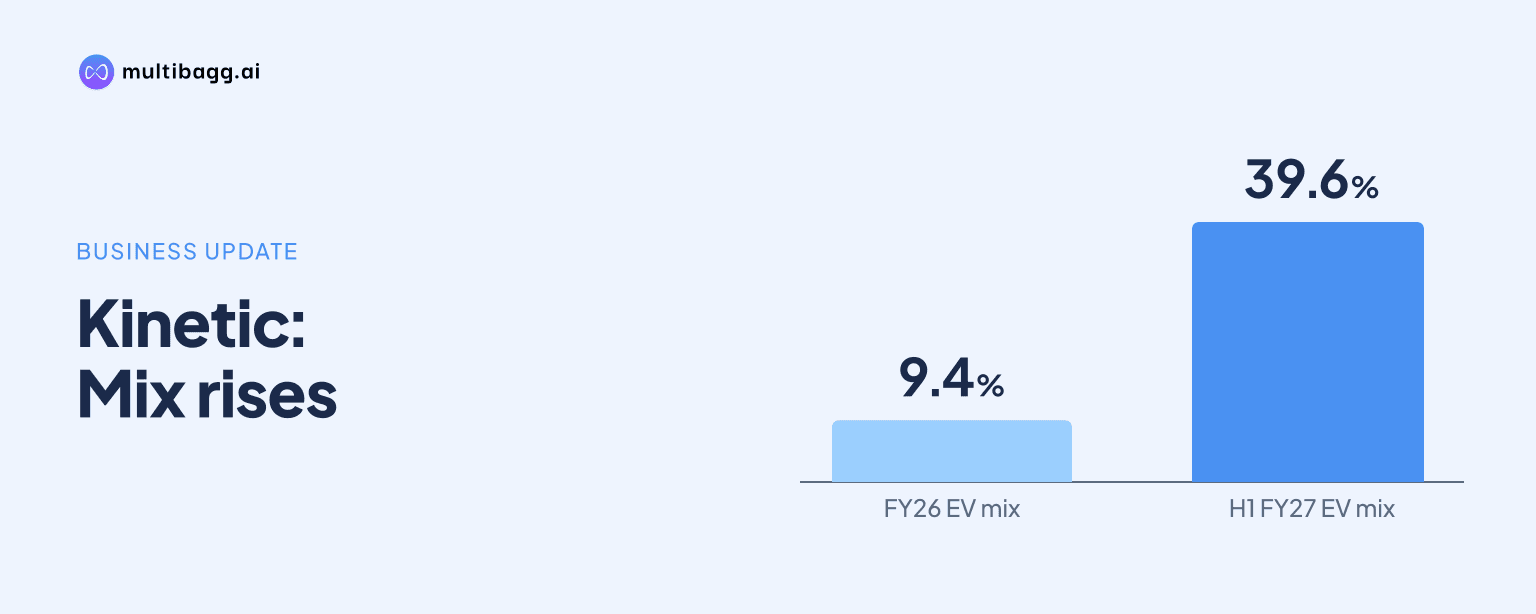
Kinetic Engineering Limited reported that electric vehicles, or EVs, accounted for 39.6% of segment-wise sales in H1 FY27, up from 9.4% in FY26. KEL also disclosed more than 7,000 cumulative electric-scooter sales through Kinetic Watts & Volts and two-wheeler EV volumes scaling to 700-900 units a month.
Know Kinetic Engineering inside out
Results, valuation, peers and who's buying, in one view.
Why did KEL’s EV sales share reach 39.6% in H1 FY27?
KEL reported that EVs contributed 39.6% of segment-wise sales in H1 FY27, making EV its largest individual reported segment, ahead of transmission at 32.9%, driveline at 24.4% and others at 3.1%. This marked a change from FY26, when transmission accounted for 48.7% of sales, driveline for 32.7%, EV for 9.4% and others for 9.3%.
The mix shift developed across several reporting periods. EV represented 5.0% of KEL’s segment sales in FY24, rose to 7.6% in FY25 and reached 9.4% in FY26 before increasing to 39.6% in H1 FY27. Over the FY24-to-H1 FY27 period, transmission declined from 49.0% to 32.9% and driveline declined from 37.0% to 24.4%.
KEL’s geographical sales mix also moved further towards India in H1 FY27. India accounted for 75.6% of sales, compared with 67.0% in FY26, while Mexico’s contribution fell to 20.1% from 28.0% and the US contribution was 4.3%, compared with 4.0%. The presentation does not disclose absolute H1 FY27 sales or an EV revenue amount for the half year.
What operating metrics support KEL’s EV sales growth?
KEL said Kinetic Watts & Volts had recorded more than 7,000 cumulative electric-scooter sales since commencing operations. The company said the Kinetic DX scooter had gained market acceptance and positioned the business among the top 15 EV scooter manufacturers, although the presentation does not provide a market-share percentage or ranking methodology.
Two-wheeler EV volumes were scaling to 700-900 units a month in KEL’s April-November 2026 year-to-date update. KEL reported current output of 75-100 units per shift per day, against standard capacity of up to 200 units per shift per day. The presentation does not state the number of operating shifts, production utilisation, scooter inventory or monthly retail sales separately.
KEL had appointed more than 85 dealers by the April-November 2026 update and was targeting more than 150 dealers by FY27. It had issued more than 170 letters of intent, or LoIs, for dealerships. The gap between more than 170 LoIs and more than 85 appointed dealers shows that the disclosed network rollout was still in progress.
Got a follow-up? Ask IRIS
How does KEL’s EV strategy connect with its components business?
KEL’s EV activity includes electric scooters through Kinetic Watts & Volts and EV-related component capabilities. The company said it is expanding into EV drivetrain systems, axles and gear solutions, while its manufacturing operations produce forgings, gearboxes, shafts and chassis components. Its two-wheeler and three-wheeler parts include chassis, frames, side stands, rear forks, swing arms and main stands supplied welded and painted.
The auto-components business has submitted samples for new projects and expects commercial production to commence in the first half of 2027. Management estimated annual business potential of about Rs 100 crore for these projects, including component supplies to Kinetic Watts & Volts. This is estimated annual potential rather than reported revenue.
Management separately expects the electric-scooter business to contribute at least Rs 100 crore to consolidated revenue during FY27. This is a full-year expectation rather than a reported H1 FY27 result. The presentation does not split the expected FY27 EV contribution between scooter sales, related parts supply and other EV activities.
What changed in KEL’s legacy sales mix and financial context?
Transmission and driveline remained material businesses despite their lower shares in H1 FY27. Together, the two segments represented 57.3% of segment sales in H1 FY27, compared with 81.4% in FY26. Transmission declined by 15.8 percentage points and driveline by 8.3 percentage points, while EV increased by 30.2 percentage points.
KEL’s FY26 consolidated net sales were Rs 157.75 crore, up from Rs 142.46 crore in FY25 and Rs 143.17 crore in FY24. Earnings before interest, tax, depreciation and amortisation, or EBITDA, were Rs 13.77 crore in FY26, down from Rs 17.82 crore in FY25, while EBITDA margin was 8.3%, compared with 11.5%. The presentation does not provide profitability by EV, transmission or driveline segment.
KEL’s FY26 reported net profit was Rs 0.87 crore, compared with Rs 6.23 crore in FY25, while reported profit after tax margin was 0.6%, down from 4.0%. FY26 included Rs 0.76 crore of exceptional items relating to past-service cost from a wage-code revision in gratuity. The annual income statement provides context for the EV transition but does not establish EV business profitability.
Conclusion
KEL’s reported sales mix shows EV becoming its largest individual segment in H1 FY27 at 39.6%, compared with 9.4% in FY26, alongside more than 7,000 cumulative scooter sales and monthly EV volumes of 700-900 units. Transmission and driveline together still represented 57.3% of segment sales, leaving KEL exposed to both EV activity and established auto-component categories.
The next disclosed milestones are KEL’s target of more than 150 dealers by FY27, management’s expectation that electric scooters will contribute at least Rs 100 crore to FY27 consolidated revenue, and expected commercial production for new component projects in the first half of 2027. Management has identified about Rs 100 crore of annual potential for those projects, including supplies to Kinetic Watts & Volts, but has not disclosed conversion, revenue timing or segment margins.

