








Thirumalai Chemicals Ltd. completes US plant mechanical work
Max Plan at ₹4,999/yr₹8,999

Find your next multibaggerBe a Pro Investor
Research stocks and track your picks on the go. Download the app.
Key highlights
- TCL has completed mechanical construction at its approximately US$340 million West Virginia project.
- The facility combines 40.5 KTPA of maleic anhydride capacity with more than 30 KTPA of malic acid and fumaric acid capacity.
- TCL says feedstock represents 50% to 70% of production cost and regional prices are at least 25% lower than in other markets.
- Project funding is at an advanced stage of finalisation while commissioning and sequential unit testing continue.
powered by IRIS
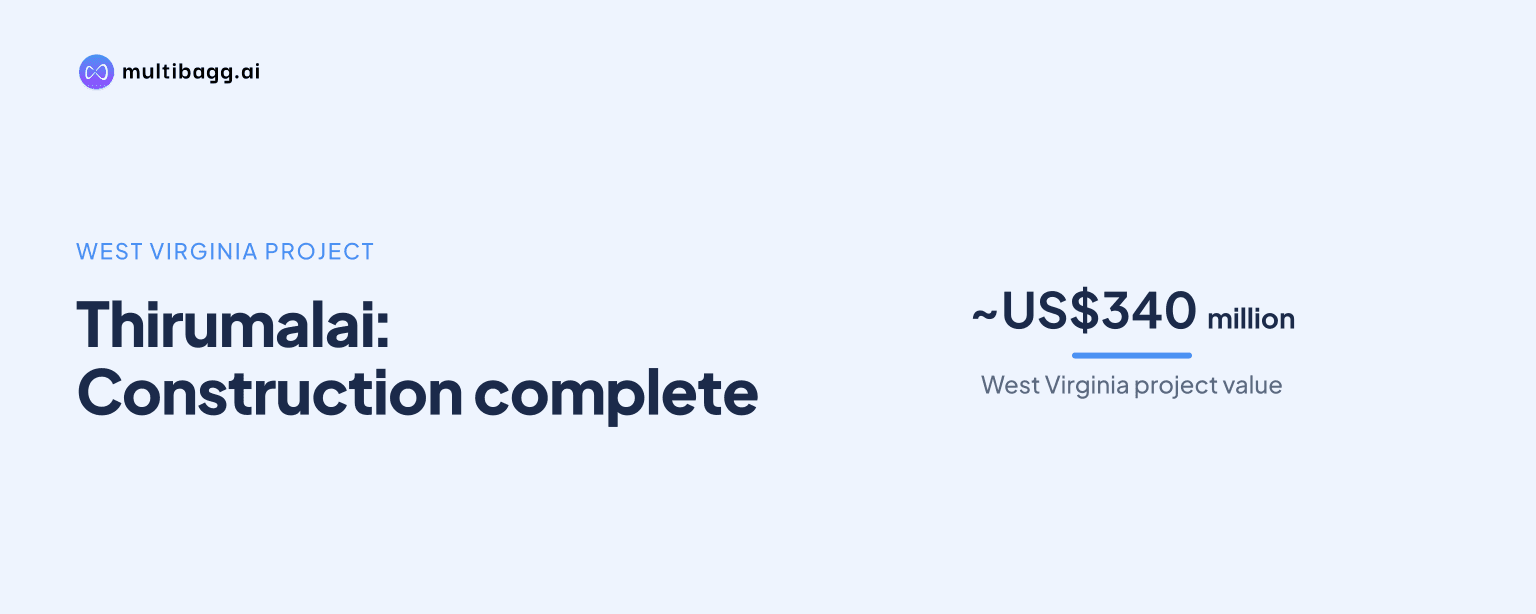
Thirumalai Chemicals Ltd. has completed mechanical construction at its approximately US$340 million West Virginia facility, combining 40.5 KTPA of maleic anhydride capacity with more than 30 KTPA of food ingredients; commissioning and sequential testing are under way while project funding is at an advanced stage of finalisation.
Know Thirumalai Chemicals inside out
Results, valuation, peers and who's buying, in one view.
What has TCL completed at the US facility?
TCL has completed mechanical construction at the West Virginia project, which includes a 40.5 KTPA maleic anhydride plant and a food-ingredients plant of more than 30 KTPA. The facility has not yet begun commercial operations because commissioning activities and sequential testing of various units remain under way.
The next steps are funding completion and commissioning of the two integrated plants rather than further mechanical construction. TCL says project funding is at an advanced stage of finalisation, and commercial operations will follow completion of commissioning activities, although the presentation gives no specific commissioning or production date.
The project is within an established industrial chemical complex, where TCL says electricity, water, wastewater treatment, rail-spur access, a barge port and security are available from day one. This infrastructure supports the planned manufacture of maleic anhydride, malic acid and fumaric acid at the site.
What capacity will TCL add in West Virginia?
TCL is building two integrated plants with 40.5 KTPA of maleic anhydride capacity and more than 30 KTPA of food-ingredient capacity. KTPA means thousand tonnes per annum, and TCL has not disclosed separate capacities for the malic acid and fumaric acid units within the food-ingredients plant.
TCL says the integrated configuration can use self-generated energy while converting maleic anhydride into downstream products. The company presents malic acid and fumaric acid as additions to its food-ingredients portfolio, intended to soften the effect of price fluctuations in a single product category.
The 40.5 KTPA maleic anhydride plant is designed around locally available n-butane. TCL says feedstock accounts for 50% to 70% of production cost and that prices in the region are at least 25% lower than in other markets, making input availability a central part of the project’s cost assumptions.
Why does TCL see a market opportunity for the project?
TCL cites import dependence in food ingredients as a market opening: imports account for more than 65% of malic acid consumption in the US and Mexico and more than 70% of fumaric acid consumption in the US. Its presentation also says the US has only one manufacturer of maleic and fumaric acid, operating at a cost disadvantage, without providing market-size or pricing data.
The company also identifies a change in the merchant market for maleic anhydride. According to TCL, acquisitions of two major maleic anhydride producers by end users have opened opportunities for independent suppliers, while customer engagement for the project has intensified and received what management describes as encouraging market response.
Location is another part of the commercial case. TCL says 40% of North American maleic anhydride customers are within 1,000 miles of the project site, feedstock is available within 70 miles, and the nearest international port is within 500 miles. The stated logistics reach includes US customers and export routes to Europe and Africa.
TCL also cites sustainable and biodegradable polymer applications for maleic anhydride in its market outlook. This is management’s assessment rather than a sales forecast: the presentation reports healthy demand across maleic anhydride, malic acid and fumaric acid, but discloses no order book, contracted volume, selling-price assumption or revenue target.
Got a follow-up? Ask IRIS
What is driving the US$340 million project cost?
TCL keeps the estimated project cost at approximately US$340 million despite an extended execution timeline. It identifies higher financing costs, contractor-driven construction cost increases, productivity impacts and debt-raising expenses as the main factors continuing to create cost pressure.
The company says its construction approach is intended to offset part of the US execution cost. TCL manufactured 100% of the plant and machinery in modular form at its special economic zone unit in Ranipet and shipped the modules to the US project site for final assembly, reducing onsite erection and installation work.
TCL says in-house construction has given it greater control over quality and flexibility, and management says project cost remains below that of similar plants built by global peers despite the escalation. The presentation does not identify those projects or provide their capacity, construction period or cost, so that comparison cannot be independently assessed from the disclosed material.
The financial framework depends on downstream value addition. TCL says high capital and fixed costs make new maleic anhydride projects unviable without derivative products, explaining why the 40.5 KTPA maleic anhydride unit is paired with more than 30 KTPA of malic acid and fumaric acid capacity.
What needs to happen before TCL begins commercial production?
TCL needs to finalise funding and complete commissioning before the two integrated plants begin commercial production. Although mechanical construction is complete, the company says sequential testing of units continues and expressly links commercial operations to the completion of commissioning after funding finalisation.
Management expects the project to pay back within seven years of operations. That expectation depends on the facility achieving its stated input-cost and market assumptions, including regional n-butane prices at least 25% below other markets and access to 40% of North American maleic anhydride customers within 1,000 miles.
TCL says the industrial-complex location can support future expansion of products derived from maleic anhydride. However, the company has not disclosed the capacity, timing, capital requirement or product slate for any expansion beyond the 40.5 KTPA maleic anhydride plant and the more than 30 KTPA food-ingredients plant.
Conclusion
Completed mechanical construction moves TCL’s approximately US$340 million US project into commissioning, with 40.5 KTPA of maleic anhydride capacity connected to more than 30 KTPA of malic acid and fumaric acid capacity. The disclosed commercial case combines integrated production, locally available n-butane, modular equipment made in Ranipet and proximity to North American customers.
The next developments to watch are funding finalisation, completion of sequential unit testing and the start of commercial operations, for which TCL has not disclosed a date. Management’s seven-year payback expectation will depend on commissioning progress, cost control and conversion of customer engagement into sales.

