








Thirumalai Chemicals Ltd. EBITDA reaches Rs 50 crore in Q2
Max Plan at ₹4,999/yr₹8,999

Find your next multibaggerBe a Pro Investor
Research stocks and track your picks on the go. Download the app.
Key highlights
- TCL’s standalone EBITDA rose to Rs 50 crore in Q2 FY27 from Rs 11 crore in Q2 FY26.
- TCL’s standalone gross profit margin increased to 30.3% in Q2 FY27 from 22.3% a year earlier.
- TCL reported consolidated EBITDA of Rs 48 crore, but finance cost of Rs 57 crore resulted in a Rs 34 crore loss after tax.
- TCL generated Rs 117 crore of net operating cash in H1 FY27 against Rs 268 crore of net cash used in H1 FY26.
powered by IRIS
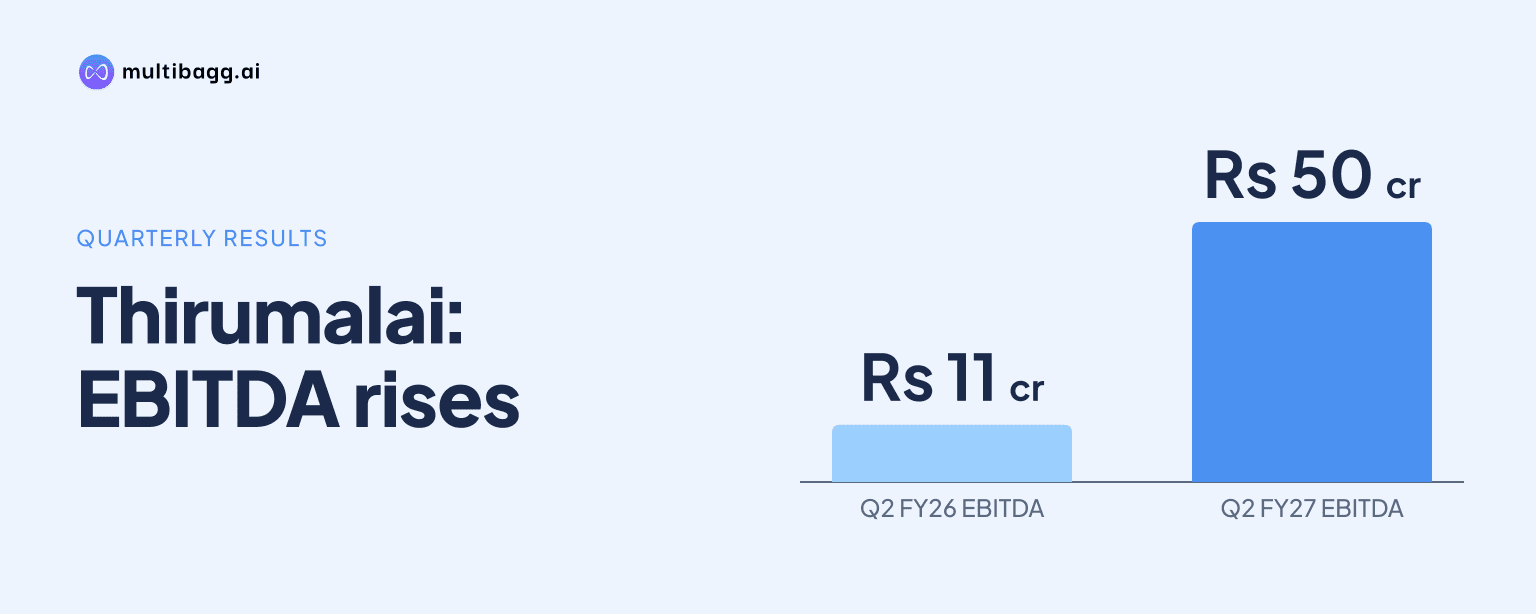
Thirumalai Chemicals Ltd. reported standalone earnings before interest, tax, depreciation and amortisation (EBITDA) of Rs 50 crore in Q2 FY27, compared with Rs 11 crore a year earlier, as gross margin rose to 30.3% despite a 5.0% decline in revenue from operations. TCL nevertheless reported a consolidated loss after tax of Rs 34 crore after finance cost reached Rs 57 crore.
Know Thirumalai Chemicals inside out
Results, valuation, peers and who's buying, in one view.
What changed in TCL’s Q2 FY27 standalone earnings?
TCL’s standalone operation returned to profit in Q2 FY27, recording profit after tax of Rs 12 crore against a loss after tax of Rs 13 crore in Q2 FY26. EBITDA increased by Rs 39 crore to Rs 50 crore, while revenue from operations declined to Rs 339 crore from Rs 357 crore.
Total income was Rs 360 crore in Q2 FY27, down from Rs 372 crore a year earlier, with other income increasing to Rs 20 crore from Rs 15 crore. Sequentially, total income rose from Rs 340 crore in Q1 FY27, although EBITDA was marginally lower than the Rs 51 crore reported in that quarter.
How did TCL lift standalone margins while revenue fell?
TCL lifted standalone gross profit margin to 30.3% in Q2 FY27 from 22.3% in Q2 FY26, a rise of 8.0 percentage points. Cost of goods sold declined by Rs 38 crore to Rs 251 crore, more than offsetting the Rs 18 crore reduction in revenue from operations and lifting gross profit to Rs 109 crore from Rs 83 crore.
Employee benefits expense fell to Rs 13 crore from Rs 16 crore, while other expenses declined to Rs 46 crore from Rs 56 crore. These movements took EBITDA margin to 13.9% from 3.1%, although it was below the 14.9% margin reported in Q1 FY27, when gross profit margin was 34.8%.
The first-half comparison shows the same margin-led change. Standalone revenue from operations for H1 FY27 was Rs 670 crore, down 16.5% from Rs 803 crore in H1 FY26, but gross profit rose to Rs 227 crore from Rs 150 crore and gross margin reached 32.5% from 18.3%; EBITDA consequently increased to Rs 101 crore from Rs 18 crore.
Why did TCL report a consolidated loss despite higher EBITDA?
TCL reported a consolidated loss because its Q2 FY27 finance cost of Rs 57 crore exceeded earnings before interest and tax (EBIT) of Rs 26 crore. The company recorded a loss before tax of Rs 30 crore and a loss after tax of Rs 34 crore, compared with a Rs 33 crore loss after tax in Q2 FY26.
The operating result nevertheless improved year on year. Consolidated revenue from operations increased 33.9% to Rs 596 crore, gross profit rose 44.0% to Rs 162 crore, and EBITDA rose to Rs 48 crore from Rs 5 crore; EBITDA margin widened to 8.0% from 1.0%.
The sequential comparison also shows higher consolidated activity. Revenue from operations rose from Rs 547 crore in Q1 FY27 to Rs 596 crore in Q2 FY27, while EBITDA increased from Rs 36 crore to Rs 48 crore; finance cost also rose from Rs 52 crore to Rs 57 crore, and the loss after tax narrowed from Rs 44 crore to Rs 34 crore.
Got a follow-up? Ask IRIS
What do TCL’s H1 FY27 cash flow and balance sheet show?
TCL’s consolidated loss after tax narrowed to Rs 78 crore in H1 FY27 from Rs 93 crore in H1 FY26, while EBITDA turned positive at Rs 84 crore from a negative Rs 20 crore. Revenue from operations increased 27.7% to Rs 1,143 crore, but finance cost rose to Rs 109 crore from Rs 44 crore.
Operating cash flow turned positive in the first half, with net cash generated from operating activities of Rs 117 crore compared with net cash used of Rs 268 crore in H1 FY26. Cash and cash equivalents closed at Rs 90 crore, up from Rs 64 crore at the start of FY27, after Rs 112 crore of cash generation from operations before direct taxes.
The balance sheet records a shift towards non-current borrowings. Non-current borrowings were Rs 1,556 crore at H1 FY27 versus Rs 680 crore at FY26, while current borrowings declined to Rs 586 crore from Rs 1,413 crore; the combined reported borrowing balance was Rs 2,142 crore against Rs 2,093 crore. Capital work-in-progress increased to Rs 2,853 crore from Rs 2,518 crore, and total assets rose to Rs 5,095 crore from Rs 4,737 crore.
What is TCL expecting in Q3 FY27?
TCL expects customer enquiries of approximately 3,000 metric tonnes in the Maleic Acid contract season to improve order visibility in Q3 FY27. Management said flexible production planning and premium-order execution are expected to support Food Acid margins, while firm global Maleic Anhydride prices and spot-based orders are expected to support Fumaric Acid realisations.
Management expects Phthalic Anhydride prices to ease gradually in Q3, which it says may improve buying activity, with Paints and unsaturated polyester resin identified as demand drivers. At Ranipet, the re-catalysed large reactor achieved its expected yield, while the Malic Acid plant operated at 13 tonnes per day in Q2 amid consistent domestic demand at stronger margins.
At Dahej, TCL reported 95% capacity utilisation at its Phthalic Anhydride reactor and its highest flaking level of 305 tonnes per day. Fumaric Acid production reached 335 metric tonnes in September, while management said recovery in Folpet production, improving Saccharin demand and a gradual revival in Dyes and Intermediates could support overall Q3 sales of approximately 1,950 metric tonnes.
Conclusion
TCL’s Q2 FY27 results show that standalone earnings improved despite lower sales, with lower cost of goods sold lifting gross margin to 30.3% and EBITDA to Rs 50 crore. Consolidated revenue and EBITDA also increased, but consolidated finance cost of Rs 57 crore remained above EBIT of Rs 26 crore, resulting in a Rs 34 crore quarterly loss after tax.
The next quarter will show whether expected Phthalic Anhydride buying activity, approximately 3,000 metric tonnes of Maleic Acid enquiries and anticipated Q3 sales of about 1,950 metric tonnes translate into earnings. Management’s disclosed outlook also leaves Malaysian esters demand, raw-material and freight costs, and the trajectory of consolidated finance costs as matters to watch.

