








Thirumalai Chemicals cuts Scope 1 emissions 23.2% year on year
Max Plan at ₹4,999/yr₹8,999

Find your next multibaggerBe a Pro Investor
Research stocks and track your picks on the go. Download the app.
Key highlights
- Thirumalai Chemicals reported a 23.2% year-on-year reduction in Scope 1 emissions.
- Renewable sources accounted for 81.44% of Thirumalai Chemicals' total energy.
- Thirumalai Chemicals reported 22,120 t CO₂e avoided across Scope 1 and Scope 2 emissions compared with the previous year.
- Thirumalai Chemicals reported a 29.17% reduction in water consumption compared with the previous year.
powered by IRIS
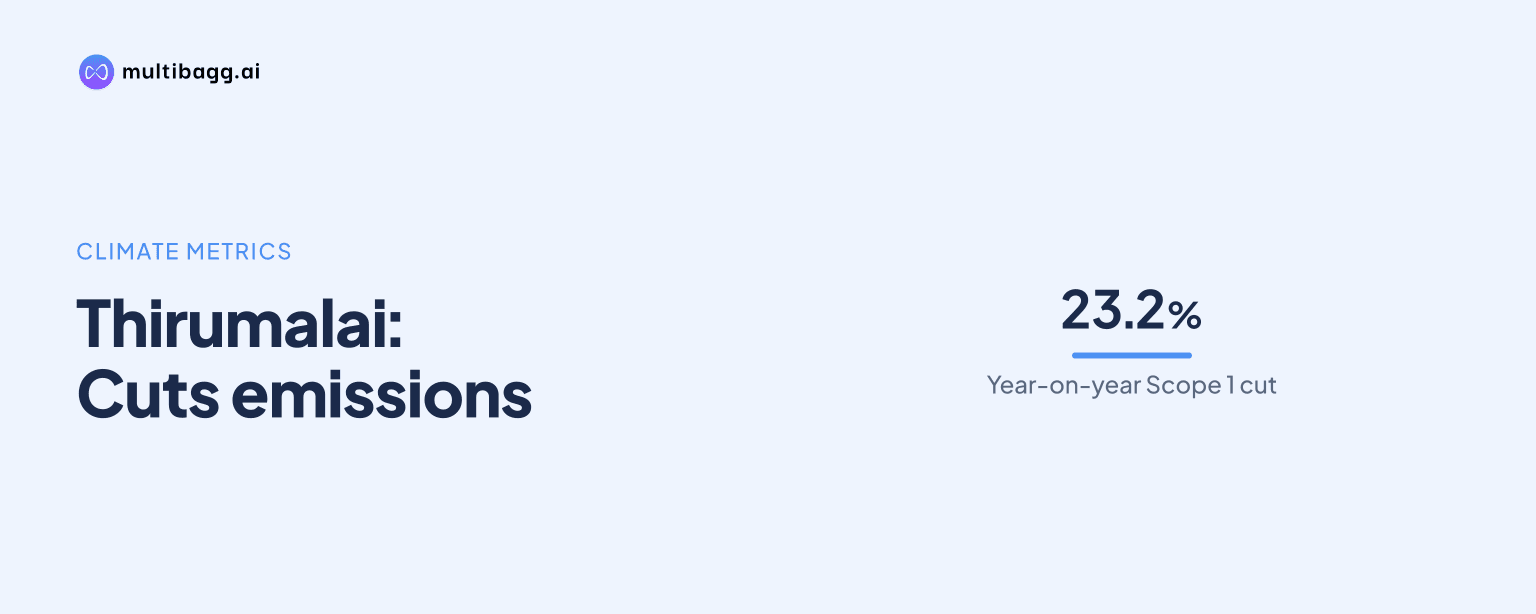
Thirumalai Chemicals Ltd. reported a 23.2% year-on-year reduction in Scope 1 emissions and said renewable sources supplied 81.44% of total energy in its Planet scorecard. The disclosure also recorded 22,120 t CO₂e avoided across Scope 1 and Scope 2 emissions compared with the previous year.
Know Thirumalai Chemicals inside out
Results, valuation, peers and who's buying, in one view.
How much did Thirumalai Chemicals cut Scope 1 emissions?
Thirumalai Chemicals reported a 23.2% year-on-year reduction in Scope 1 emissions. Its Planet scorecard did not disclose the underlying Scope 1 emissions total or the prior-year volume, but it did provide the percentage change against the previous year.
Thirumalai Chemicals also reported a 16.12% reduction in Scope 2 emissions from its baseline year. The company identifies 2022-23 as the baseline year for its environmental aspirations, while the Scope 1 metric uses a year-on-year comparison, meaning the two reductions are reported against different periods.
The 22,120 t CO₂e figure covers avoided emissions across Scope 1 and Scope 2 compared with the previous year. Thirumalai Chemicals did not split this total between the two categories or provide an emissions-intensity measure in the presentation.
How much renewable energy did Thirumalai Chemicals use?
Thirumalai Chemicals said renewable sources accounted for 81.44% of its total energy. The Planet scorecard does not give total energy consumption or a previous-year renewable-energy share, so the reported percentage cannot be compared with an earlier period from the supplied disclosure.
Thirumalai Chemicals separately reported 105,115 GJ of clean energy generated on-site from waste heat. The presentation does not state whether this waste-heat figure is included within the 81.44% renewable-energy share, so the two metrics cannot be combined.
The energy indicators are reported alongside a 16.12% reduction in Scope 2 emissions from the 2022-23 baseline year. The disclosure presents both measures but does not quantify any relationship between the renewable-energy share, on-site waste-heat generation and the Scope 2 result.
What did Thirumalai Chemicals report on water and waste?
Thirumalai Chemicals reported a 29.17% reduction in water consumption compared with the previous year, alongside 16,839.4 KL of rainwater harvested and reused. It also said 100% of process water was treated and reused through zero liquid discharge, or ZLD.
The company’s 2030 water aspiration is a 10% reduction from the 2022-23 baseline year. Because the reported 29.17% reduction is measured against the previous year rather than the stated baseline, the presentation does not establish comparable progress against the 2030 target.
Thirumalai Chemicals said 75.75% of hazardous waste was diverted from landfill through co-processing and that 372 tons of plastic packaging waste was recycled under extended producer responsibility, or EPR, compliance. The disclosure does not provide total hazardous-waste generation or total industrial-waste tonnage.
Got a follow-up? Ask IRIS
What environmental targets has Thirumalai Chemicals set for 2030?
Thirumalai Chemicals has stated three environmental aspirations for 2030: a 25% reduction in greenhouse-gas emissions, a 10% reduction in water consumption and a 10% reduction in industrial waste. Each aspiration is measured from the 2022-23 baseline year.
The reported Scope 1 reduction of 23.2% is year on year, while the Scope 2 reduction of 16.12% is from the baseline year. Since the presentation does not state the emissions boundary for the 25% greenhouse-gas aspiration or provide a baseline-to-current Scope 1 result, neither figure alone confirms progress against that 2030 aspiration.
Thirumalai Chemicals also reported 18,616 trees planted cumulatively over three years, with a survival rate above 85%. The presentation does not state that the tree-planting measure is included in the company’s 25% greenhouse-gas reduction aspiration.
What other ESG indicators did Thirumalai Chemicals disclose?
Thirumalai Chemicals said its ESG risk rating improved to 25.4 in FY26 from 28.4 in FY25, and it ranked 127th among 549 global chemicals companies. The presentation does not identify the rating provider or its methodology.
On workforce and safety indicators, Thirumalai Chemicals reported an approximate workforce of 800, gender diversity of 9.9% and 11,714 person-hours of training delivered. It also reported zero lost-time injury frequency rate, zero fatalities and zero POSH-related incidents in FY 2025-26.
Thirumalai Chemicals reported Rs 1.96 crore invested in corporate social responsibility in FY 2025-26 and said more than 25,000 people were reached through its programmes. It also reported that 97.59% of value-chain partners were covered through occupational health and safety awareness programmes.
Conclusion
Thirumalai Chemicals disclosed measurable environmental results across emissions, energy, water and waste, led by a 23.2% year-on-year Scope 1 emissions reduction and an 81.44% renewable share of total energy. The 22,120 t CO₂e avoided across Scope 1 and Scope 2, 29.17% lower water consumption and 75.75% hazardous-waste diversion provide further operating indicators.
The next disclosures to watch are progress toward the company’s 2030 aspirations from the 2022-23 baseline: 25% lower greenhouse-gas emissions, 10% lower water consumption and 10% lower industrial waste. Comparable updates on baseline-to-current emissions, total energy use, water consumption and waste tonnage would clarify measured progress against those targets.

