








TCL Dahej reactor reaches 95% utilisation during Q2 FY27
Max Plan at ₹4,999/yr₹8,999

Find your next multibaggerBe a Pro Investor
Research stocks and track your picks on the go. Download the app.
Key highlights
- TCL's Dahej Phthalic Anhydride reactor reached 95% capacity utilisation in Q2 FY27.
- Dahej recorded its highest Phthalic Anhydride flaking rate of 305 tonnes per day in Q2 FY27.
- Dahej Fumaric Acid production reached a monthly high of 335 metric tonnes in September.
- TCL's standalone EBITDA rose to Rs 50 crore in Q2 FY27 from Rs 11 crore in Q2 FY26.
powered by IRIS
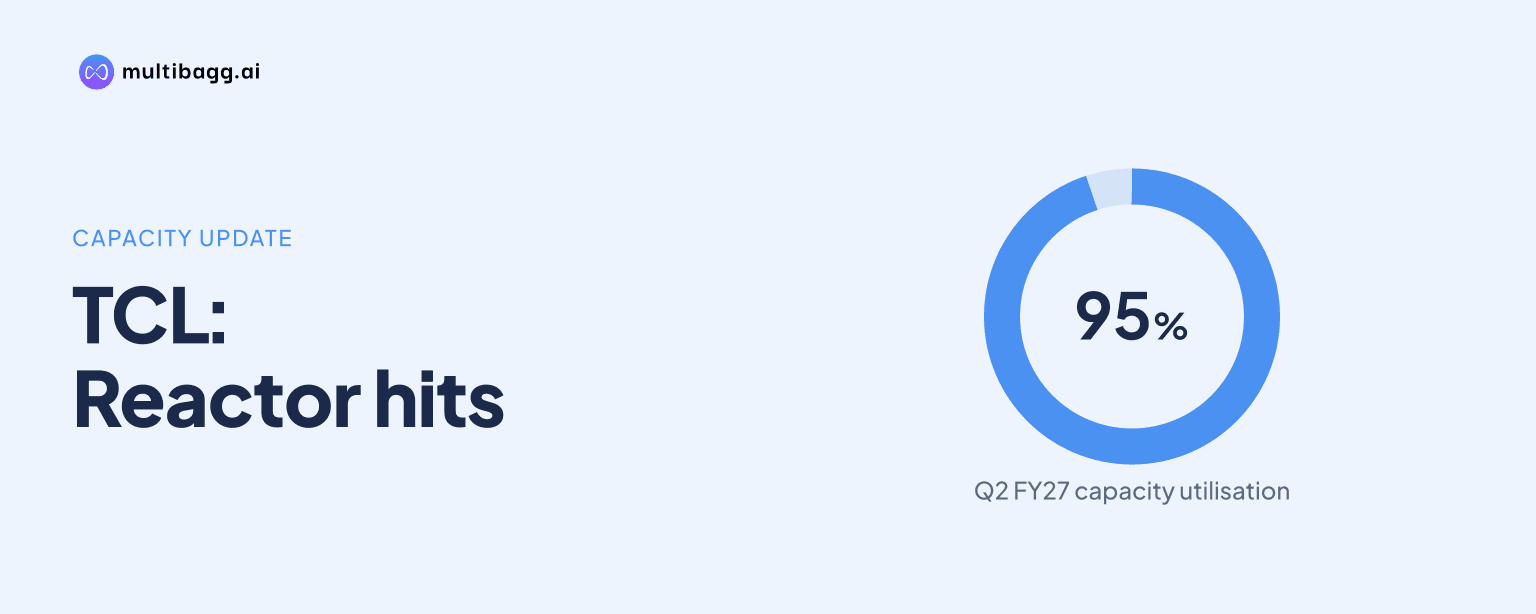
Thirumalai Chemicals Ltd. reported 95% capacity utilisation at its Dahej Phthalic Anhydride reactor in Q2 FY27, when the site also achieved its highest flaking rate of 305 tonnes per day and produced a record 335 metric tonnes of Fumaric Acid in September. The company said new certifications enabled it to serve all application segments.
Know Thirumalai Chemicals inside out
Results, valuation, peers and who's buying, in one view.
How did TCL's Dahej reactor perform in Q2 FY27?
TCL's Dahej Phthalic Anhydride reactor operated at 95% capacity utilisation in Q2 FY27 and achieved its highest flaking rate of 305 tonnes per day. The company reported both operating measures for its Dahej site, identified in the presentation as TCLIPL, alongside the September Fumaric Acid production record of 335 metric tonnes.
The 95% figure measures utilisation of the reactor's available capacity, while 305 tonnes per day is the reported flaking-output rate. TCL did not disclose the reactor's nameplate capacity or quarterly Phthalic Anhydride production in the update. As a result, the reported utilisation cannot be converted into a quarterly production volume from the supplied information.
Phthalic Anhydride prices strengthened in Q2 FY27 as raw-material costs increased and product availability remained tight, according to TCL. The company said higher prices affected customer buying and procurement patterns. Export performance remained resilient despite competition from China and Taiwan, although shipping constraints and higher freight costs continued to influence trade flows.
The Q2 operating record came after the Government of India extended anti-dumping duties on Phthalic Anhydride imports for another five years. TCL said the extension provided continued trade protection to the domestic industry. Ortho-Xylene prices, a relevant raw-material market factor, remained influenced by crude oil, global aromatics dynamics, geopolitical tensions and supply constraints during the quarter.
What changed in TCL's food-acid operations?
TCL expanded the addressable application segments for its Dahej food-acid operation through ISO, KOSHER, Halal and Food Safety and Standards Authority of India, or FSSAI, certifications. The company said these certifications enabled it to cater to all application segments, while Fumaric Acid production reached a monthly high of 335 metric tonnes in September.
The presentation does not provide certification dates, customer numbers, segment revenue or sales volumes associated with the four certifications. It does distinguish the Dahej Fumaric Acid record from Phthalic Anhydride operations: the 335-metric-tonne measure is monthly production in September, whereas 95% utilisation and 305 tonnes per day refer to the Dahej Phthalic Anhydride reactor.
At Ranipet, TCL's Malic Acid plant operated at 13 tonnes per day in Q2 FY27. The company cited energy-cost efficiency, consistent domestic demand and a favourable product mix. Ranipet also recorded 100% first-pass quality and completed an FSSC 22000 Version 6 audit, while its large Phthalic Anhydride reactor operated consistently following re-catalyzation and achieved its expected yield.
TCL prioritised Fumaric Acid sales towards the domestic market in Q2 FY27 because freight costs were elevated. Additional supplies from its D2 site, TCL IPL, supported domestic customer requirements. This differed from the Phthalic Anhydride business, where TCL continued exports despite competition from China and Taiwan and higher freight costs.
Got a follow-up? Ask IRIS
How did Q2 FY27 operations compare with TCL's financial results?
TCL's standalone profit after tax turned to Rs 12 crore in Q2 FY27 from a Rs 13 crore loss in Q2 FY26, even as standalone total income declined to Rs 360 crore from Rs 372 crore. Earnings before interest, tax, depreciation and amortisation, or EBITDA, increased to Rs 50 crore from Rs 11 crore over the same comparison.
The consolidated comparison was different. Total income rose by Rs 152 crore to Rs 606 crore and EBITDA increased by Rs 43 crore to Rs 48 crore in Q2 FY27. However, consolidated profit after tax remained a loss of Rs 34 crore, compared with a Rs 33 crore loss in Q2 FY26.
For H1 FY27, standalone total income was Rs 700 crore against Rs 820 crore in H1 FY26, while standalone EBITDA rose to Rs 101 crore from Rs 18 crore. Standalone profit after tax was Rs 26 crore compared with a Rs 27 crore loss. Consolidated total income increased to Rs 1,156 crore from Rs 902 crore, EBITDA reached Rs 84 crore from a Rs 20 crore loss, and the consolidated loss after tax narrowed to Rs 78 crore from Rs 93 crore.
What does TCL expect for Phthalic Anhydride and food acids in Q3 FY27?
TCL expects Phthalic Anhydride prices to ease gradually in Q3 FY27, which management said may improve buying activity. Management identified paints and unsaturated polyester resin, or UPR, as the key expected demand drivers, following the Q2 period in which higher prices influenced procurement decisions.
Management also expects continuing focus on the Middle East and Africa, together with emerging European opportunities, to support Phthalic Anhydride exports. TCL cited diversified sourcing and evolving trade opportunities as the mechanisms. This outlook follows Q2 FY27 export conditions shaped by Chinese and Taiwanese competition, shipping constraints and higher freight costs.
For food acids, management said the Maleic Acid contract season had customer enquiries of approximately 3,000 metric tonnes and was expected to improve order visibility. TCL said flexible production planning and premium-order execution would support margins across food acids. It also expects firm global Maleic Anhydride prices and spot-based orders to support Fumaric Acid realisations, while retaining a domestic-market focus.
Management expects recovery in Folpet production, improved Saccharin demand and a gradual revival in dyes and intermediates to support Q3 sales of approximately 1,950 metric tonnes. TCL also said secured institutional contract volumes for diethyl phthalate, or DEP, and potential new domestic and export customers could support volume growth. These are management expectations, not reported Q3 results.
Conclusion
TCL's Q2 FY27 update links high Dahej operating activity with broader food-acid market access: the Phthalic Anhydride reactor reached 95% utilisation, flaking reached 305 tonnes per day and September Fumaric Acid output reached 335 metric tonnes. Separately, standalone profit after tax moved to Rs 12 crore from a Rs 13 crore loss, although the consolidated result remained a Rs 34 crore loss.
The next disclosed markers are whether Phthalic Anhydride buying activity responds to gradually easing Q3 prices, whether approximately 3,000 metric tonnes of Maleic Acid enquiries improve order visibility, and whether overall Q3 sales reach approximately 1,950 metric tonnes. TCL's stated plans also include domestic Fumaric Acid opportunities and Phthalic Anhydride export activity in the Middle East, Africa and Europe.

