










KKCL H1 FY27 PAT rose 19% as apparel realisations improved
Key highlights
- KKCL’s H1 FY27 PAT rose 19% year on year to Rs 94 crore.
- H1 FY27 revenue from operations increased 11% to Rs 652 crore and EBITDA increased 19% to Rs 133 crore.
- Apparel realisation rose to Rs 881 per unit from Rs 869, while quantity sales fell to 86 lakh units from 88 lakh.
- KKCL reported 675 EBO stores in Q2 FY27 after adding five stores during the quarter.
powered by IRIS
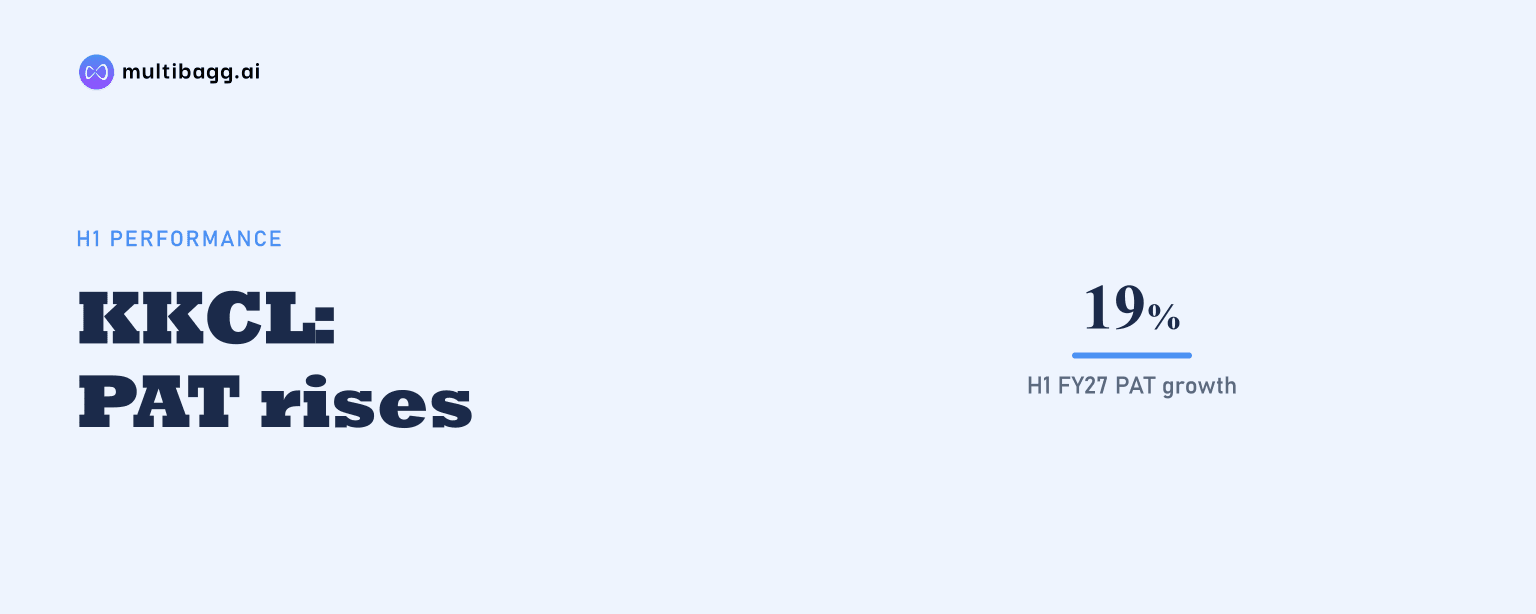
Kewal Kiran Clothing Limited reported H1 FY27 profit after tax of Rs 94 crore, up 19% year on year, as operating revenue rose 11% to Rs 652 crore and apparel sales realisation increased to Rs 881 per unit from Rs 869 despite volume sales declining to 86 lakh units from 88 lakh units.
Know Kewal Kiran Clothing inside out
Results, valuation, peers and who's buying, in one view.
How did KKCL perform in H1 FY27?
KKCL’s H1 FY27 profit after tax, or PAT, increased by Rs 15 crore to Rs 94 crore from Rs 79 crore in H1 FY26, while the PAT margin rose to 14% from 13%. Revenue from operations increased by Rs 64 crore to Rs 652 crore, compared with Rs 588 crore a year earlier. The reported earnings increase was faster than revenue growth, with PAT rising 19% against an 11% revenue increase.
Earnings before interest, tax, depreciation and amortisation, or EBITDA, grew 19% to Rs 133 crore in H1 FY27 from Rs 113 crore in H1 FY26. EBITDA margin increased by 1 percentage point to 20%, while profit before tax rose 18% to Rs 123 crore and its margin moved to 18% from 17%. Gross profit increased 13% to Rs 280 crore, and gross profit margin improved to 43% from 42%.
Did higher realisations offset lower unit volumes for KKCL?
KKCL sold 86 lakh units in H1 FY27, down from 88 lakh units in H1 FY26, while apparel sales realisation rose by Rs 12 per unit to Rs 881. The reported figures show that revenue growth occurred despite a 2 lakh-unit decline in total quantity sales. Apparel’s share of total quantity sold also increased to 83% from 73%, changing the mix of units sold toward apparel.
Accessories realisation rose by Rs 41 per unit to Rs 153 in H1 FY27 from Rs 112 in H1 FY26. The presentation does not disclose revenue by apparel and accessories, so it does not quantify each category’s contribution to the Rs 64 crore increase in H1 sales. It does show that both apparel and accessories recorded higher per-unit realisation while total volumes fell.
In Q2 FY27, the volume movement was larger. Quantity sales were 47 lakh units, versus 55 lakh units in Q2 FY26, while apparel realisation increased to Rs 904 per unit from Rs 861. Accessories realisation moved to Rs 156 per unit from Rs 108, and apparel units formed 84% of quantity sales, compared with 71% a year earlier.
Which costs and margins changed in H1 FY27?
KKCL’s H1 FY27 EBITDA margin rose to 20% from 19% as cost of goods sold represented 57% of net sales, compared with 58% in H1 FY26, and selling and distribution expense fell as a share of sales. Cost of goods sold increased by Rs 32 crore to Rs 372 crore, but its share of Rs 652 crore net sales declined by 1 percentage point. That movement coincided with the 1 percentage-point improvement in gross profit margin to 43%.
Selling and distribution expense declined by Rs 1 crore to Rs 28 crore in H1 FY27 from Rs 29 crore, reducing its sales share to 4% from 5%. Employee expense increased to Rs 92 crore from Rs 84 crore, remaining 14% of sales, while administrative and other expense increased to Rs 26 crore from Rs 22 crore and stayed at 4% of sales. The lower cost-of-goods and selling-and-distribution ratios offset those increases in absolute operating expenses.
The Q2 comparison also showed a margin change. Q2 FY27 EBITDA was Rs 80 crore, up 12% from Rs 71 crore, on revenue of Rs 373 crore, up 5% from Rs 354 crore. Cost of goods sold accounted for 57% of Q2 sales versus 58% a year earlier, while selling and distribution expense represented 5% rather than 6%, lifting EBITDA margin to 21% from 20%.
Got a follow-up? Ask IRIS
How did KKCL’s product and channel mix shift?
KKCL’s H1 FY27 sales mix shifted away from jeans and trousers and toward other categories, with jeans accounting for 48% of sales compared with 50% in H1 FY26. Trousers declined to 9% from 11%, while shirts were unchanged at 21%. T-shirts increased to 8% from 7%, and the others category expanded to 13% from 11%.
Retail represented 57% of H1 FY27 sales, up from 54% in H1 FY26, while non-retail declined to 43% from 46%. KKCL defines retail as exclusive brand outlets, or EBOs, plus large-format stores, or LFS. Its non-retail category includes multi-brand outlets, e-commerce, factory outlets and exports, but the presentation does not provide sales values for these individual channels.
KKCL reported 675 EBO stores in Q2 FY27, compared with 670 in Q1 FY27, indicating a net addition of five stores during the quarter. The presentation separately lists four additions in Q1 FY27 and five in Q2 FY27. This retail-channel expansion occurred as the retail sales share increased by 3 percentage points in the H1 comparison.
What changed in KKCL’s balance sheet by September 2026?
KKCL’s total assets increased to Rs 1,610 crore as at September 2026 from Rs 1,496 crore as at March 2026, led by current assets rising to Rs 1,096 crore from Rs 943 crore. Trade receivables increased by Rs 85 crore to Rs 406 crore, inventories rose by Rs 14 crore to Rs 272 crore and cash and cash equivalents increased by Rs 81 crore to Rs 257 crore. Current investments, however, declined to Rs 106 crore from Rs 136 crore.
Total equity increased by Rs 83 crore to Rs 1,202 crore as at September 2026, including other equity of Rs 950 crore against Rs 876 crore at March 2026. Current liabilities rose to Rs 337 crore from Rs 286 crore, with trade payables increasing to Rs 142 crore from Rs 99 crore. Borrowings were Rs 46 crore at September 2026, down from Rs 48 crore, while non-current liabilities declined to Rs 71 crore from Rs 91 crore.
Conclusion
KKCL’s H1 FY27 results show that profit increased faster than sales: PAT rose 19% to Rs 94 crore while revenue rose 11% to Rs 652 crore. Higher apparel and accessories realisations, a larger apparel share of units sold, lower cost of goods sold as a share of sales and lower selling-and-distribution intensity coincided with EBITDA margin rising to 20% from 19%, even as total unit volume fell to 86 lakh.
The next operating measures to watch are whether apparel realisation, which reached Rs 904 per unit in Q2 FY27, remains above the Rs 861 reported in Q2 FY26, and whether volumes recover from 47 lakh Q2 units versus 55 lakh a year earlier. Store-network execution is also unresolved after KKCL reported five EBO additions in Q2 FY27, taking the total to 675 stores.