










Kody secures Medigo manufacturing rights with contracted volumes
Key highlights
- Kody's three-year Medigo agreement makes it the exclusive worldwide manufacturer of four screening-robot variants.
- The Medigo agreement includes binding minimum purchases across biennial commercial periods, although Kody did not disclose unit volumes.
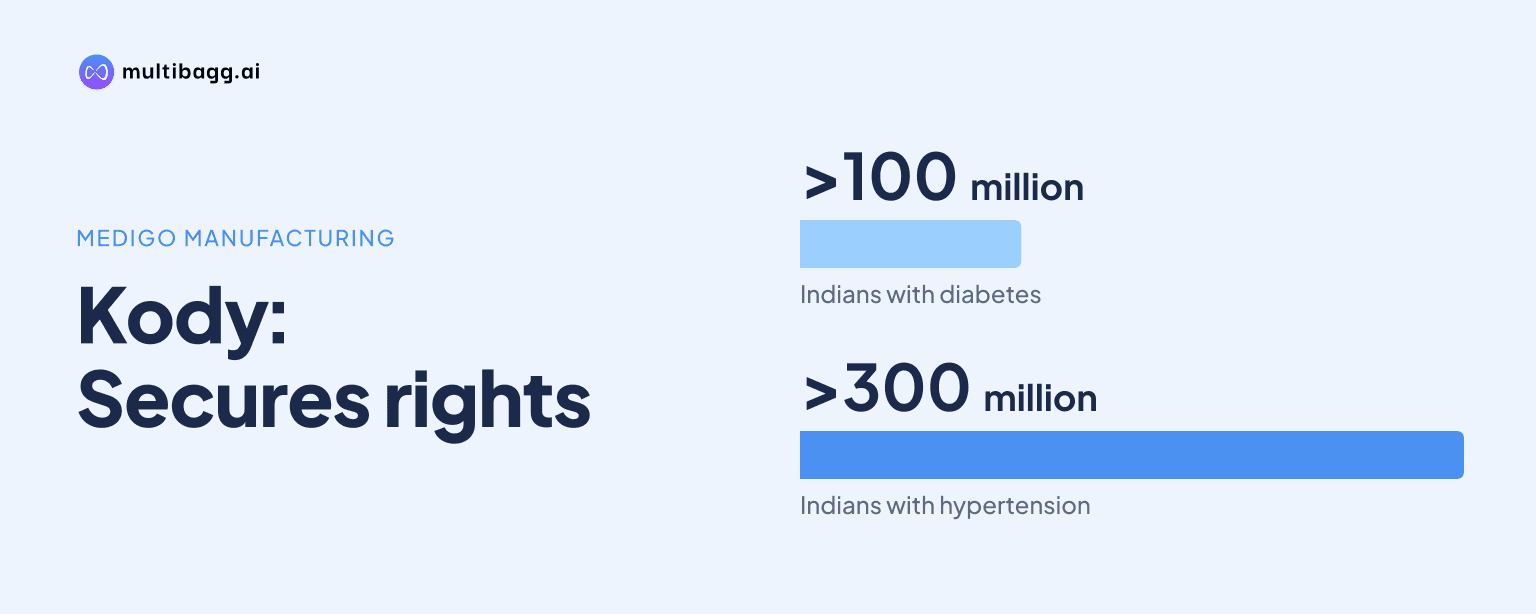
- Kody cites more than 100 million Indians with diabetes and more than 300 million with hypertension.
- Potential Medigo recurring revenue includes future per-screening charges and replenishment of testing consumables.
powered by IRIS
Kody secured exclusive worldwide manufacturing rights for the four-product Medigo range in a three-year agreement entered in June, with binding minimum purchases across biennial commercial periods. The arrangement gives Kody contracted hardware volumes for its healthcare-robotics entry, while screening charges and consumable replenishment are described as future usage-linked opportunities.
Know Kody Technolab inside out
Results, valuation, peers and who's buying, in one view.
What does Kody's Medigo agreement cover?
Kody is the exclusive worldwide manufacturer of the full Medigo range under a tripartite agreement entered in June. The agreement covers Medigo Static, Medigo Kids, Medigo Women and Medigo Mobile, while Kody's joint venture Falcon Tech Robotics holds exclusive global distribution rights. Kody's diagnostic partner has the clinical and commercialisation responsibilities, separating production from distribution and clinical delivery.
The agreement runs for three years and includes a binding minimum purchase framework arranged across biennial commercial periods. Kody says the committed volumes allow it to plan manufacturing capacity, supply-chain needs and costs against confirmed demand. This differs from a speculative product launch because Kody says it is entering the medical-screening segment with contracted volumes rather than first building inventory and waiting for customer orders.
The four-product design is intended to apply one robotics and engineering base across different care settings. Kody identifies its existing capabilities as mechanical design, embedded electronics, autonomous operation, artificial intelligence, or AI, and production discipline. Kody says these capabilities were developed under one roof and are now being applied to health screening rather than representing a separate manufacturing platform.
Why is Medigo a healthcare-robotics entry for Kody?
Medigo is Kody's healthcare-robotics entry because it is designed for autonomous point-of-care screening in locations where conventional diagnostic access can be limited. Kody identifies schools, workplaces, public areas and remote communities as intended deployment settings, with the Mobile variant addressing areas lacking fixed infrastructure. Its stated aim is to take screening to people rather than requiring travel to a diagnostic centre.
The need cited by Kody is tied to non-communicable diseases in India. Kody says such diseases account for 60% of deaths in India, compared with less than 53% under a decade earlier. It also cites a national study by the Indian Council of Medical Research, or ICMR, estimating that more than 100 million Indians have diabetes and more than 300 million have hypertension, with many people undiagnosed.
Kody frames the constraint as reach rather than medical knowledge. Its Medigo proposition is fast, autonomous screening that can operate at scale where trained staff and diagnostic infrastructure are scarce. That framing is relevant because the product line contains both fixed and mobile machines: a fixed unit can serve a regular site, while the mobile version is configured for communities without a permanent screening location.
How does Kody's manufacturing position extend beyond India?
Kody's manufacturing position extends beyond India because its rights apply worldwide to every Medigo unit, rather than to one national market. Falcon Tech Robotics has exclusive global distribution rights, and the diagnostic partner is responsible for clinical and commercialisation work. If Medigo enters additional geographies, Kody says the resulting manufacturing volume would feed the same production line.
This structure gives Kody a role in the product's global expansion without assigning it direct responsibility for every distribution or clinical activity. Management says higher volumes can reduce unit costs while expanding Kody's participation as the product's footprint grows. That is a manufacturing-scale argument, not a disclosed forecast for Medigo sales, country launches or profitability.
The agreement also gives Kody field exposure it says is valuable during an initial healthcare rollout. Machines operating in different locations can provide usage patterns, clinical feedback and regulatory experience across jurisdictions. Kody says this information can show what users and markets value in practice, while the first committed hardware volumes establish the installed base from which later revenue mechanisms may develop.
Got a follow-up? Ask IRIS
Will Medigo create recurring revenue for Kody?
Medigo is designed to create recurring revenue over time, but Kody says hardware is the first revenue leg and the recurring components will build only as units are deployed and used. Each screening may be charged at pre-fixed rates in the future, according to the presentation, while testing consumables require replenishment. Neither mechanism is presented as immediate revenue from the first shipment.
The distinction matters because the binding minimum purchase framework supports the manufacturing phase, whereas screening fees and consumables depend on utilisation of the installed fleet. Kody says its current priority is getting units deployed, operating and trusted. Management is still working through the monetisation model internally, reflecting the clinical and operational requirements of a healthcare category.
Kody also identifies longer-term product possibilities without making a near-term forecast. The test panel may widen, and the AI layer may deepen as the product gains field data. Kody says aggregated and anonymised screening data could eventually help health authorities understand the regional and community distribution of non-communicable diseases, but it explicitly says these possibilities are not forecasts for the current year.
What could Medigo add to Kody's wider manufacturing plan?
Medigo could add demand to Kody's wider manufacturing plan because the company says every unit sold globally would be built by Kody. Kody currently makes around 200 robots a month and says phase one of its new facility will raise capacity to 1,000 robots a month in FY27. The facility is intended to manufacture Kody's entire robot range, including Medigo, Odigo and Vulcan.
The new site's 12,000-robots-a-month figure is a design ceiling rather than its opening production rate. Kody says the 200,000 square foot layout has been planned so capacity can be added in phases as demand develops, rather than committing to the full scale immediately. The company also says it will continue working alongside manufacturing partner WEMS.
For Medigo, the binding minimum-purchase framework provides a demand base that Kody says can inform capacity, supply-chain and cost planning. However, the presentation does not disclose Medigo order volumes, production schedules, purchase values or the proportion of the new facility that would be allocated to health-screening products. Those undisclosed details limit any assessment of the agreement's immediate manufacturing contribution.
Conclusion
Kody's Medigo arrangement gives it a defined manufacturing role in a new healthcare-robotics category, supported by a three-year agreement and binding minimum purchases. The four-variant range targets fixed facilities, schools, women's health settings and communities without fixed infrastructure, while the division of duties gives Falcon Tech Robotics global distribution and a diagnostic partner clinical and commercialisation responsibilities.
The next point to watch is deployment and operating experience, because Kody says recurring screening charges and consumables revenue depend on an installed base that is in use. Investors will also need to assess progress on Kody's internally developing monetisation model, the pace of Medigo's geographical expansion, and whether additional test panels or AI capabilities move from stated longer-term possibilities into disclosed commercial plans.