










Kody Technolab H1 revenue nearly doubled as margin fell
Key highlights
- Kody Technolab reported H1FY27 revenue from operations of Rs 62.50 crore, up 97.30% year on year.
- Kody Technolab’s H1FY27 PAT was Rs 5.20 crore and its PAT margin was 8.33%, versus 14.14% in H1FY26.
- Kody Technolab sold 191 Odigo units in H1FY27, compared with 59 units in H1FY26.
- Kody Technolab reported advertising revenue of Rs 2.20 crore in H1FY27, compared with nil a year earlier.
powered by IRIS
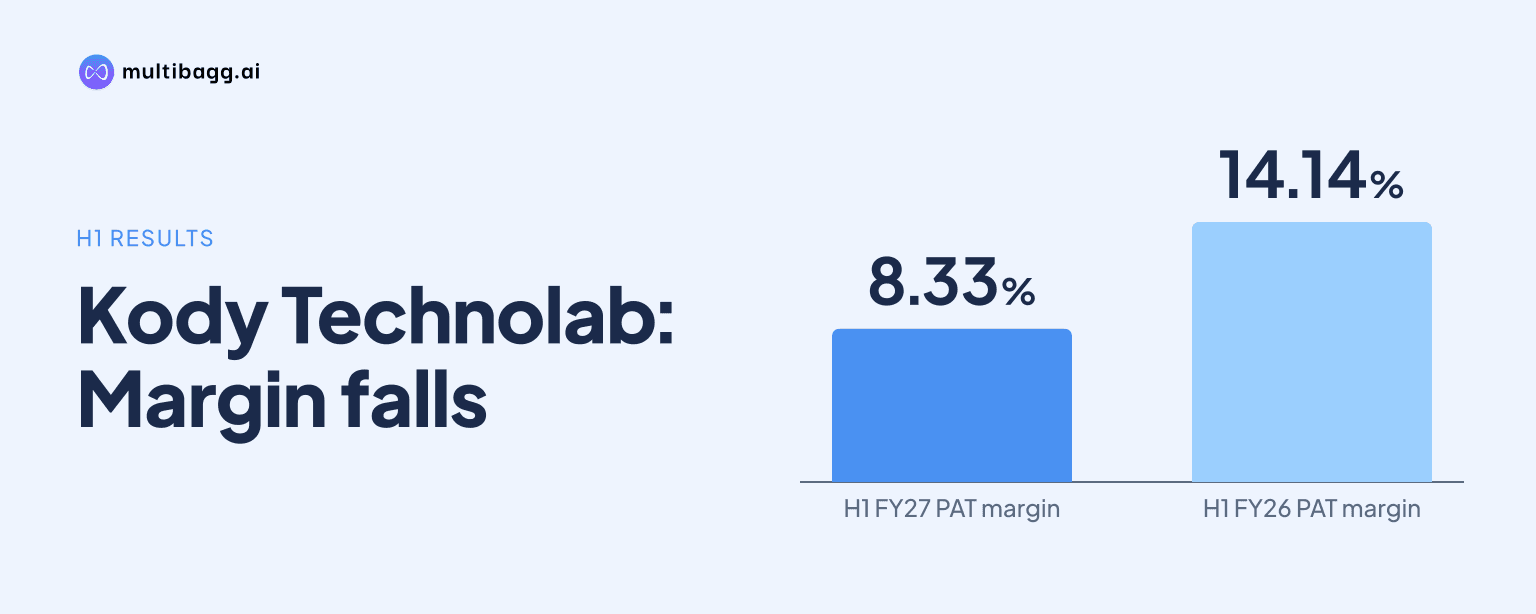
Kody Technolab Limited reported consolidated H1FY27 revenue from operations of Rs 62.50 crore, up 97.30% year on year, while profit after tax margin fell to 8.33% from 14.14% as it funded upfront Odigo deployment costs under an advertising revenue-share model. Management expects advertising from deployed assets to begin contributing more in H2FY27.
Know Kody Technolab inside out
Results, valuation, peers and who's buying, in one view.
How did Kody Technolab perform in H1FY27?
Kody Technolab nearly doubled consolidated revenue in H1FY27, reaching Rs 62.50 crore for the half year ended September 30, 2026. Earnings before interest, tax, depreciation and amortisation, or EBITDA, increased 53% year on year to Rs 14.53 crore, equal to a 23.25% margin, while profit before tax rose 25% to Rs 5.21 crore.
Profit after tax, or PAT, was Rs 5.20 crore and represented 8.33% of revenue, compared with a 14.14% PAT margin in H1FY26. Revenue growth therefore outpaced the growth in profit before tax, reflecting the cost timing associated with Odigo deployments as described by management.
Odigo generated Rs 23.75 crore of revenue, up 49.37% year on year, as unit sales rose to 191 from 59 in H1FY26. Revenue from Vulcan, Medigo and other robots was Rs 12.24 crore, compared with Rs 4.5 crore in the prior-year half, with management saying Vulcan was being sold to some of the same customers and buildings as Odigo.
Why did Kody Technolab’s PAT margin decline?
Kody Technolab says its PAT margin declined because it increasingly deployed Odigo robots under an advertising revenue-share model rather than selling them outright. Under that model, deployment, transportation, installation, on-ground support and depreciation costs are recognised when a robot goes live, while related advertising income is expected to be earned over the following three years.
Management said it made a substantial number of these deployments in H1FY27. That means the half included the full initial cost of assets that had generated relatively little advertising revenue at the reporting date, contributing to the comparison between the 8.33% H1FY27 PAT margin and the 14.14% margin reported for H1FY26.
The company distinguishes this consolidated effect from its standalone business, where management said PAT margin was broadly unchanged year on year. It said this occurred despite investment in research and development, teams across geographies, marketing and business development, which management described as expansion spending.
Kody Technolab has not disclosed a numerical PAT-margin target. Management said it does not expect the decline to continue because deployment costs do not recur for the same asset, operating and business-development expenses are expected to remain broadly steady, and advertising revenue from H1FY27 deployments should increase from H2FY27.
Got a follow-up? Ask IRIS
What does Odigo contribute to Kody Technolab’s model?
Odigo contributed Rs 23.75 crore in H1FY27 revenue and operates as both a robot product and an advertising asset in Kody Technolab’s model. Sales of 191 units in H1FY27 were more than three times the 59 units sold in H1FY26, while management said sales cycles had shortened after Indian mall operators adopted the product.
The advertising model is supported by the deployed fleet. Kody Technolab reported more than 150 Odigos in the United Arab Emirates, or UAE, and more than 50 in India, including installations at LuLu hypermarkets, BurJuman and Dubai Outlet Mall in the UAE, and Jio World Drive, DLF Mall of India and LuLu Mall in India.
Total advertising revenue was Rs 2.20 crore in H1FY27, compared with nil in H1FY26. Management said India led advertising revenue during the half, while the LuLu Retail network in the UAE had gone live and remained at an earlier stage of commercial monetisation; campaigns from more than five global brands were running on that network.
Odigo uptime was above 95%, according to Kody Technolab, and management plans to add H2FY27 features including product explanation, cross-selling and visitor guidance. It expects the India Odigo fleet to reach 200 to 250 units by the end of H2FY27, which is a management expectation rather than a reported deployment outcome.
What could change in H2FY27 for Kody Technolab?
Kody Technolab expects H2FY27 to include more advertising monetisation from robots installed during H1FY27. In India, Kody Media appointed 3rd Eye Media Works as exclusive agency partner to monetise advertising inventory across Odigo robots in premium malls, while its LuLu Retail in-store advertising network in the UAE is already live.
Management said UAE advertising realisation per robot is materially higher than in India and that it is prioritising expansion into further LuLu hypermarkets. Kody Technolab closed H1FY27 with more than 300 robots deployed across India and the UAE, and entered H2FY27 with a deployment pipeline of more than 500 units across India, the UAE and the wider Gulf Cooperation Council, or GCC.
The company also said its first commercial shipment of medical robotics was scheduled for Q3FY27 after it had shipped demonstration units and refined the product using feedback. Certification was progressing across markets with differing requirements, and management said the first commercial shipment was slightly later than originally planned because medical robotics is a regulated category.
Deployment timing remains a disclosed uncertainty for H2FY27. Kody Technolab said site readiness and partner schedules can shift deployments and revenue between periods, while regional disruption during H1FY27 constrained exports to the UAE and slowed scheduled deployments; management said the UAE plan was delayed rather than cancelled and that deployments were back on track.
Conclusion
Kody Technolab’s H1FY27 results show a change in revenue mix and cost timing rather than a simple comparison of sales and margin. Revenue rose 97.30% to Rs 62.50 crore, Odigo sales increased to 191 units from 59, and advertising revenue reached Rs 2.20 crore from nil, while the PAT margin fell to 8.33% as the company funded upfront deployment costs for advertising assets.
The next point to watch is management’s H2FY27 plan to monetise assets already deployed, including the live LuLu Retail network in the UAE and the 3rd Eye Media Works arrangement in India. Other disclosed milestones are execution against the more than 500-unit deployment pipeline, the planned Q3FY27 medical-robotics shipment and the management target of taking India’s Odigo fleet to 200 to 250 units by the end of H2FY27.