










KPI Green Energy takes IPP and large solar EPC role
Key highlights
- KPI Green Energy is assigned IPP projects in solar, wind, FDRE and RTC at all capacities.
- KPI Green Energy will execute solar and solar-led EPC projects above 50 MW.
- Sun Drops Energia is assigned all BESS EPC work and solar or hybrid EPC projects up to 50 MW.
- KP Group targets 10 GWp of owned generation, 10 GWp of EPC and 10 GWh of storage by FY32.
powered by IRIS
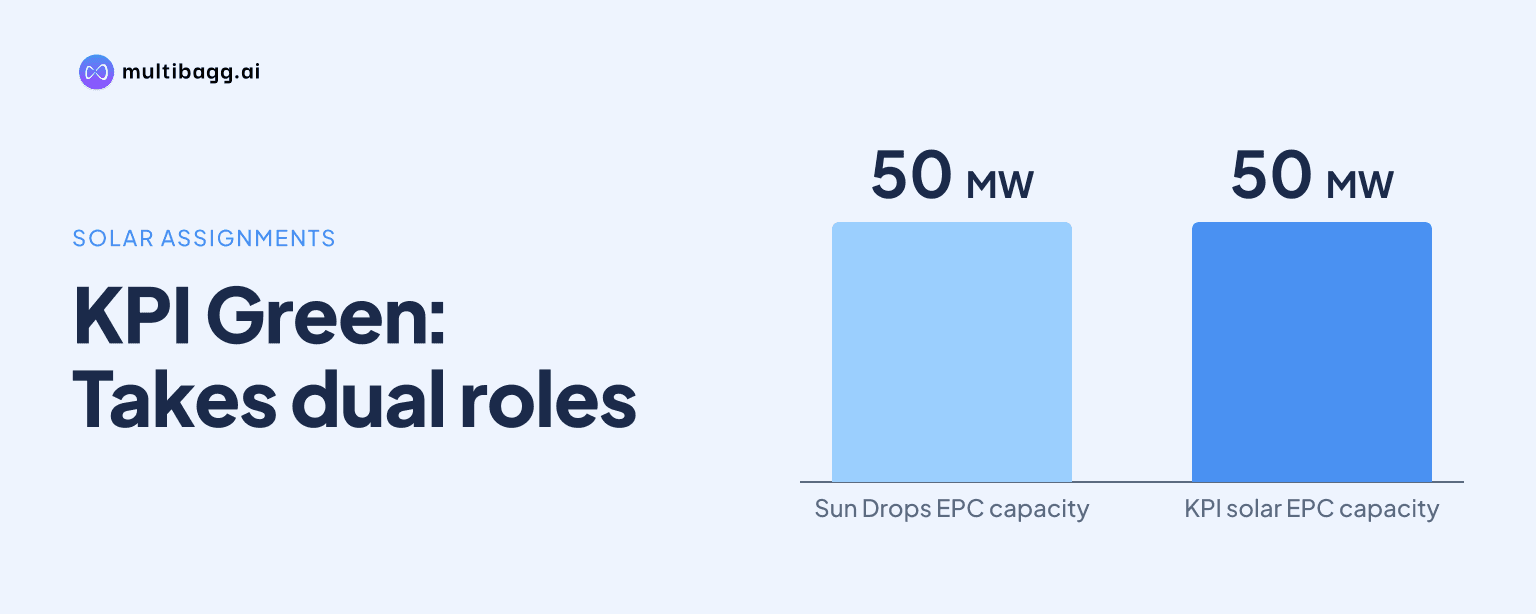
In the Q2 FY27 realignment, KPI Green Energy Limited was assigned independent power producer, or IPP, projects at all capacities and solar and solar-led engineering, procurement and construction, or EPC, work above 50 megawatts (MW). The allocation supports KP Group’s FY32 target of 10 gigawatt-peak (GWp) of owned generation.
Know KPI Green Energy inside out
Results, valuation, peers and who's buying, in one view.
What does the realignment assign to KPI Green Energy?
KPI Green Energy will be KP Group’s IPP-focused platform for solar, wind and the presentation’s FDRE and RTC project categories at all capacities. The group’s structure therefore separates asset ownership from the 50 MW EPC boundary, allowing KPI Green Energy to house IPP projects below as well as above that threshold.
For EPC, KPI Green Energy will execute solar projects above 50 MW and solar-led hybrid, FDRE and RTC projects above 50 MW. A solar-led project is one in which solar represents more than 50% of total project capacity, making both project size and generation mix relevant to the allocation.
The Q2 FY27 presentation identifies KPI Green Energy as the group’s flagship IPP platform and a listed company. It distinguishes this role from KP Energy’s wind EPC mandate, KP Green Engineering’s 23-product design, engineering, fabrication and galvanisation business, and Sun Drops Energia’s storage and smaller-project activities.
Which businesses go to KP Energy and Sun Drops Energia?
KP Energy will be the dedicated wind EPC platform for wind projects at all capacities, including wind balance-of-plant work for group IPP projects. It also receives wind-led hybrid, FDRE and RTC EPC projects above 50 MW, where wind accounts for more than 50% of total capacity.
The structure assigns the wind portion of all hybrid orders to KP Energy. This applies alongside KPI Green Energy’s role as lead EPC platform for solar-led projects above 50 MW, meaning a single hybrid order can involve separate group entities according to its wind component and lead technology.
Sun Drops Energia will undertake solar EPC projects up to 50 MW and all hybrid, FDRE and RTC EPC projects up to 50 MW. The presentation identifies Sun Drops Energia as a subsidiary of KPI Green Energy, while maintaining the 50 MW cutoff for its solar and hybrid EPC allocation.
Sun Drops Energia is assigned all battery energy storage system, or BESS, EPC work, including storage for group companies and BESS within FDRE or RTC projects, at all capacities. It is also assigned standalone BESS IPP, group-captive IPP, BESS assembly and cell manufacturing, giving it responsibility across storage EPC, storage assets and manufacturing.
Got a follow-up? Ask IRIS
How does the 50 MW rule allocate EPC orders?
The 50 MW rule directs solar EPC above 50 MW to KPI Green Energy, while solar EPC of up to 50 MW goes to Sun Drops Energia. For hybrid, FDRE and RTC EPC projects above 50 MW, the lead technology decides the principal platform: solar-led work goes to KPI Green Energy and wind-led work goes to KP Energy.
The allocation does not place every component of a hybrid project with one entity. On solar-led projects above 50 MW, KPI Green Energy is the lead EPC platform, but the wind portion is assigned to KP Energy. KP Energy also performs wind balance-of-plant work for group IPP and captive projects at all capacities.
BESS follows a different mechanism from the 50 MW solar split. Sun Drops Energia is designated for all BESS EPC, including BESS within FDRE and RTC projects, while its standalone BESS IPP and group-captive IPP responsibilities are also stated for all capacities.
The presentation states that inter-company transactions under the structure will be on an arm’s-length basis. That disclosure is relevant because a hybrid order above 50 MW may combine KPI Green Energy’s solar-led EPC role with KP Energy’s wind-component execution, while Sun Drops Energia can provide BESS EPC in FDRE or RTC configurations.
What FY32 targets frame the new operating structure?
KP Group’s KP 3.0 plan sets committed FY32 targets of 10 GWp of owned generation, 10 GWp of EPC and 10 gigawatt-hours (GWh) of battery storage. The presentation labels the owned-generation target as IPP by KPI Green Energy, third-party EPC excluding related parties, and storage spanning cell manufacturing to BESS assembly.
The group reports 10.6 GW of group capacity and more than 32 years of history on its overview page. Its 10 GWh storage target aligns with Sun Drops Energia’s manufacturing assignment, while the 10 GWp EPC target is explicitly limited to third-party EPC rather than related-party work.
KPI Green Energy’s consolidated net worth was Rs 3,525 crore in H1 FY27, compared with Rs 2,871 crore in H1 FY26, a 23% increase stated in the presentation. Fixed assets rose 125% to Rs 6,993 crore from Rs 3,102 crore, while total assets and liabilities increased to Rs 12,037 crore from Rs 6,164 crore.
Cash flow from operating activities rose to Rs 406 crore in H1 FY27 from Rs 270 crore in H1 FY26, which the presentation states was a 50% increase. Investing cash outflow was Rs 1,482 crore versus Rs 1,172 crore, financing cash inflow was Rs 1,183 crore versus Rs 974 crore, and ending cash and cash equivalents were Rs 224 crore versus Rs 192 crore.
Conclusion
The Q2 FY27 structure makes KPI Green Energy the group’s IPP vehicle for solar, wind, FDRE and RTC at all capacities, while limiting its EPC mandate to solar and solar-led projects above 50 MW. KP Energy receives wind EPC and wind-led large hybrid work, while Sun Drops Energia holds BESS, group-captive and smaller solar or hybrid EPC responsibilities.
The next disclosed milestone is KP Group’s FY32 plan for 10 GWp of owned generation, 10 GWp of third-party EPC and 10 GWh of battery storage. Future project disclosures can show how the 50 MW threshold, the more-than-50% solar or wind test, and arm’s-length inter-company arrangements are applied in practice.