










Sun Drops Energia Limited targets 10 GWh BESS and cells by FY31
Key highlights
- Sun Drops targets 10 GWh each of BESS assembly and cell manufacturing by FY31.
- Sun Drops lists 5 GWh of BESS assembly in FY28 and 1,000 containers of annual output.
- Sun Drops lists 5 GWh of cell production in FY29 and 5 million cells of annual output.
- Sun Drops reports 565 MW and 1,130 MWh of BESPAs executed.
powered by IRIS
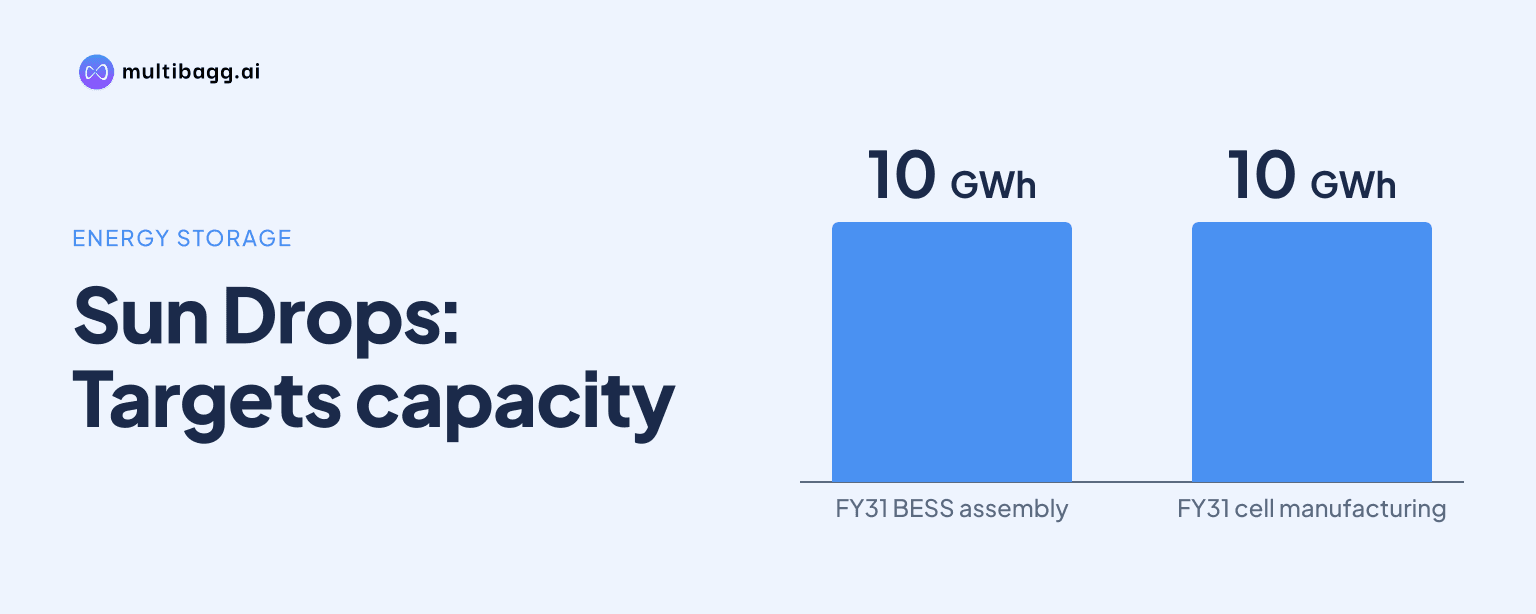
Sun Drops Energia Limited is targeting 10 GWh of BESS assembly and 10 GWh of cell manufacturing at a Gujarat campus by FY31, following planned 5 GWh BESS assembly in FY28 and 5 GWh cell production in FY29. The presentation says design, hiring and equipment ordering are under way.
Know KPI Green Energy inside out
Results, valuation, peers and who's buying, in one view.
What capacity is Sun Drops targeting by FY31?
Sun Drops is targeting 10 GWh of battery energy storage system, or BESS, assembly capacity and 10 GWh of cell-manufacturing capacity by FY31. The presentation describes the FY31 configuration as “10 GWh + 10 GWh” at one integrated energy-solution campus in Gujarat, rather than as a single 20 GWh BESS assembly line.
A gigawatt-hour, or GWh, is an energy-capacity measure, while BESS refers to battery systems that store electricity for later release. Sun Drops presents the programme under its battery-storage growth platform, where it also reports executed BESS power capacity of 565 megawatts, or MW, and energy capacity of 1,130 megawatt-hours, or MWh, through BESPAs.
The manufacturing target is set against a cited India BESS requirement of 236 GWh by FY32. Sun Drops’ FY31 plan therefore covers two linked activities, assembly and cell production, each with a stated 10 GWh capacity target, while the cited national requirement is an external opportunity figure for the following financial year.
What is Sun Drops’ manufacturing schedule from FY28 to FY31?
Sun Drops schedules 5 GWh of BESS assembly in FY28, 5 GWh of cell production in FY29 and 10 GWh each of BESS and cell capacity in FY31. The presentation also identifies FY28 as the planned BESS SOP year, although it does not define SOP or provide a commissioning date within FY28.
The disclosed sequence puts BESS assembly ahead of cell production by one financial year. For FY28, Sun Drops gives an annual output measure of 1,000 containers; for FY29, it lists 5 million cells annually and 314 ampere-hour, or Ah, and 576 Ah cell specifications. The FY31 entry combines both activities at the Gujarat campus.
The presentation does not disclose capital expenditure, equipment-delivery timing, construction dates, manufacturing ramp rates or customer allocations for the FY28, FY29 or FY31 stages. It also does not state whether the FY29 cell output will supply the FY28 BESS assembly operation, despite placing both capacities at the same campus.
Got a follow-up? Ask IRIS
What work has Sun Drops disclosed for the Gujarat campus?
Sun Drops says design has been engaged, a team has been hired and an equipment order has been placed for the programme. These three actions are listed under “Execution in motion” alongside the FY28, FY29 and FY31 capacity stages, but the presentation provides no hiring count, equipment supplier or order value.
The campus has about 110 acres of land with RED permission, according to the presentation. Sun Drops identifies the land, the planned 10 GWh BESS capacity and the planned 10 GWh cell capacity together as the basis for an integrated site, without disclosing land cost, the meaning of RED permission or further permission milestones.
The one-campus structure contrasts with the separate activity stages: 5 GWh BESS assembly is listed for FY28 and 5 GWh cell production for FY29, before the 10 GWh-plus-10 GWh configuration in FY31. Sun Drops does not disclose battery chemistry, even though it lists 314 Ah and 576 Ah cell specifications for the FY29 stage.
How does Sun Drops’ manufacturing plan relate to its BESS portfolio?
Sun Drops reports BESPAs executed at 565 MW and 1,130 MWh, while separately planning 10 GWh of BESS assembly by FY31. The executed portfolio is expressed in both power and energy terms, whereas the factory roadmap uses GWh capacity and annual outputs such as 1,000 containers in FY28.
The wider company presentation lists BESS at 0.57 GW within a total 8.33 GW portfolio. A gigawatt, or GW, measures power capacity, while the 10 GWh manufacturing target measures energy capacity, so the 0.57 GW portfolio measure cannot be directly compared with the FY31 10 GWh assembly target.
Sun Drops describes BESS as battery banks that store surplus solar or wind power and release it on demand. The FY28-to-FY31 programme extends the disclosed battery activity from executed BESS arrangements to assembly and cell manufacturing, but the presentation does not state how much factory output would serve internal projects, BESPAs or external customers.
Conclusion
Sun Drops has set out a phased Gujarat manufacturing plan that begins with 5 GWh of BESS assembly in FY28, adds 5 GWh of cell production in FY29 and targets 10 GWh each of BESS and cell capacity by FY31. The plan sits alongside 565 MW and 1,130 MWh of executed BESPAs and a cited 236 GWh India BESS requirement by FY32.
The next disclosed milestones are the FY28 BESS SOP and the FY29 cell-production stage, with stated annual outputs of 1,000 containers and 5 million cells respectively. Sun Drops has disclosed land of about 110 acres, design engagement, hiring and an equipment order, while capital expenditure, commissioning dates, technology details and customer commitments remain undisclosed.