










Kranti Industries Limited H1 revenue rises 21% while EBITDA falls
Key highlights
- Kranti’s H1 FY27 revenue rose 21.4% to Rs 50.6 crore from Rs 41 crore in H1 FY26.
- Kranti’s H1 FY27 gross margin increased to 51.9% from 45.6%, while EBITDA margin fell to 13.2% from 17.3%.
- Kranti reported Q2 FY27 profit after tax of Rs 56 lakh after a Rs 5 lakh loss in Q1 FY27.
- Kranti management expects Jaipur to contribute around Rs 9 crore to Rs 10 crore of revenue in FY27.
powered by IRIS
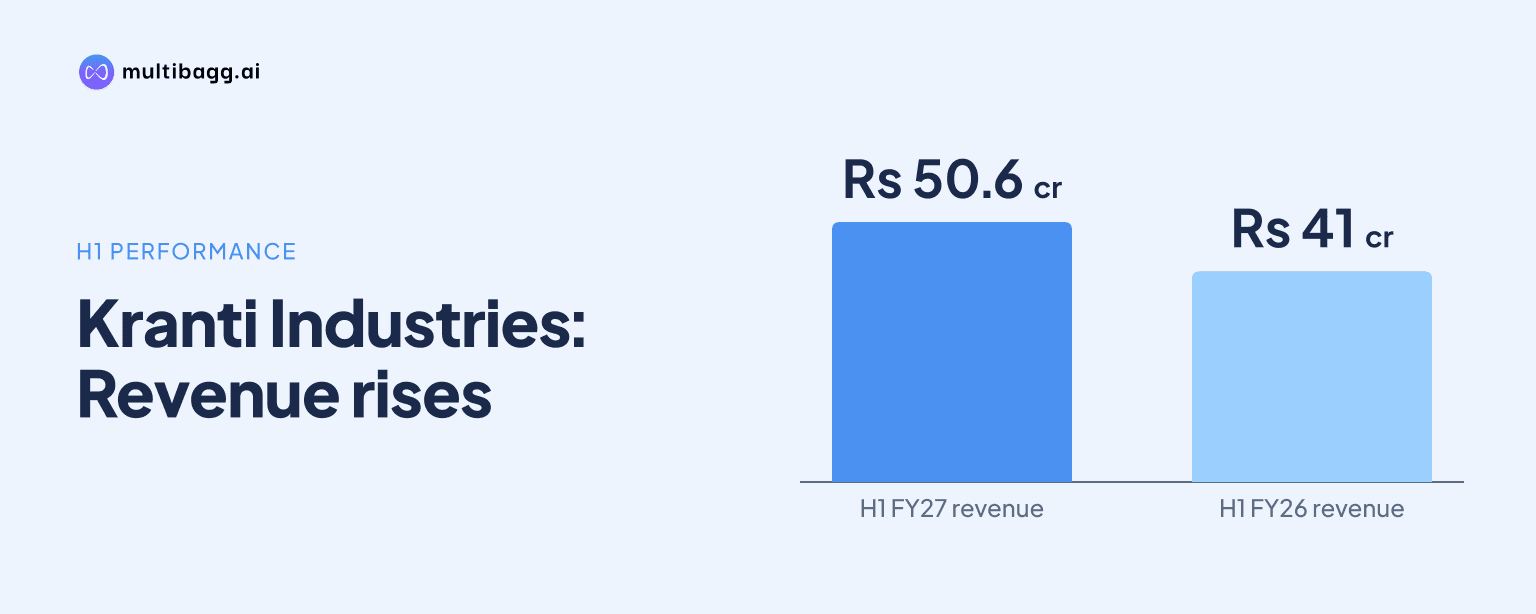
Kranti Industries Limited reported H1 FY27 revenue growth of 21.4% to Rs 50.6 crore, but EBITDA declined to Rs 6.68 crore from Rs 7.23 crore despite gross margin expanding by 630 basis points to 51.9%. Management said fixed costs, finance costs and rising depreciation continued to affect overall profitability.
Know Kranti Industries inside out
Results, valuation, peers and who's buying, in one view.
How did Kranti perform in H1 FY27?
Kranti increased revenue and gross profit in H1 FY27, while EBITDA and profit before depreciation and tax declined from H1 FY26. Revenue from operations rose to Rs 50.6 crore from Rs 41 crore, while gross profit increased to Rs 26.28 crore from Rs 19.02 crore. Gross margin improved to 51.9% from 45.6% in the prior-year period.
Kranti’s gross-profit growth outpaced its revenue growth, but that improvement did not translate into higher EBITDA for the six-month period. Gross profit rose 38.2%, compared with revenue growth of 21.4%, while EBITDA margin fell to 13.2% from 17.3%. The gross-margin increase was 630 basis points, where one basis point equals one-hundredth of a percentage point.
Why did Kranti’s EBITDA fall despite higher gross profit?
Kranti’s H1 FY27 EBITDA was lower because the rise in gross profit was accompanied by pressure from the company’s cost structure. EBITDA declined by Rs 0.55 crore to Rs 6.68 crore even as gross profit rose by Rs 7.26 crore to Rs 26.28 crore. Management said fixed costs, finance costs and increasing depreciation costs affected overall profitability during H1 FY27.
The margin comparison shows the distinction between Kranti’s improvement in gross profitability and its operating result. Gross margin rose from 45.6% in H1 FY26 to 51.9% in H1 FY27, while EBITDA margin moved down from 17.3% to 13.2%. Management said its focus is to turn revenue growth into stronger operating profitability through capacity utilisation, operational efficiency and tighter cost management.
Did Kranti return to profit in Q2 FY27?
Kranti returned to profit in Q2 FY27, reporting profit after tax of Rs 56 lakh after a Rs 5 lakh loss in Q1 FY27. Profit before tax was Rs 83 lakh, and profit before depreciation and tax rose 56.5% sequentially to Rs 2.9 crore from Rs 1.85 crore in Q1 FY27. Management described the quarter as a sequential recovery.
Kranti’s Q2 revenue from operations reached Rs 25.16 crore, up 16.4% from Rs 21.6 crore in Q2 FY26, while gross profit increased 33.8% to Rs 13.67 crore. Gross margin improved to 54.3% from 47.2% a year earlier. EBITDA was Rs 3.8 crore, below Rs 4 crore in Q2 FY26 but 32.2% above Rs 2.87 crore in Q1 FY27.
The Q2 margin trend was better sequentially but had not erased the H1 decline against the prior year. EBITDA margin increased to 15.1% in Q2 FY27 from 11.3% in Q1 FY27, a 382-basis-point sequential improvement. However, the H1 EBITDA margin of 13.2% remained below 17.3% in H1 FY26, reflecting the lower first-quarter margin within the half year.
Got a follow-up? Ask IRIS
What is Kranti doing to improve capacity use and margins?
Kranti is prioritising manufacturing utilisation, inventory optimisation, working-capital management and cost discipline to improve margins. Management said Pune was operating at more than 75% utilisation and gave blended utilisation of about 65%. In separate responses, it described Jaipur utilisation as around 65% and around 55%, leaving the disclosed current Jaipur level inconsistent.
Kranti expects the Jaipur plant to move above 75% utilisation, which management described as its break-even level, by the end of the current quarter and the next quarter. Management expects Jaipur to contribute around Rs 9 crore to Rs 10 crore of revenue in FY27 and around Rs 15 crore to Rs 17 crore in the following financial year. The plant had already started operations by the November 18, 2026 earnings call.
Kranti is also targeting a lower inventory cycle from more than 141 business days to at least 121 days, or below 100 days, by the end of FY27. Management said inventory was elevated because of product variety, new product additions and tools. It also said more than 100 products and two categories had been added over the past two years, while work in the defence category had started during the current year.
Conclusion
Kranti’s H1 FY27 results show that higher sales and better gross margins have not yet produced higher half-year EBITDA. Revenue rose 21.4% to Rs 50.6 crore and gross profit rose 38.2% to Rs 26.28 crore, but EBITDA declined to Rs 6.68 crore as management identified fixed costs, finance costs and depreciation as profitability pressures. Q2, however, showed a sequential recovery, including Rs 56 lakh of profit after tax.
The next measures to watch are Jaipur’s progress towards management’s above-75% break-even utilisation expectation, its Rs 9 crore to Rs 10 crore FY27 revenue contribution estimate, and inventory days against the target of 121 days or below 100 days by year-end. Management also said it expects blended EBITDA margin to reach around 17.5% to 18% by the end of FY27 or in the early part of the following year, and plans to release a two-year expansion plan by the end of the current quarter.