










Kranti Industries discloses six facilities and 115 machines
Key highlights
- Kranti Industries reports six modern manufacturing facilities including group companies, while naming three Pune plants and one Jaipur plant.
- Kranti Industries reports more than 115 high-tech production machines and over 450 skilled professionals.
- Kranti Industries' dashboard shows 86.6% OEE, a 97.4% quality rate and total output of 50,824.
- The September 2026 presentation does not disclose 700 metric tonnes of monthly foundry or precision-casting capacity.
powered by IRIS
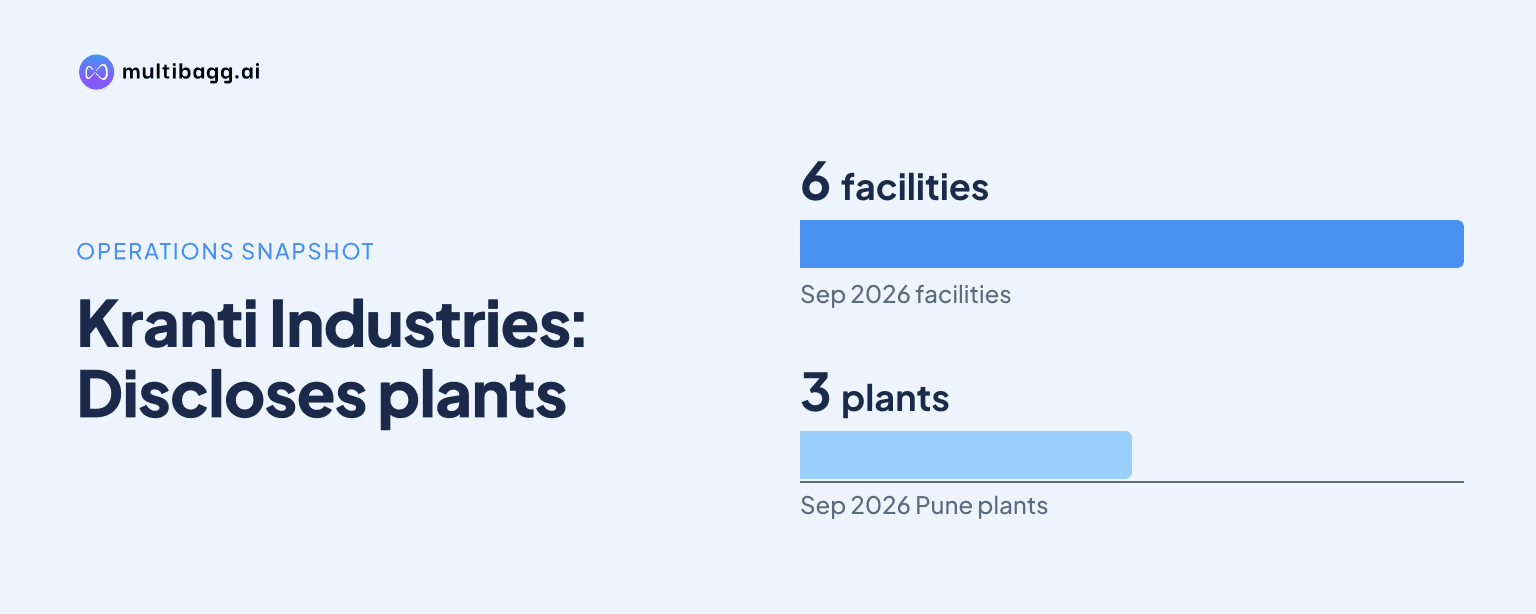
Kranti Industries Limited reports six modern manufacturing facilities, including group companies, and more than 115 high-tech production machines in its September 2026 presentation. The company specifically identifies three Pune plants and one Jaipur plant, while the presentation does not disclose a five-location network or 700 metric tonnes of monthly foundry and precision-casting capacity.
Know Kranti Industries inside out
Results, valuation, peers and who's buying, in one view.
How many manufacturing sites does Kranti Industries disclose?
Kranti Industries discloses six modern manufacturing facilities including group companies, but names only four sites: Plants 1, 2 and 3 in Pune and Plant 4 in Jaipur. The four named plants are presented under Kranti Industries Pvt. Ltd. in the September 2026 investor presentation.
The group-wide total is therefore two facilities higher than the individually identified sites. Kranti Industries does not give the location, activity, ownership structure or capacity of the other two facilities included in its six-facility count.
Pune accounts for three of the four expressly named plants, compared with one in Jaipur. This shows that the disclosed named footprint is concentrated in Pune, although Kranti Industries does not provide plant-wise production volumes, employee numbers or installed capacity for either city.
What equipment does Kranti Industries use in its plants?
Kranti Industries lists 10 equipment categories covering machining, measurement, testing and washing. Its machinery includes five-axis turn-mill machining centres for complex multi-operation work, vertical turret lathes for large and heavy components, and computer numerical control, or CNC, turning centres for diverse parts.
The company also identifies broaching machines, leakage-testing machines, five-axis horizontal machining centres, horizontal machining centres and vertical machining centres. Kranti Industries describes these as equipment for profiles, testing and high-accuracy operations, but does not split its more than 115 machines by equipment type or plant.
Coordinate measuring machines and industrial washing machines complete the disclosed equipment list. The presentation says the production process extends from machining through inspection, testing and washing, but it does not describe a furnace, melting operation or casting line among these 10 categories.
Does Kranti Industries disclose foundry or precision-casting capacity?
No, Kranti Industries does not disclose 700 metric tonnes of monthly foundry or precision-casting capacity in the supplied September 2026 presentation. Its facility pages quantify six manufacturing facilities, more than 115 machines, more than 450 professionals, more than 200 products and annual production of fewer than 1 million parts, rather than casting tonnage.
Kranti Industries says it manufactures components ranging from 100 millimetres to 1,200 millimetres. That is a dimensional range, not a capacity measure, and the presentation gives no monthly output figure, foundry location, precision-casting facility, furnace specification or casting-product mix.
The distinction is material to the description of the network. Vertical turret lathes are identified for large, heavy components and five-axis machining centres for intricate geometries, but the disclosed equipment supports a machining-led description rather than a quantified foundry-and-casting footprint.
Got a follow-up? Ask IRIS
How large is Kranti Industries' disclosed manufacturing platform?
Kranti Industries reports more than 115 high-tech production machines, over 450 skilled professionals and more than 200 diversified products. It also states that it produces fewer than 1 million parts annually and has more than 45 years of manufacturing experience, tracing its origins to 1981.
These figures are group-level operating indicators rather than utilisation measures. Kranti Industries does not disclose annual installed capacity, output by facility, machine-hour availability or the share of production made at the Jaipur plant.
Its historical FY26 standalone revenue mix indicates that tractors were the largest end-market segment at 64.7%, followed by construction equipment at 15.4% and electric vehicles at 5.3%. Commercial vehicles represented 1.2% and agri implements 0.6%, but the presentation does not connect any revenue segment to a particular plant or equipment category.
The 49.3 percentage-point difference between tractors and construction equipment shows the reported concentration of FY26 standalone revenue in tractors. Other categories accounted for 11.5%, while new product development contributed 1.3%, according to the same segment disclosure.
How is Kranti Industries monitoring production digitally?
Kranti Industries describes a connected manufacturing system using enterprise resource planning, CNC-enabled cutting machines, tool-vending machines, multi-gauging systems and digital monitoring. It says shop-floor data are aggregated, validated and processed in real time through management information system dashboards and a smart-factory dashboard.
The dashboard reports overall equipment effectiveness, or OEE, of 86.6%, availability of 93.1%, performance of 91.2% and a quality rate of 97.4%. It also shows total output of 50,824, with OEE up 4.4%, availability up 4.1%, performance up 3.6%, quality up 2.9% and output up 8.7% versus the previous month.
The displayed downtime analysis separates 76.4 planned hours, 46.3 unplanned hours, 23.1 setup or adjustment hours, 18.7 breakdown hours and 12.4 other hours. Kranti Industries identifies condition monitoring, predictive maintenance, machine-health monitoring and production analytics as digital capabilities, but does not state whether the dashboard covers all six facilities.
Conclusion
Kranti Industries presents a group manufacturing platform of six facilities, more than 115 machines and over 450 professionals, with four plants specifically identified across Pune and Jaipur. Its disclosed capabilities cover machining, inspection, testing and washing, while tractors represented 64.7% of historical FY26 standalone revenue and the presentation provides no evidence for the proposed 700-metric-tonne monthly foundry or precision-casting capacity.
What to watch next is whether Kranti Industries resolves the gaps in its September 2026 disclosure by identifying the two facilities beyond the four named plants and supplying plant-level capacity or utilisation measures. The reported dashboard provides a current operating reference point of 86.6% OEE and 50,824 total output, but does not disclose a facility commissioning schedule, expansion target or Jaipur-specific production plan.