










Krsnaa targets 40%-45% cash-based revenue mix in FY27
Key highlights
- Krsnaa targets cash-based PPP projects to contribute 40%-45% of FY27 revenue, versus 35%-38% currently.
- Management aims to return working capital to around 90-100 days over the next two to three years.
- Krsnaa said cash and non-cash projects have similar project-level margins, while cash collections can reduce financing costs.
- Krsnaa's Himachal Pradesh cash-based tender covers 34 CT machines and runs for more than 15 years, according to management.
powered by IRIS
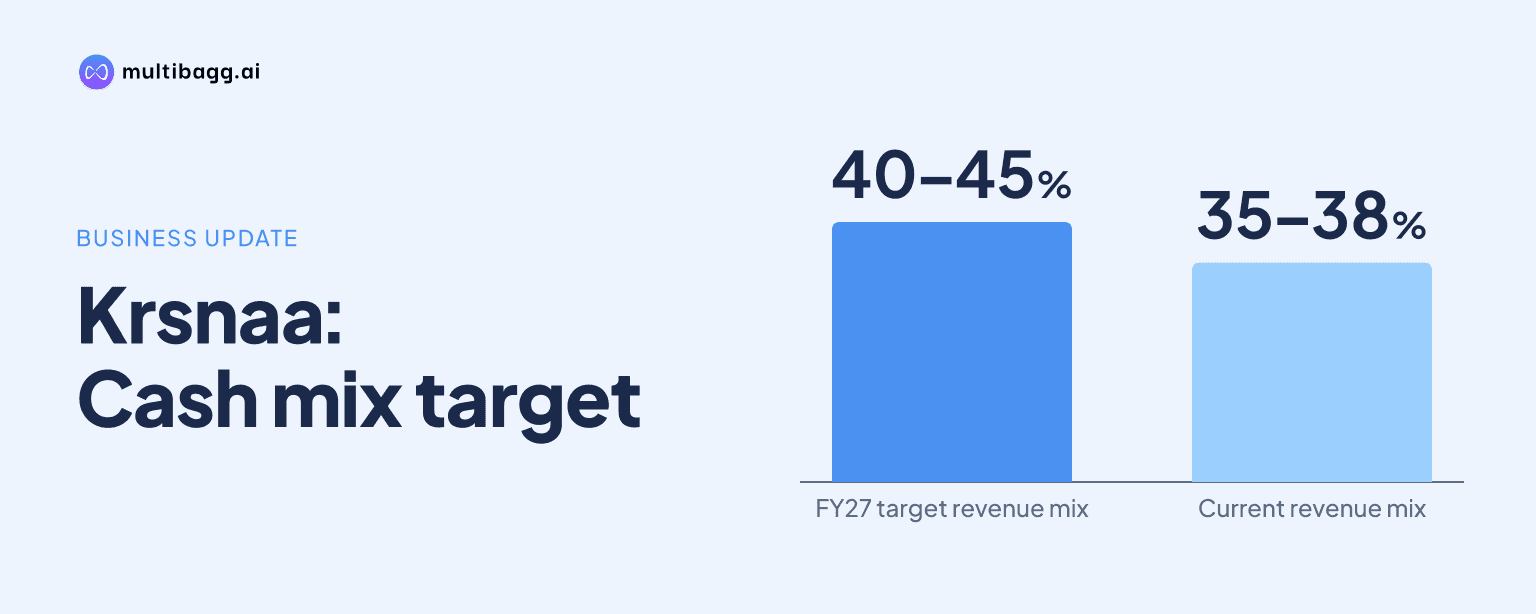
Krsnaa Diagnostics Limited expects cash-based public-private partnership, or PPP, projects to contribute 40%-45% of overall revenue in FY27, up from about 35%-38% currently. Management said the mix shift should reduce working-capital requirements and financing costs, although cash and non-cash projects carry similar margins at the individual-project level.
Know Krsnaa Diagnostics inside out
Results, valuation, peers and who's buying, in one view.
What cash-based revenue mix is Krsnaa targeting in FY27?
Krsnaa is targeting a 40%-45% contribution from cash-based PPP projects to overall revenue in FY27, compared with a current contribution of around 35%-38%. Management made the target in response to an investor question on FY27 and said recently added cash-based PPP projects should help lift the proportion as the wider business grows.
The target implies an increase of at least 2 percentage points from the upper end of the current range and as much as 10 percentage points from its lower end. Management said its initial aspiration had been 50% and that it was working to improve the share further through additional cash-based PPP tenders in the pipeline.
The 40%-45% objective refers specifically to cash-based PPP projects, rather than a separate disclosed target for all cash-generating operations. Krsnaa also identified retail as a growth lever, but management provided retail contribution goals separately, including a double-digit share of total revenue by the end of FY27.
Why is Krsnaa selecting more cash-based PPP projects?
Krsnaa is selecting more cash-based PPP projects because management expects upfront cash collection to reduce working-capital requirements over a one-year period. Mitesh Dave said higher cash receipts could be reused for further investments and operational requirements instead of being tied up in receivables.
Management said the strategy reflects both deliberate tender selection and government preferences. Krsnaa has consciously chosen certain cash-based PPP opportunities, while some governments prefer cash models when they do not have specified government allocations, creating two routes for the cash-project mix to rise from 35%-38%.
The focus is relevant because payment timing differs across states. Management said Assam and Odisha were paying on time, while Maharashtra, Karnataka and Himachal Pradesh had payment delays; after excluding the newly started Rajasthan project, it described residual receivables as primarily overdue in a couple of states.
Rajasthan was excluded from management's residual receivables assessment because invoicing and payment processes take time when a PPP project starts. Management said most Rajasthan revenue started from the first quarter, while 75%-80% of laboratory implementation had been completed and additional laboratories requested by the government were still being implemented.
Will cash-based projects raise Krsnaa's margins and ROCE?
Cash-based and non-cash-based projects have similar margins at the project level, according to Krsnaa. Management said the company-level benefit comes from lower financing costs when cash collections improve, which can add to margin by reducing the cost of funding working capital.
Management linked the cash-business plan to its goal of improving return on capital employed, or ROCE, into the higher teens. Other stated levers include a sale-and-leaseback model and cost optimisation across consumables, reagents and employee costs, though management did not give a date or numerical path for reaching the higher-teens aspiration.
The Rajasthan project shows why higher revenue need not produce a distinct project-margin profile. Krsnaa said fees paid to hospitals and channel partners rise directly with Rajasthan revenue because partners manage operations in the large PPP project, while cost optimisation had kept earnings before interest, taxes, depreciation and amortisation, or EBITDA, margin intact.
Management did not disclose separate EBITDA margins for cash-based PPP projects, non-cash PPP projects or retail. It instead said the financing-cost effect from a larger cash mix could improve company-level margin, distinguishing that effect from similar margins at the individual-project level.
Got a follow-up? Ask IRIS
Which projects can increase Krsnaa's cash-based business?
Krsnaa identified two newly announced cash-based projects: a Himachal Pradesh tender covering 34 computed tomography, or CT, machines, and a positron emission tomography-computed tomography, or PET-CT, project in Punjab. Management described the Himachal Pradesh contracts as tenders of more than 15 years, providing long-term revenue visibility without disclosing their revenue value.
Management said new PPP projects are one of four growth levers, alongside retail expansion, the Apulki strategic tie-up and the ramp-up of existing operations. It said the incremental contribution from the two new tenders and other projects in the pipeline would be shared in coming quarters, rather than providing a revenue split at the time of the call.
Retail is intended to become a second meaningful component of the revenue mix. Krsnaa aims for retail to contribute a double-digit percentage of total revenue by the end of FY27, and management said it was looking toward a higher-teens contribution moving toward 20% or more in the following two to three years.
Management attributed retail volume growth to ground-level activations and an expanded channel network. It said retail prices had increased in some areas, but large Rajasthan PPP volumes lowered blended revenue per test; management nevertheless cited almost 35% year-on-year business growth and expected revenue per test to rise as radiology projects stabilise.
How does the strategy affect Krsnaa's working capital?
Krsnaa is seeking to return working capital to its historical range of around 90-100 days through collections of existing dues and a larger cash-based PPP mix. Management gave this as a two-to-three-year objective while discussing growth of more than 20%, rather than setting a target for an individual quarter.
The collection requirement is material because an analyst noted payables had increased from Rs 63 crore to Rs 230 crore. Krsnaa said this balance included trade creditors as well as creditors related to project enhancement and capital items, but did not provide a breakdown between Rajasthan partners, equipment suppliers and regular suppliers.
Management said it had received confirmations and assurances from government authorities and expressed strong confidence that collections would occur in the third quarter, or Q3. It also acknowledged that payments expected during the preceding weeks had been delayed, making the stated Q3 collection expectation a management view rather than a reported collection outcome.
A greater cash-based mix could reduce the need to finance receivables, but it does not eliminate execution risk in new projects. Krsnaa said Rajasthan was a key driver of test volumes, while its lower PPP pricing reduced blended revenue per test and partner fees rose with revenue as the project ramped up.
Conclusion
Krsnaa's proposed move from a 35%-38% cash-based PPP revenue share to 40%-45% in FY27 is primarily a cash-conversion and funding strategy rather than a claim of higher project-level margins. Management expects the resulting reduction in financing costs and working-capital requirements to support company-level economics, alongside retail growth and the 34-machine Himachal Pradesh project.
The next disclosed milestones are management's Q3 collection expectation, progress toward the 90-100-day working-capital range over two to three years, and possible announcements on further cash-based PPP tenders. Investors can also watch execution of the Punjab PET-CT project, completion of the remaining 20%-25% of Rajasthan laboratory implementation and retail's path to a double-digit revenue contribution by the end of FY27.