










Krsnaa targets Rs 200 crore Q3 collections amid receivables
Key highlights
- Krsnaa reported receivables of approximately Rs 470 crore at September 30, 2026.
- Management has visibility on around Rs 200 crore of potential Q3 FY27 collections.
- Krsnaa expects cash-based revenue of approximately Rs 400 crore, or 40% to 45% of FY27 revenue.
- Q2 FY27 revenue rose 32% to Rs 271 crore, while EBITDA margin declined to 27% from 29%.
powered by IRIS
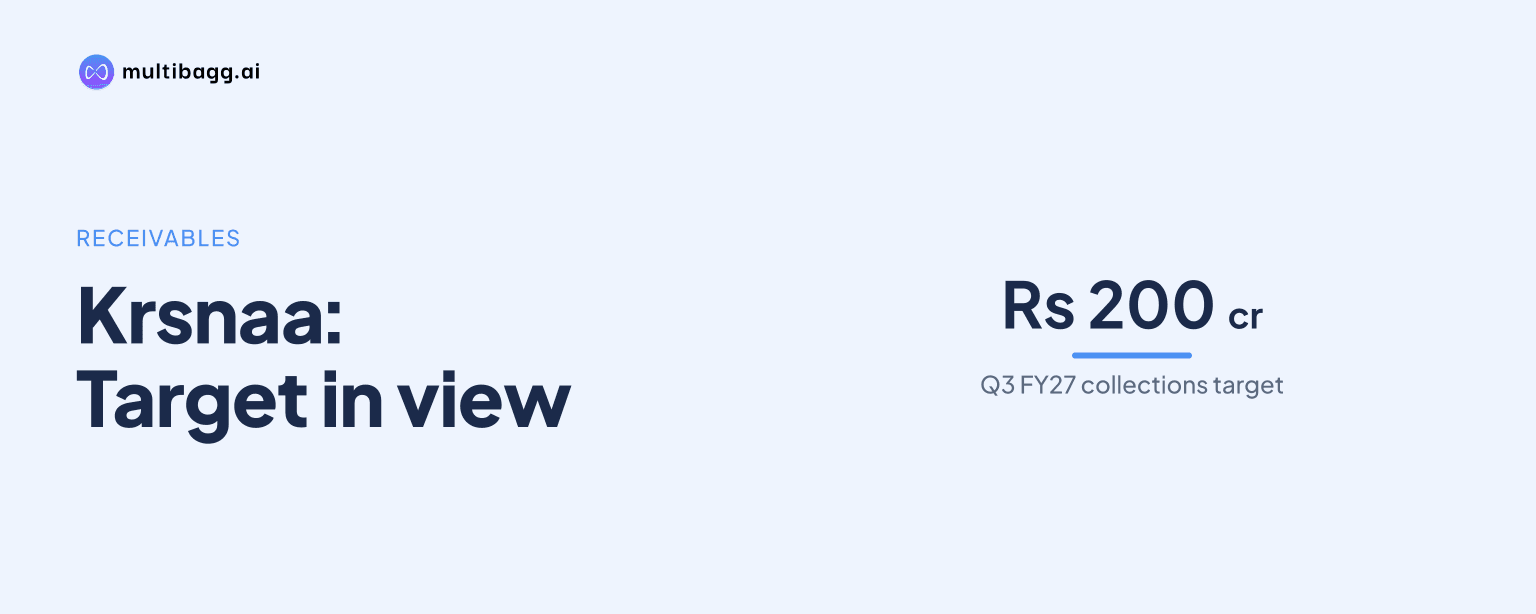
Krsnaa Diagnostics Limited has visibility on about Rs 200 crore of potential collections in Q3 FY27 after receivables reached approximately Rs 470 crore on September 30, 2026. Krsnaa said government fund-allocation and payment-disbursement delays extended its collection cycle, while management cited confirmations and assurances from authorities supporting its collection expectation.
Know Krsnaa Diagnostics inside out
Results, valuation, peers and who's buying, in one view.
Why did Krsnaa’s receivables reach Rs 470 crore?
Krsnaa’s receivables rose to approximately Rs 470 crore at September 30, 2026, because of business expansion and delays in fund allocation and payment disbursements by certain government authorities. Management acknowledged that the collection cycle had extended and identified improving collections as one of its highest priorities.
The newly started Rajasthan project also contributed to the balance because its invoicing and payment process was still being established. Management said this process takes time in a public-private partnership, or PPP, model, and added that receivables excluding Rajasthan were primarily overdue amounts in a couple of states.
Krsnaa named Maharashtra, Karnataka and Himachal Pradesh as states where there were certain payment delays. In contrast, management said Assam and Odisha were paying on time. The Rs 470 crore balance therefore includes both initial billing associated with Rajasthan and delayed payments in specific state contracts rather than delayed payments across all operations.
How much does Krsnaa expect to collect in Q3 FY27?
Krsnaa has visibility on potential collections of around Rs 200 crore during Q3 FY27, based on ongoing discussions and communications with state-government authorities. Management said some payments expected in the preceding weeks had been delayed, but it expressed strong conviction that collections would occur in the quarter.
The Rs 200 crore figure is management’s collection expectation, not a reported collection or a contractual guarantee. Senior management said it was directly engaging with relevant authorities and monitoring collections across major projects. It also said Q3 collections have historically been relatively higher, while stressing its efforts to recover dues during the quarter.
A Rs 200 crore collection would represent about 43% of the Rs 470 crore receivables reported at September 30. However, Krsnaa did not provide a closing receivables target, a state-wise collection schedule, or the project-level composition of the expected collection amount.
How is Krsnaa changing its revenue mix to manage working capital?
Krsnaa expects cash-based revenue to contribute about 40% to 45% of FY27 revenue, aggregating to approximately Rs 400 crore. Management said the current cash-based share was around 35% to 38%, and linked the planned increase to retail growth, cash-based PPP projects and a selective approach to new tenders.
Management said some governments prefer cash models when they do not have specified government allocations, while Krsnaa is also consciously selecting certain cash-based PPP opportunities. It cited two awarded cash-based projects: 34 computed tomography, or CT, machines in Himachal Pradesh and a positron emission tomography-computed tomography, or PET-CT, project in Punjab.
Krsnaa said cash-based and non-cash-based projects have similar project-level margins. At the company level, management said a greater cash mix can reduce the financing-cost element and lower working-capital requirements. It is also pursuing additional cash PPP tenders, although the call did not disclose award dates or potential revenue from those opportunities.
Got a follow-up? Ask IRIS
What do Krsnaa’s Q2 and H1 FY27 results show?
Krsnaa reported Q2 FY27 revenue from operations of Rs 271 crore, up 32% from Rs 206 crore in Q2 FY26, while receivables stood at about Rs 470 crore at the September 30 quarter-end. Management attributed revenue growth to newly operationalised projects, existing operations and the expanding retail network.
Profitability did not rise at the same pace as revenue. Earnings before interest, tax, depreciation and amortisation, or EBITDA, before corporate social responsibility and employee stock-option expenses increased to Rs 72 crore from Rs 60 crore, but the margin fell to 27% from 29%. Profit after tax increased to Rs 25 crore from Rs 24 crore as Krsnaa absorbed upfront costs, depreciation and finance costs from newly implemented projects.
For H1 FY27, revenue rose 27% to Rs 507 crore from Rs 399 crore in H1 FY26. EBITDA before the cited expenses rose to Rs 131 crore from Rs 113 crore, but the margin declined to 26% from 28%, while profit after tax fell to Rs 41 crore from Rs 45 crore. Management attributed the profit moderation to expanded-network costs, depreciation and finance costs.
What could change Krsnaa’s collection profile after Q3 FY27?
Krsnaa’s collection profile could change if the potential Rs 200 crore Q3 FY27 collection converts into cash and the cash-based revenue mix reaches management’s 40% to 45% FY27 expectation. As of Q2 FY27, its network included 259 pathology laboratories, 196 CT and magnetic resonance imaging, or MRI, centres, and more than 8,400 patient touch points.
Retail is part of the company’s push towards cash-generating business. Krsnaa’s retail business generated around Rs 23.5 crore in Q2 FY27, representing about 9% of group revenue and year-on-year growth of approximately 35%. Patient volume grew 45% and test volumes increased 48% during the quarter.
Rajasthan remains important to both receivables and operating leverage. Management said most Rajasthan operating costs and depreciation had already entered the profit and loss account, with additional manpower and consumable costs expected as revenue ramps up. Krsnaa said Rajasthan has potential to generate around Rs 250 crore on an annualised basis, but indicated that most of this contribution should come in the next financial year.
Conclusion
Krsnaa’s near-term working-capital outcome depends on whether its stated Rs 200 crore Q3 FY27 collection visibility converts into cash against the Rs 470 crore receivable balance at September 30, 2026. Revenue growth was 27% in H1 FY27, but the EBITDA margin declined by 2 percentage points to 26%, increasing the importance of collection execution and project utilisation.
The next disclosures to watch are Krsnaa’s reported Q3 collections, the movement in receivables as Rajasthan billing matures, and progress towards the 40% to 45% cash-based FY27 revenue mix. Management also identified cash-based Punjab PET-CT and Himachal Pradesh CT projects, further PPP tenders in the pipeline, and Rajasthan’s next-financial-year annualised revenue potential of around Rs 250 crore.