










Krsnaa retail hits September break-even, targets FY27 EBITDA
Key highlights
- Krsnaa’s retail diagnostics business was operationally break-even in September, the final month of Q2 FY27.
- Krsnaa reported around Rs 23.5 crore of retail revenue in Q2 FY27, up approximately 35% year on year.
- Retail patient volumes rose 45% and test volumes grew 48% in Q2 FY27.
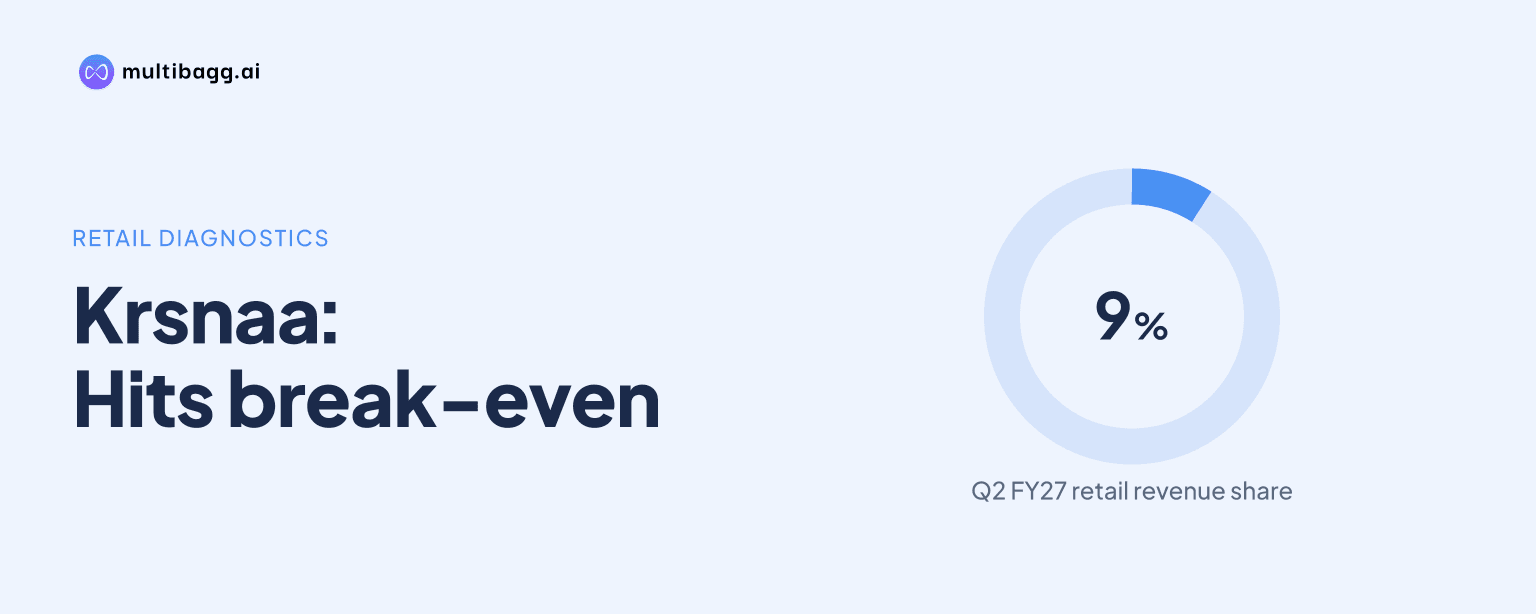
- Retail represented approximately 9% of group revenue, and Krsnaa targets a double-digit contribution by FY27-end.
powered by IRIS
Krsnaa Diagnostics Limited’s retail diagnostics business reached operational break-even in September, the final month of Q2 FY27, after generating around Rs 23.5 crore of quarterly revenue. Management said the unit should reach absolute break-even including marketing costs by Q3 FY27 or early Q4 FY27 and exit FY27 with positive earnings before interest, tax, depreciation and amortisation, or EBITDA.
Know Krsnaa Diagnostics inside out
Results, valuation, peers and who's buying, in one view.
Has Krsnaa’s retail business reached profitability?
Yes, Krsnaa said its retail business was operationally break-even in September, but it has not yet reported full-quarter retail EBITDA profitability after brand and marketing expenditure. Management linked the September milestone to retail network building, consumer engagement and revenue growth, while stating that continued marketing interventions remain necessary to build awareness.
Krsnaa expects absolute break-even, including operating and marketing costs, by Q3 FY27 or early Q4 FY27. Management then expects the retail business to exit FY27 with positive EBITDA, although it did not disclose a standalone quarterly retail profit-and-loss statement, retail EBITDA amount or separate marketing-cost figure.
The retail milestone came as the wider group expanded. Consolidated revenue from operations rose 32% year on year to Rs 271 crore in Q2 FY27 from Rs 206 crore in Q2 FY26, while EBITDA before corporate social responsibility and employee stock option expenses increased to Rs 72 crore from Rs 60 crore. However, the group EBITDA margin declined to 27% from 29% because recently implemented projects carried upfront operating costs.
How fast is Krsnaa’s retail diagnostics business growing?
Krsnaa’s retail business generated around Rs 23.5 crore in Q2 FY27, up approximately 35% year on year, with patient volumes rising 45% and test volumes increasing 48%. Retail accounted for approximately 9% of group revenue during the quarter, making its revenue growth modestly higher than the group’s 32% revenue increase.
Test volumes grew 13 percentage points faster than retail revenue, based on the stated 48% and 35% growth rates. During the call, management said group blended revenue per test had been affected by a larger contribution from lower-priced public-private partnership, or PPP, testing in Rajasthan, while retail pricing had increased in some areas.
Krsnaa said it engaged more than 10,000 people during Q2 FY27 through conferences, webinars and meetings. Wellness camps, digital marketing and improved centre-vending activity were also used to build consumer demand, alongside expansion of preventive and specialised testing in cardiac care, oncology, metabolic health and obesity.
Why can Krsnaa expand retail using its existing network?
Krsnaa’s retail model uses existing laboratories, pathologists, radiologists, logistics and technology, rather than building a separate diagnostic platform from scratch. Management identified this reuse as the operating-leverage mechanism supporting direct-to-consumer expansion, because retail demand can be routed through assets already serving PPP and institutional patients.
At the end of Q2 FY27, Krsnaa’s network comprised 259 pathology laboratories, 196 computed tomography, or CT, and magnetic resonance imaging, or MRI, centres, and more than 8,400 patient touch points. The network covered 334 districts across 19 states and union territories, with approximately 75% of centres in rural areas.
The diagnostic platform also had more than 350 radiologists supporting its 196 CT and MRI centres, 57 National Accreditation Board for Hospitals and Healthcare Providers-accredited pathology laboratories, and 75 National Accreditation Board for Testing and Calibration Laboratories-accredited radiology centres. These assets can support retail expansion, but management’s September break-even comments show that consumer acquisition and brand spending remain additional costs.
Krsnaa did not provide the number of retail centres, a pathology-versus-radiology split for retail revenue, or the cost of retail marketing. As a result, the operational break-even disclosure establishes the direction of retail economics but does not allow a separate assessment of retail margins in Q2 FY27.
Got a follow-up? Ask IRIS
What retail revenue share is Krsnaa targeting by FY27-end?
Krsnaa aims for retail to contribute a double-digit share of total revenue by the end of FY27, compared with approximately 9% in Q2 FY27. Management also said it was looking for retail to reach the higher teens and move towards 20%-plus of group revenue over the next two to three years, describing this as an aspiration rather than a quantified retail revenue forecast.
Retail is part of management’s broader effort to raise cash-based revenue. Krsnaa said the current cash-based share, including retail and cash-based PPP projects, was around 35% to 38% of revenue and is expected to reach 40% to 45% by FY27-end, aggregating to approximately Rs 400 crore for the year.
Management said cash-based PPP projects and retail can reduce working-capital requirements because collections are more immediate than in government-funded PPP contracts. That objective is material because group receivables stood at approximately Rs 470 crore as of September 30, while management said it had visibility on potential collections of around Rs 200 crore during Q3.
The group’s H1 FY27 figures show why management is focused on utilisation and cash generation. Revenue from operations rose 27% to Rs 507 crore from Rs 399 crore in H1 FY26, while EBITDA before corporate social responsibility and employee stock option expenses rose 16% to Rs 131 crore from Rs 113 crore. The EBITDA margin declined to 26% from 28%, and profit after tax fell to Rs 41 crore from Rs 45 crore as the expanded network added operating, depreciation and finance costs.
How does the Rajasthan ramp-up affect Krsnaa’s retail outlook?
Krsnaa said Rajasthan PPP operations are raising group volumes and lowering blended revenue per test because of the project’s pricing, while retail activations are also increasing consumer volumes. Management said 75% to 80% of Rajasthan implementation had been completed, with most laboratories in place and further laboratories requested by the government still being implemented.
Management told analysts that most Rajasthan operating costs and depreciation had already entered the profit and loss account. Incremental manpower and consumable costs will arise as revenue ramps up, but management expects better operating leverage as patient volumes increase and said it was looking for an improvement in group margins from the current 27% Q2 FY27 level.
Rajasthan is therefore a separate driver from retail, but it affects reported group pricing and margins against which retail progress is viewed. Krsnaa expects Rajasthan to have the potential to deliver around Rs 250 crore on an annualised basis, with the majority of that level expected in the next full financial year rather than during the current implementation year.
Conclusion
Krsnaa’s retail business has crossed an operating milestone, reaching September break-even after delivering around Rs 23.5 crore in Q2 FY27 revenue and 45% patient-volume growth. Its ability to use a network of 259 pathology laboratories, 196 CT and MRI centres and more than 8,400 patient touch points provides the infrastructure supporting further retail expansion, while marketing expenditure remains necessary to convert that capacity into consumer demand.
The next measures to watch are management’s planned absolute break-even by Q3 FY27 or early Q4 FY27, followed by positive retail EBITDA at the FY27 exit. Management is also targeting a double-digit retail revenue contribution by FY27-end and a 40% to 45% cash-based revenue mix, while seeking to collect around Rs 200 crore of receivables in Q3.