










LAPL Automotive Limited Reports 4.1% H1 FY27 Revenue Growth
Key highlights
- LAPL Automotive reported H1 FY27 revenue of ₹4,364 lakh, up 4.1% from ₹4,194 lakh a year earlier.
- H1 FY27 EBITDA was ₹633 lakh and EBITDA margin was 14.42%, versus 15.29% in H1 FY26.
- H1 FY27 net profit declined 10.5% to ₹296.82 lakh, with a net profit margin of 6.76%.
- Management expects about 40% FY27 revenue growth and aims for a 14.5% to 15.5% EBITDA margin.
powered by IRIS
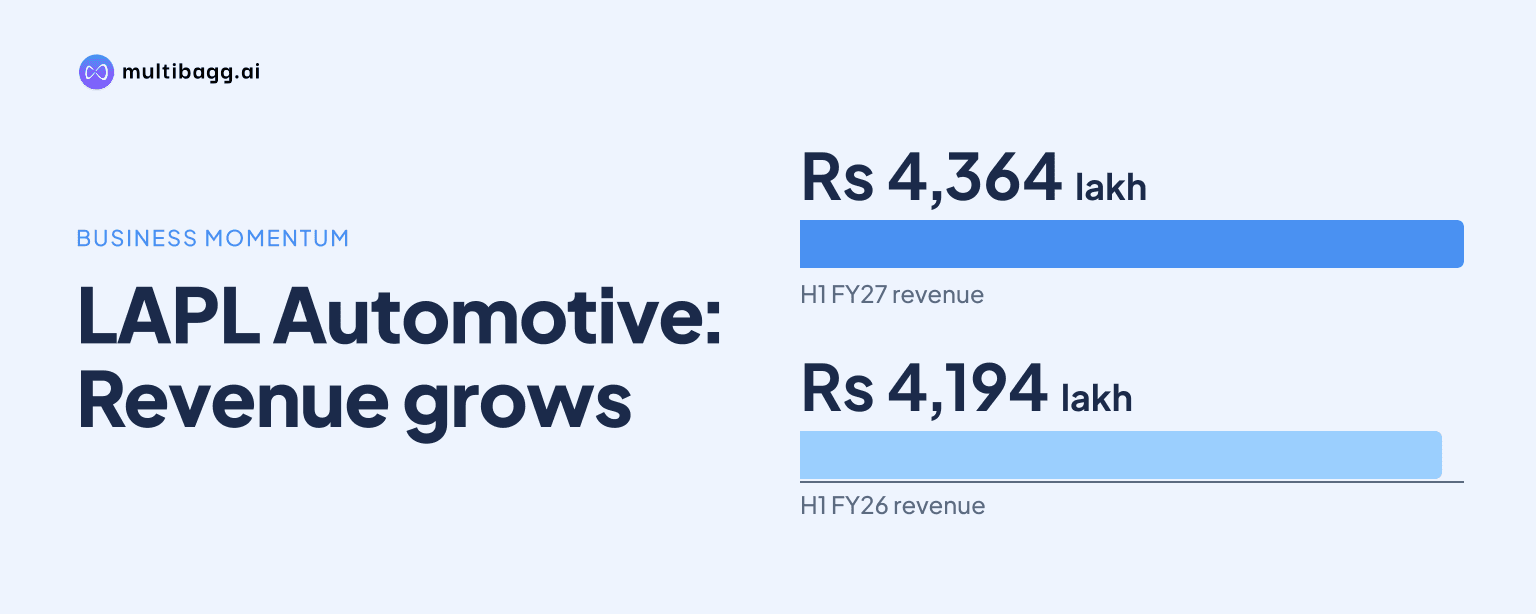
LAPL Automotive Limited reported H1 FY27 revenue from operations of ₹4,364 lakh, a 4.1% year-on-year increase, while net profit declined 10.5% to ₹297 lakh and EBITDA margin stood at 14.42%. The results matter because management is targeting about 40% revenue growth for FY27 despite a modest first-half performance.
Know LAPL Automotive inside out
Results, valuation, peers and who's buying, in one view.
What did LAPL Automotive report for H1 FY27?
LAPL Automotive reported revenue from operations of ₹4,364 lakh for the half year ended September 30, 2026, compared with ₹4,194 lakh in H1 FY26. Total income was ₹4,388.32 lakh. The company said EBITDA was ₹633 lakh, against ₹641 lakh a year earlier, while EBITDA margin declined to 14.42% from 15.29%.
Net profit for H1 FY27 was ₹296.82 lakh, compared with about ₹330 lakh in the corresponding period of the previous year. This resulted in a net profit margin of 6.76%. Earnings per share for the half year was ₹2.97. The reported figures were part of the company's unaudited standalone results for the period.
Why did LAPL Automotive's profit margins decline?
LAPL Automotive management attributed the lower profitability to raw-material costs, hiring and investments related to capacity expansion. EBITDA remained broadly close to the previous year's level, but the slower pace of revenue growth resulted in a lower EBITDA margin during the first half.
Management also said that delays in customer orders and programmes that remain under development affected H1 growth. These factors limited the contribution from business expected from newer customer relationships. The company nevertheless said that the promised order book remains in place, according to the management commentary during its earnings call.
The difference between revenue growth and profit performance is notable. Revenue rose by ₹170 lakh over the previous-year period, whereas EBITDA was ₹8 lakh lower and net profit fell by roughly ₹33 lakh. The H1 numbers therefore reflect pressure on operating profitability while the company continues to spend on people and manufacturing capacity.
What is LAPL Automotive's FY27 growth plan?
LAPL Automotive has indicated that it expects about 40% revenue growth in FY27. Management linked this expectation to OEM partnerships, new vendor codes, electric-vehicle-related products and the progress of its fourth manufacturing facility, referred to as Unit IV.
The company is seeking to expand its automotive-component business across lighting systems, motors, mirrors and other components. Management said the business has developed over more than two decades from a single automotive unit into an integrated manufacturer. It is now pursuing additional OEM opportunities alongside its existing operations.
LAPL Automotive also stated that it aims to sustain EBITDA margin in a range of about 14.5% to 15.5%. Its H1 FY27 margin of 14.42% was just below the lower end of that range. The company's ability to meet the revenue objective will therefore depend on the conversion of delayed customer programmes and the ramp-up of new business during the second half.
Got a follow-up? Ask IRIS
How does the H1 performance compare with LAPL Automotive's recent history?
LAPL Automotive said its FY26 revenue had grown about 41% to ₹9,325 lakh, with an EBITDA margin of 16.75%. Against that base, H1 FY27 revenue growth of 4.1% represents a slower start to the current financial year. H1 revenue of ₹4,364 lakh is also below half of FY26 revenue, making the second half significant for the stated annual growth objective.
The November 18, 2026 call was LAPL Automotive's inaugural earnings call after its BSE listing. As a result, the company noted that detailed historical quarter-by-quarter comparisons from earlier calls are limited. Investors have the H1 financial results, the management commentary and the audio recording of the call as the main disclosed references for assessing the current period.
The company held the virtual investor and analyst interaction on November 18, 2026, following the announcement of its financial results on November 13. Executive Director Shubham Goyal, Managing Director Neeraj Goyal, Finance Manager Rauf Momin, Chief Financial Officer Sunil Dharasurkar and Company Secretary Shubhangi Rajput were among the management representatives identified for the interaction.
What does the H1 update mean for investors and operations?
LAPL Automotive's H1 update shows that the company maintained revenue growth but faced lower margins and net profit while it invested in capacity and business development. For investors, the central disclosed issue is the gap between 4.1% H1 revenue growth and management's expectation of about 40% growth for the full year.
For operations, Unit IV and new OEM programmes are important because management has linked them to its growth plan. The company has not disclosed a numerical capacity addition, commissioning date or contribution estimate for the new facility in the information provided. Similarly, it has not disclosed the value or timing of the customer orders mentioned during the call.
The EV focus and OEM strategy place LAPL Automotive in segments where product development, vendor approvals and programme timelines can influence the timing of revenue recognition. Management's comments indicate that some planned business was delayed rather than cancelled, but the disclosed material does not provide independently quantified order-book details.
Conclusion
LAPL Automotive delivered H1 FY27 revenue of ₹4,364 lakh, up 4.1% year on year, but EBITDA margin narrowed to 14.42% and net profit declined to ₹297 lakh. The results show the effect of slower order conversion, raw-material costs, hiring and capacity-related expenditure during the first half.
The next point to watch is whether delayed customer programmes, new vendor codes, OEM partnerships and Unit IV progress support the management target of about 40% FY27 revenue growth. Investors will also monitor whether the company can bring EBITDA margin back within its stated 14.5% to 15.5% range.