










LAPL says Varroc share may remain high despite additions
Key highlights
- LAPL expects three new customers to buy 50,000 motors in their first year.
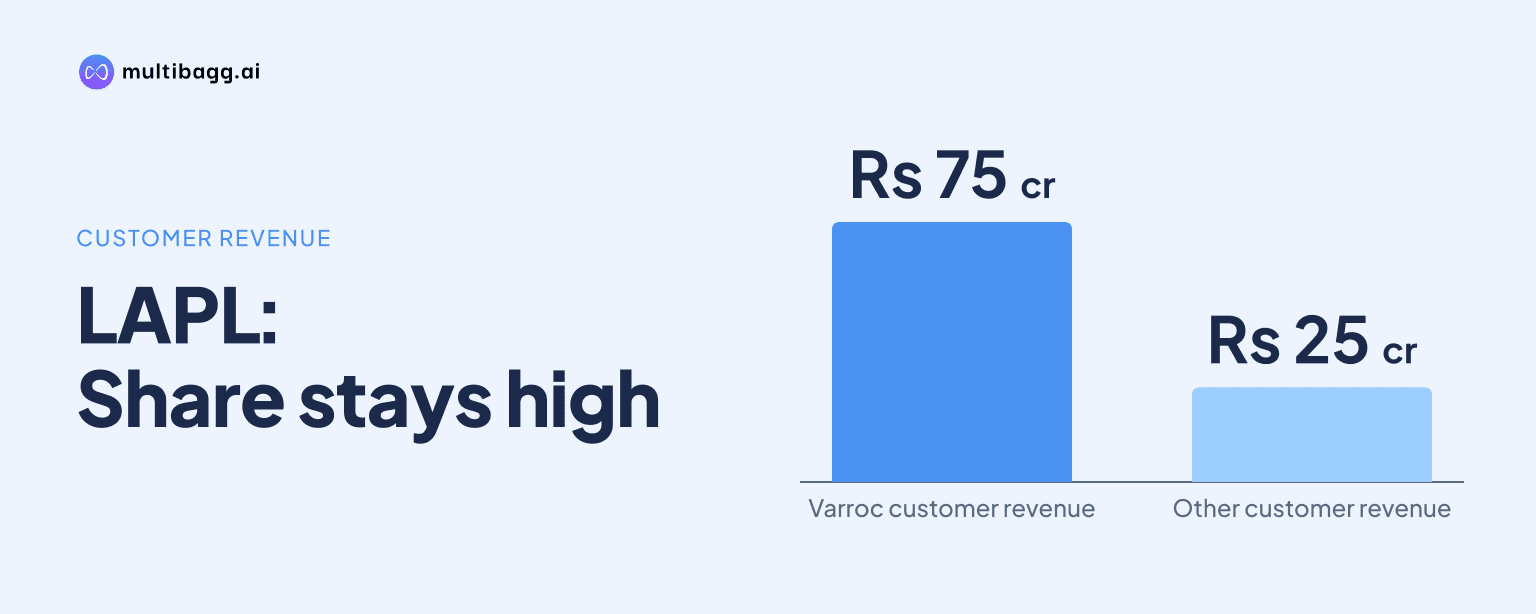
- Management illustrated customer mix with Rs 75 crore from Varroc and Rs 25 crore from other customers.
- LAPL said its three new vendor-code customers are each above Rs 20,000 crore in size.
- Management expects second-half EBITDA margin of 14.5% to 15.5%.
powered by IRIS
In the earnings call, LAPL Automotive Limited said Varroc’s revenue share may not decline materially despite three new global customer additions expected to buy 50,000 motors in their first year, because Varroc is also continuing to award new product-development work and could expand in absolute revenue terms.
Know LAPL Automotive inside out
Results, valuation, peers and who's buying, in one view.
Will LAPL's Varroc concentration decline?
LAPL said Varroc concentration may not reduce materially as a percentage of revenue if sales to Varroc rise alongside revenue from newer customers. An analyst said Varroc accounted for more than 75% of FY26 revenue, and management confirmed that Varroc was LAPL’s largest customer. Management did not provide a FY28 or FY29 target for Varroc, the top three customers or the top five customers.
Management used an illustrative revenue mix of Rs 75 crore from Varroc and Rs 25 crore from other customers. In that example, adding Rs 10 crore to other-customer revenue lifts that group to Rs 35 crore, but Varroc revenue could also increase through additional products. Management said the percentage split might therefore not show a major shift even as the company adds customers and products.
The example was not reported revenue or a forecast. It shows that LAPL’s diversification programme is additive rather than a replacement of Varroc business: non-Varroc revenue can increase in rupees while the largest customer’s percentage contribution remains elevated if both revenue streams grow.
What will LAPL's three new vendor codes contribute?
LAPL said it has received three vendor codes from companies with global operations, each with a size above Rs 20,000 crore. Management said some are Tier 1 automotive suppliers and that motors are a new segment for these customers. The call did not name the companies, disclose contracts or provide customer-specific revenue commitments.
For the first year of launch, management expects the three customers together to use about one month of LAPL’s capacity across the year. It illustrated the expectation with volumes: if LAPL makes 15,000 motors a month for existing customers, the three new customers together could buy 50,000 motors within one year. This is management’s launch-year expectation, not reported sales.
Management said LAPL will offer the new customers existing off-the-shelf products as well as research and development, or R&D, products. Because the motor category is new for their brands, management said it would take time to gain traction. The transcript provides no motor pricing, so the 50,000-motor expectation cannot be converted into a revenue estimate.
Got a follow-up? Ask IRIS
Why could Varroc business continue to expand?
LAPL said Varroc continues to assign newer products for development because it trusts the company, which management cited as the reason the customer’s revenue can grow with diversification. The call did not disclose Varroc’s order book, number of development programmes, vehicle platforms or committed purchase volumes.
Management said R&D projects are generally undertaken for original equipment manufacturer, or OEM, customers when they introduce a new vehicle or a facelift. In most cases, customers bear development costs and LAPL bills those costs. Management said subsequent supply can continue while the relevant vehicle remains in the market and generates orders.
This OEM mechanism links LAPL’s order flow to the customer vehicle’s production and market performance. Management said an increase in an OEM’s vehicle order book increases LAPL’s product order book. It also said customer-concentration risk should decrease as it supplies similar products and new R&D products to additional customers, but it gave no numerical endpoint for that intended reduction.
How is LAPL building business beyond Varroc?
LAPL said Unit 4 will make OEM products, not products directly sold into the replacement market. Management said LAPL supplies existing customers, which then decide whether to serve replacement-market demand. The company’s customer-expansion plan is therefore focused on OEM and supplier relationships rather than a direct aftermarket sales channel.
Management said capital expenditure is being added product by product instead of through a one-time purchase of 14 to 15 machines. A new motor in development requires a separate winding machine, while balancing, hot stamping and varnishing can be performed using existing equipment. Management said machinery was in transit and expected revenue to increase drastically in the second half after it arrives.
Management projected 40% growth for the year and said it had issued indents of about Rs 15 crore a month for the second half. It also said EBITDA, or earnings before interest, tax, depreciation and amortisation, margin should be around 14.5% to 15.5% in the second half. These are management expectations; the call did not provide a date for the core unit to begin operations.
LAPL is also seeking higher revenue per vehicle through 90 millimetre light-emitting diode, or LED, projector headlamps. Management said earlier bus-product ticket sizes ranged from Rs 70 to Rs 600, while the new headlamps average about Rs 2,000. With eight headlamps on a bus, management said the headlamp value can reach about Rs 16,000, compared with a previous Rs 3,000 to Rs 4,000 basket across up to 40 plastic components.
Conclusion
LAPL’s three new vendor codes broaden its customer roster and could add 50,000 motors of first-year demand, while higher-value headlamps and OEM development projects expand its product opportunity. However, management’s Rs 75 crore Varroc and Rs 25 crore other-customer illustration indicates that larger non-Varroc sales will not necessarily produce a proportionate fall in Varroc’s revenue share.
The next points to watch are the conversion of the three vendor codes into the expected 50,000 motors, the arrival of machinery in transit and the planned Rs 15 crore monthly second-half indents. Management also expects a 14.5% to 15.5% second-half EBITDA margin, while the timing of the core unit and any quantified customer-concentration target remain undisclosed.