










Solarium shifts residential sales to Kits to lower fixed costs
Key highlights
- Solarium reported Rs 4.5-Rs 5 crore of Solar Kit revenue from mid-August to September 30.
- Management expects Solar Kits to generate 15%-18% gross margin and 10%-12% EBITDA margin.
- Residential revenue was Rs 37.6 crore in H1, while the non-Kit run rate was Rs 4-Rs 5 crore a month.
- Management cited Gujarat residential-solar subsidies of about Rs 95,000 to Rs 1 lakh.
powered by IRIS
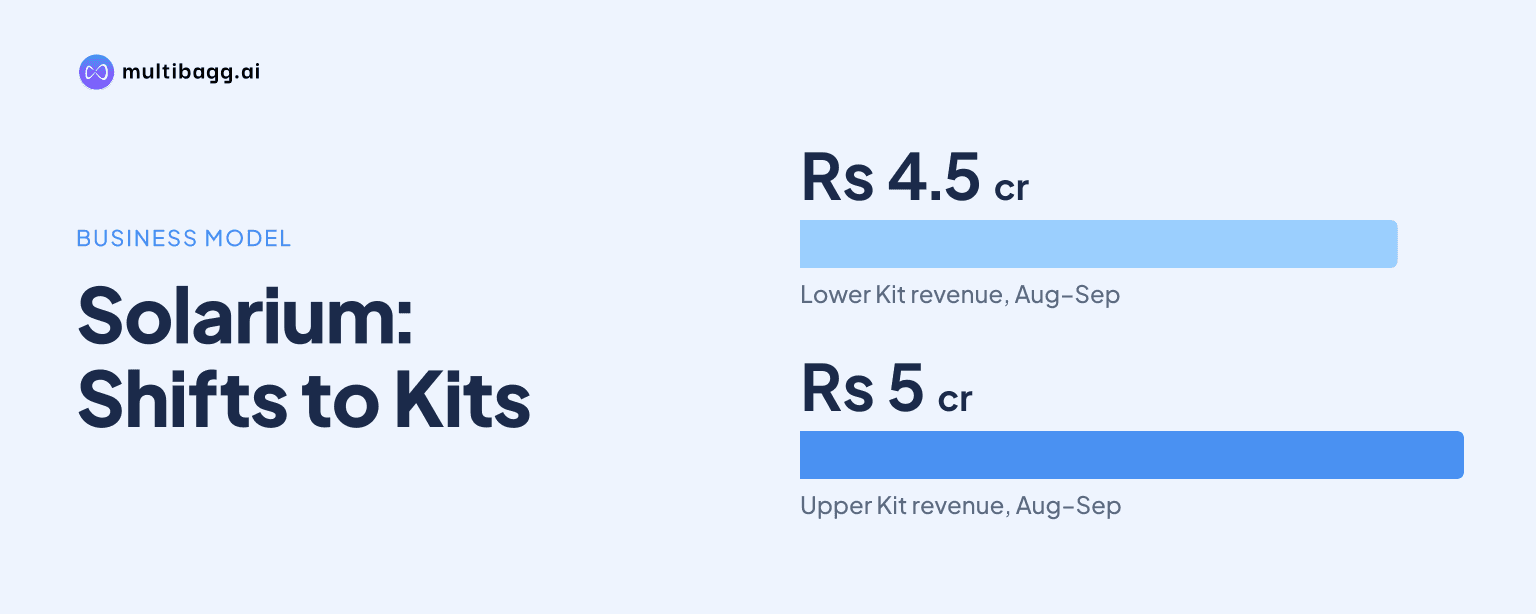
Solarium is shifting residential sales from company-run, end-to-end expansion to branded Kits supplied through local installers, aiming for 10%-12% earnings before interest, tax, depreciation and amortisation (EBITDA) margins while limiting warehouse-related fixed costs. Management reported Rs 4.5-Rs 5 crore of Kit revenue from mid-August to September 30.
Know Solarium Green Energy inside out
Results, valuation, peers and who's buying, in one view.
Why is Solarium changing its residential solar strategy?
Solarium is changing course because its earlier end-to-end residential model added fixed costs as it opened warehouses and entered more cities. Management said the business had at one point reached a monthly residential run rate of about Rs 10 crore, but the city-by-city expansion model required spending before each warehouse could generate returns.
The revised model supplies branded Solar Kits to existing local rooftop installers, who complete the last-mile installation. Management said the change is intended to retain broadly similar EBITDA economics while avoiding the fixed-cost burden attached to maintaining Solarium-operated execution teams, warehouses and city infrastructure.
The change followed a lower reported residential pace in the first half (H1). Residential revenue was Rs 37.6 crore in H1, equivalent to about Rs 6 crore a month, compared with the Rs 10-Rs 12 crore monthly rate excluding Kits discussed on the prior call. Management said the current non-Kit residential run rate is Rs 4-Rs 5 crore a month.
How does Solarium's Solar Kit model work?
Solarium's Solar Kit model combines more than 25 installation items into one branded package for local installers. Management said these installers had previously sourced materials from multiple vendors, often in small quantities, while Solarium can procure components in batches of 100, 500 or 1,000 Kits.
Solarium holds inventory until it dispatches the Kit to the installer, and management said orders are generally taken in truckload quantities from distributors. The model therefore retains an inventory requirement, but it avoids building a full company-run installation operation in every city where residential demand emerges.
Management expects lower gross margins from Kits than from the established residential business, but also lower fixed costs. It guided to a 15%-18% gross margin and 10%-12% EBITDA margin for Kits, while putting the conventional residential segment's gross margin at about 35%-37%.
The comparison shows that management is accepting a lower gross-margin percentage on the product sold through installers in exchange for a lower fixed-cost structure. Management did not disclose distributor commissions, installer margins, inventory days or credit terms, so the working-capital outcome of the model cannot yet be quantified from the call.
Got a follow-up? Ask IRIS
What sales has Solarium reported from Solar Kits?
Solarium reported Rs 4.5-Rs 5 crore of Kit revenue from mid-August to September 30, covering roughly the first one-and-a-half months after the launch. Management said the initial month was focused mainly on setting up distribution, and Kit sales are currently included in the residential segment rather than reported separately.
Management expects total residential monthly revenue, including Kits, to reach Rs 8-Rs 10 crore over the next one to two months, versus the Rs 4-Rs 5 crore run rate excluding Kits. This is an expectation rather than formal guidance, and management did not provide a target for Kit volumes, distributor count or the share of residential revenue expected from Kits.
Solarium said it will go deeper in selected markets, including Gujarat and Uttar Pradesh, instead of pursuing uniform city expansion. In Gujarat, management cited a state subsidy of about Rs 28,000 on top of central support of roughly Rs 65,000-Rs 70,000, implying combined support of about Rs 95,000 to Rs 1 lakh for eligible residential installations.
Management also said it launched a zero-cost residential solar installation offering in Gujarat about a month before the call. It did not disclose the financing structure, installations completed or revenue from the offering. Management said successful execution in Gujarat could materially change residential numbers over the next six months, but declined to give a numerical forecast.
What does the pivot mean for Solarium's margins and capital use?
The pivot is designed to reduce fixed-cost intensity while management seeks 10%-12% EBITDA margins on Kits and 9%-10% EBITDA margins for the broader business in the second half (H2). Solarium reported H1 EBITDA margins of about 8%-8.5%, which management partly attributed to roughly three months of low plant utilisation during a delay related to the Approved List of Models and Manufacturers (ALMM).
Management estimated that plant underutilisation caused Rs 4.5-Rs 5 crore of fixed costs during H1. It said EBITDA would have been about 9.5%-10% had the associated production volumes been available for sale. Management also said overall gross margin declined because revenue mix shifted toward larger engineering, procurement and construction projects and module supply, while segment-level margins did not fall.
The economics vary by segment: management placed gross margin at about 35%-37% in residential, 25% in commercial, industrial and government work, and 14%-15% in manufacturing. The Kit model adds a lower-gross-margin channel, but management expects its 10%-12% EBITDA margin to reduce the effect of fixed costs that accompanied warehouse-led residential expansion.
Solarium also described a lower-working-capital approach in two 50-megawatt engineering, procurement and construction contracts, which it subcontracted after securing margins while retaining module supply. Management said no further equity raise is currently under discussion, although it may consider a fund raise for a future growth phase if execution of its order book creates a requirement.
Conclusion
Solarium's residential strategy is now centred on branded Solar Kits, bulk procurement and local installer execution rather than warehouse-heavy, company-run expansion. The early evidence is Rs 4.5-Rs 5 crore of Kit sales from mid-August to September 30 and management's expectation that monthly residential revenue including Kits could reach Rs 8-Rs 10 crore, against Rs 4-Rs 5 crore excluding them.
The next measure will be execution in Gujarat, where management cited combined subsidies of about Rs 95,000 to Rs 1 lakh and a recently introduced zero-cost installation offer. Management also expects H2 EBITDA margins of 9%-10% after H1 absorbed Rs 4.5-Rs 5 crore of fixed cost from low plant utilisation, while the pace of Kit revenue and its working-capital needs remain undisclosed.