










LAPL begins fourth-plant construction as capacity tops 90%
Key highlights
- LAPL began Unit IV construction in Chhatrapati Sambhajinagar on August 19, 2026.
- LAPL’s Lighting and Motor divisions operated at 91.25% and 90.70% utilisation in FY26.
- LAPL identifies Rs 19.56 crore for capacity expansion and backward integration.
- LAPL’s Motor Division generated Rs 55.1134 crore of FY26 revenue, versus Rs 31.7114 crore for Lighting.
powered by IRIS
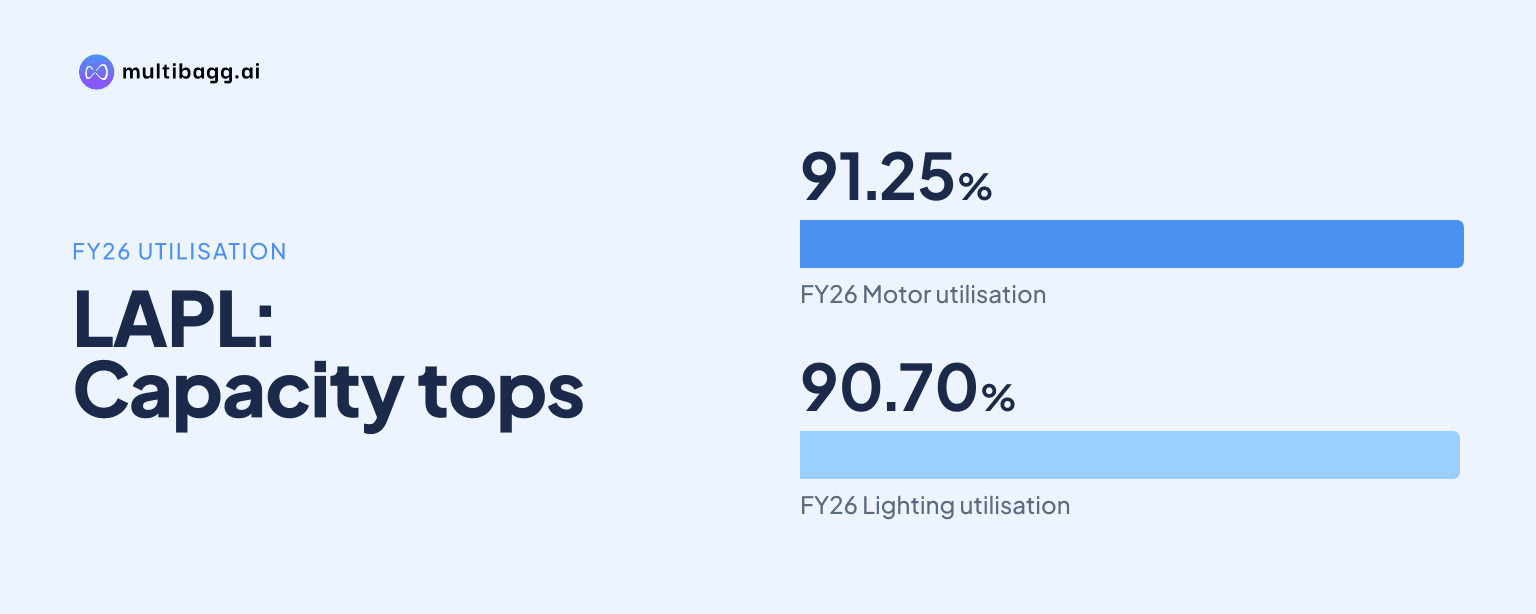
LAPL Auto Parts began construction of a fourth manufacturing facility on August 19, 2026, after its Lighting Division and Motor Division operated at 91.25% and 90.70% capacity utilisation, respectively, in FY26. LAPL’s stated Rs 19.56 crore capacity-expansion and backward-integration plan is intended to add automation, testing and in-house production.
Know LAPL Automotive inside out
Results, valuation, peers and who's buying, in one view.
Why is LAPL building a fourth manufacturing facility?
LAPL is building Unit IV after the Lighting Division and Motor Division exceeded 90% utilisation in FY26, while its three operating units handled mirrors, lighting, motors, storage and warehousing. Lighting produced 205,322 against installed capacity of 225,000, while Motors produced 136,058 against installed capacity of 150,000. The presentation labels these capacity figures as MVA without defining the measure.
The utilisation gap was 29.47 percentage points between Lighting and Mirrors, and 28.92 percentage points between Motors and Mirrors. This comparison indicates that the disclosed expansion rationale relates principally to lighting and motor operations, rather than the Mirror Division, which had 2,293 units of unused installed capacity in FY26 on the presentation’s measure.
LAPL had three facilities in Chhatrapati Sambhajinagar, Maharashtra, before Unit IV construction began. Unit I at MIDC Waluj is used for mirror assembly, storage and warehousing; Unit II at MIDC Waluj makes lighting products; and Unit III at Shendra, which is also the registered office, makes starter motors, wiper motors, brushless direct-current, or BLDC, fans and rotor assemblies.
Which LAPL businesses carry the most manufacturing activity?
LAPL’s Motor Division was its largest reported product segment in FY26 at Rs 55.1134 crore of revenue, followed by the Lighting Division at Rs 31.7114 crore. The two divisions above 90% utilisation were therefore also the largest disclosed product lines, while Mirror Division revenue was Rs 46.33 lakh and its utilisation was 61.78%.
The remaining FY26 product revenue was Rs 4.6351 crore for Other Accessories and Rs 99.22 lakh for Hood products. LAPL’s portfolio spans motors, lighting, mirrors, hoods and other accessories, but the presentation provides installed-capacity figures only for Motors, Lighting and Mirrors. It does not state how much of Unit IV will be allocated to any individual product segment.
LAPL reports two operating models: original design manufacturing, or ODM, represented 77.94% of FY26 revenue, while original brand manufacturing, or OBM, represented 22.06%. Under ODM, LAPL designs and manufactures for original equipment manufacturer, or OEM, customers that market products under their own brands; under OBM, LAPL controls the design, manufacturing, branding and sales of products under the LAPL brand.
What has LAPL disclosed about Unit IV?
LAPL disclosed that it completed a Bhumi Pujan ceremony and commenced construction of Unit IV on August 19, 2026, in Chhatrapati Sambhajinagar, Maharashtra. Its stated purpose is to strengthen manufacturing, testing and in-house production capabilities, rather than to add a named production line or a specified capacity.
LAPL identifies Rs 19.56 crore for a new manufacturing facility under its capacity-expansion and backward-integration strategy. Management says the programme is intended to increase automation and in-house production, improve quality and lead times, and reduce outsourcing and supply-chain risks. The presentation does not disclose a commissioning date, physical capacity, spending schedule or whether the Rs 19.56 crore has already been spent.
Backward integration in LAPL’s plan concerns performing more inputs or processes internally. The mechanism is consistent with Unit III’s manufacture of rotor assemblies alongside starter motors, wiper motors and BLDC fans, but the presentation does not identify which additional components or production stages Unit IV will bring in house.
Got a follow-up? Ask IRIS
How does LAPL connect expansion to customer demand?
LAPL connects the facility plan to deeper electric-vehicle OEM engagement and development of light-emitting diode, or LED, and projector-lighting solutions, as well as BLDC and high-efficiency motors. LAPL says its LED lighting works across internal-combustion-engine and electric-vehicle platforms, and that it has secured electric-vehicle customers across commercial-vehicle and two-wheeler platforms.
In August 2026, LAPL received three new vendor codes from leading automotive companies. According to the presentation, the codes allow participation in upcoming requests for quotation and development programmes, creating potential sourcing opportunities. LAPL does not name the companies, quantify potential orders or state that the codes will convert into revenue.
LAPL also outlines a platform-based OEM engagement model involving early-stage co-development, integrated component solutions and faster validation readiness. Its aftermarket strategy includes expanding distributor and spare-parts networks and standardising packaging, cataloguing and traceability. The presentation says the OBM brand can reduce dependence on OEM cycles, but provides no target above its FY26 revenue share of 22.06%.
What changed in LAPL’s operating and financial profile?
LAPL’s factory profile changed from a three-unit operating base to a planned four-facility footprint when Unit IV construction began on August 19, 2026. Within the existing base, FY26 utilisation differed sharply between Lighting and Motors at 91.25% and 90.70%, respectively, and Mirrors at 61.78%.
LAPL also reported that earnings before interest, taxes, depreciation and amortisation, or EBITDA, margin rose to 16.75% in FY26 from 8.81% in FY24. Profit after tax, or PAT, margin increased to 9.25% from 3.58% over the same period. These margin changes cover the wider business and do not establish how much, if any, is attributable to Unit IV, which was under construction in August 2026.
Conclusion
LAPL’s fourth-facility construction follows FY26 utilisation above 90% in its two largest reported product divisions, Motors and Lighting, while the Mirror Division remained at 61.78%. The Rs 19.56 crore plan combines additional manufacturing and testing capability with automation, in-house production and a stated effort to reduce outsourcing and supply-chain risks.
The next disclosed matters to watch are construction progress and commissioning details for Unit IV, which LAPL has not provided, and whether the three vendor codes received in August 2026 lead to requests for quotation or development programmes. Management’s broader plan centres on LED lighting, BLDC motors, electric-vehicle OEM engagement and a larger aftermarket network.