










Physicswallah Limited keeps JEE and NEET base batch near Rs 4,000
Key highlights
- Physicswallah says a year of live JEE or NEET base classes costs about Rs 4,000, or roughly Rs 10 a day.
- Physicswallah says it will not raise the base-batch price to pursue ARPU.
- Physicswallah’s state-board footprint expanded to 14 states from 7, with 3.9 lakh first-year enrolments.
- Physicswallah has 370 centres, and about 80% of their students were online students first.
powered by IRIS
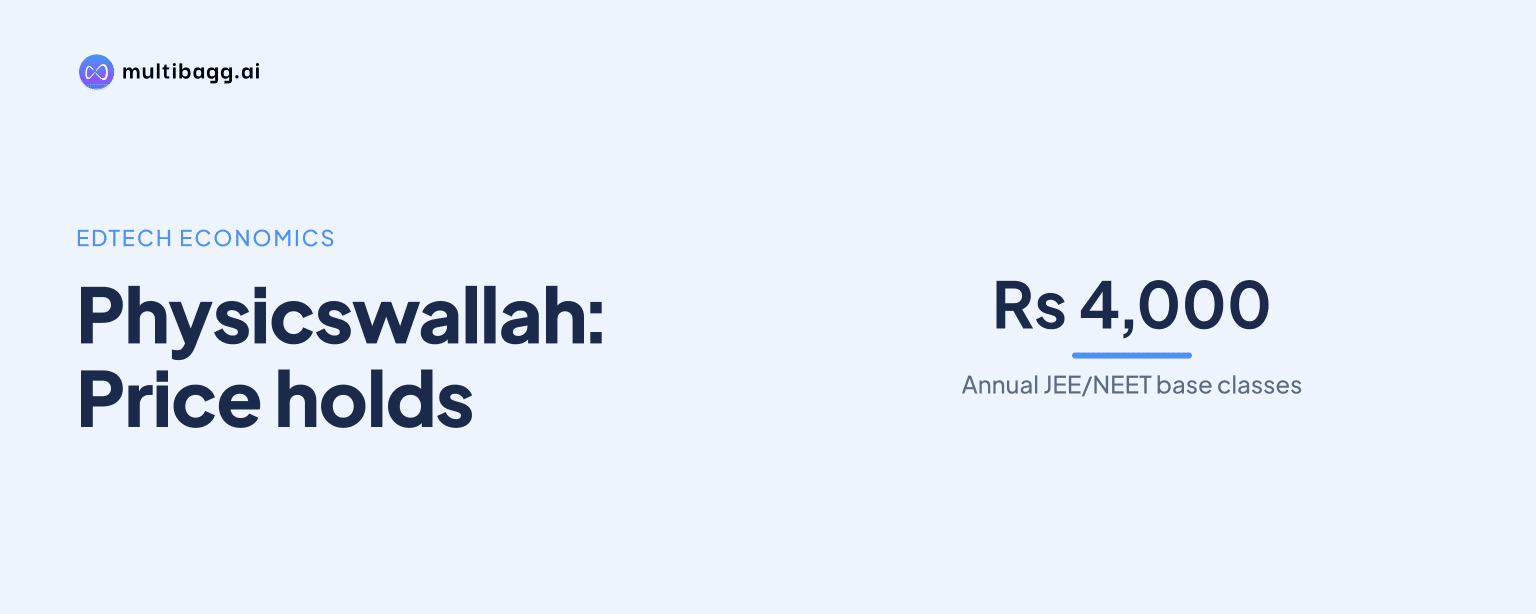
In its Investor Day 2026 presentation scheduled for November 18, 2026, Physicswallah Limited said it would keep a full-year live JEE or NEET base batch at about Rs 4,000, roughly Rs 10 a day. Physicswallah also said it would not raise this base-batch price to pursue average revenue per user, or ARPU.
Know Physicswallah inside out
Results, valuation, peers and who's buying, in one view.
Why is Physicswallah keeping the JEE and NEET base batch near Rs 4,000?
Physicswallah says it is keeping the base JEE and NEET batch affordable because it treats education as a necessity rather than a luxury. Its presentation puts the price of a year of live classes at about Rs 4,000, equivalent to roughly Rs 10 a day. That price applies to the stated base batch rather than every course or format offered by Physicswallah.
Physicswallah explicitly says it will not raise the base-batch price to chase ARPU. Instead, it says premium batches can coexist with the affordable base offering. This creates a stated distinction between the entry-level JEE and NEET proposition for Bharat and higher-priced premium batches, although the presentation does not disclose premium-batch prices or their enrolment mix.
Physicswallah links its pricing stance to the problem set out in its presentation: some students may have to leave home, rent accommodation in a large city and spend lakhs of rupees to access good teachers. Its response is a full year of live online JEE or NEET classes at about Rs 4,000, rather than a broad price-increase strategy.
How is Physicswallah extending access beyond the base online batch?
Physicswallah says it is widening access through language, earlier school years, artificial intelligence, or AI, and selected physical locations. Its language response includes vernacular batches in 10 languages, alongside regional teachers and channels. For school-age learners, it lists Class 3 to 10 offerings, Curious Junior and state-board courses across 14 states.
Physicswallah’s state-board footprint has expanded to 14 states from 7 states. It reports 3.9 lakh enrolments in the business’s first year and says the segment is already positive on earnings before interest, tax, depreciation and amortisation, or EBITDA. The presentation does not disclose state-board revenue or margins, but identifies the segment as part of the effort to build its learner base before Class 11.
For personal attention, Physicswallah lists AI Guru, AI Grader and Tuto, which it calls its one-to-one AI tutor. The company frames these products as a response to learning that remains one size for all after access has been solved. It does not provide user numbers, pricing or learning-outcome data for the three AI products in this presentation.
Got a follow-up? Ask IRIS
Where will Physicswallah spend instead of raising the base-batch price?
Physicswallah says capital will go first to new online content and categories, then AI and technology, followed by offline expansion only where a centre’s numbers work. Partnerships rank fourth and are intended to bring a new language, region or category, provided the partner’s culture fits. This ordering places online content ahead of the company’s 370-centre physical network.
Physicswallah identifies several categories for expansion beyond JEE and NEET, including Union Public Service Commission preparation, state public-service examinations, Graduate Aptitude Test in Engineering, chartered accountancy, commerce, defence and foundation courses. In its oldest category, Physicswallah says about one in five JEE and NEET aspirants study with it. That disclosed scale is paired with uneven regional penetration rather than a claim of uniform national reach.
Management’s indicative regional view puts Physicswallah penetration at 30% to 40% in the Hindi heartland, under 10% in central India and under 5% in south India. The presentation says the oldest category can still double, but does not provide a target date, revenue target or enrolment target for that outcome. The regional comparison points to more stated expansion room outside the company’s highest-penetration Hindi-belt markets.
How selective is Physicswallah’s offline centre expansion?
Physicswallah says it will open centres pin code by pin code, using its online user base as the starting point. It has 370 centres, and about 80% of their students were Physicswallah online students first, according to the presentation. The company is therefore describing offline expansion as an extension of established online demand rather than a broad rollout into every location.
Physicswallah says it will grow offline only as fast as every centre earns its place, because offline education promises results. Alongside the 370 centres, it lists 72 Pathshalas and hybrid courses as its classroom response for students who need a teacher and routine close to home. The presentation does not disclose centre-level profitability, utilisation, city count or a numerical target for additional centres.
Physicswallah also describes a common operating system for online and offline learning. It says its Noida headquarters has a live view of every classroom, the same content appears on smart boards, and digital homework lets teachers see by evening who understood. Its faculty training programme received about 40,000 applicants, selected about 300 candidates and runs for 6 to 7 months through three stages: doubt solving, content and classroom teaching.
Conclusion
Physicswallah’s stated strategy combines a base JEE and NEET price of about Rs 4,000 with premium batches, vernacular learning in 10 languages, state-board expansion from 7 to 14 states and AI-led personalisation. The presentation positions affordability as the entry point, while online content, technology and selected offline centres are the routes through which the company intends to extend reach.
The next issues to watch are whether the 370-centre network continues to follow the stated rule that each location must earn its place, and which future bets prove viable. Physicswallah identifies NEET PG, skilling, where enrolments are up 10 times, and Physicswallah Books, with 49,000 paying students, as small today, and says it will indicate which initiatives are working.