










PW says delayed NEET cycle leaves full-year enrolments below last year
Key highlights
- PW said full-cycle online NEET enrolments were 13% below last year despite Q2 growth of more than 30%.
- Offline NEET enrolments for the academic year were 8% lower, and PW expects a full-year impact.
- PW plans online and offline crash courses in Q3 and Q4 to recover part of the NEET shortfall.
- Categories beyond JEE and NEET made up 73.8% of PW's first-half enrolments, up from 64.8%.
powered by IRIS
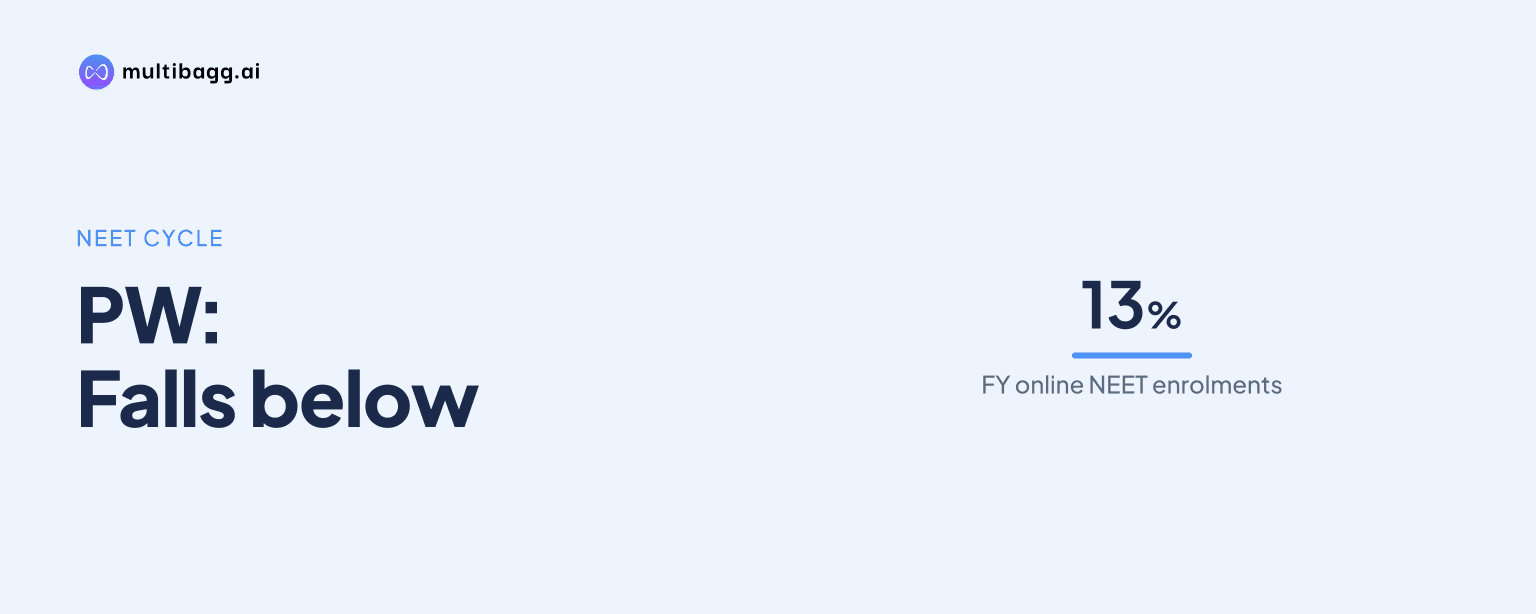
Physicswallah Limited said its delayed NEET cycle recovered in the second quarter (Q2) of financial year 2027 (FY2027) after results arrived on 16 July, but full-cycle online enrolments remained 13% below last year. PW also reported that offline NEET enrolments for the academic year were 8% lower and expects the gap to appear in full-year NEET results.
Know Physicswallah inside out
Results, valuation, peers and who's buying, in one view.
Why did PW's NEET demand rebound in Q2?
PW's NEET demand rebounded in Q2 because the result was released on 16 July, about a month late, shifting demand delayed in the first quarter into the second quarter. Management said online NEET collections rose 27% in Q2 and online enrolments increased by more than 30%, showing that students returned after the result date. The recovery followed a first-quarter period in which the timing delay affected demand.
The delayed result contributed to a broader Q2 increase in activity, although PW did not attribute all growth to NEET. PW reported 1.5 million unique enrolments in Q2, up 12.9%, while unique transacting users rose to 3.44 million from 3.22 million. Management-reported ACPU rose 9.2% to Rs 4,280 during the quarter.
PW reported Q2 revenue of Rs 1,242 crore, up 18% year on year, alongside pre-Ind AS EBITDA of Rs 233 crore. That EBITDA figure was 45% higher year on year and represented an 18.8% margin. PW also said Q2 profit after tax was Rs 142 crore, double the prior-year level, but those financial results do not change management's assessment that the NEET cycle remained behind for the full year.
How far below last year is PW's NEET cycle?
PW said its full-cycle online NEET collections were 7% below last year and enrolments were 13% lower, despite the Q2 rebound. PW separately reported that offline NEET enrolments for the academic year were down 8%. These measures distinguish a quarter in which deferred demand returned from the larger enrolment cycle that had already lost ground.
Management said it expects the remaining gap to be reflected in full-year NEET numbers. That statement is more cautious than the Q2 growth data because the late result changed the timing of enrolment rather than fully restoring the number of students accumulated over the cycle. PW did not give a numerical full-year recovery target for either online or offline NEET enrolments.
PW nevertheless described longer-term reasons it expects NEET demand to recover. Management cited an anticipated transition to a computer-based examination format in FY2028 and the structural expansion of India's medical education system. These are management expectations for the medium to long term, rather than a claim that the FY2027 enrolment shortfall has been eliminated.
Got a follow-up? Ask IRIS
How will PW try to offset the NEET shortfall?
PW plans to launch crash courses and mega crash courses in both online and offline formats during the third and fourth quarters, or Q3 and Q4, to cover part of the enrolment delta. Management said it brought forward these crash courses this year, making them an earlier intervention than usual. The plan is explicitly partial: PW said it hopes to cover some of the shortfall, not all of it.
At the company level, PW said it expects K-12 and new categories to partly offset the NEET gap. Foundation enrolments rose 15%, while foundation collections increased 40%. Boards and CUET enrolments increased 130%, providing evidence that adjacent academic categories were expanding faster than the affected NEET cycle.
Skills enrolment increased 10.3 times to 1.69 lakh in Q2, while CA enrolments grew 19% and NEET PG enrolments reached 9,500, up 35%. The offset is not uniform across the portfolio: management identified government-exam enrolments as a miss, down 24%, because vacancies and application forms had not been released. That contrast means PW is relying on several growing categories while facing a separate demand constraint in government exams.
Which PW categories are broadening beyond JEE and NEET?
PW said 73.8% of first-half enrolments came from categories beyond JEE and NEET, compared with 64.8% a year earlier. The 9-percentage-point shift shows a larger share of enrolments coming from other products during the first half of FY2027. Management also cited ACPU growth in higher-value categories including civil services, GATE and MBA.
Language-led distribution was another growth area. Vernacular enrolments rose 77% to 1.2 lakh across 10 languages, while management said its important live batches would be available in 12 Indic languages for the next academic-year batches. PW said the live artificial-intelligence translation capability uses the same teachers across languages and is intended to support distribution in South India.
South India accounted for 9% of first-half revenue, according to management, which described the region as its next growth leg across five states and 15 million students. PW said it is applying an online-first playbook there. Its broader learner funnel included 106 million cumulative app downloads, 4.1 million daily active users and engagement of 98 minutes, metrics management presented alongside the planned regional expansion.
Conclusion
PW's Q2 recovery shows that the 16 July NEET result deferred rather than erased some demand, as online NEET collections rose 27% and enrolments rose more than 30% in the quarter. However, the full-cycle comparison remains the central finding: online enrolments were 13% lower and offline academic-year enrolments were 8% lower, even as categories beyond JEE and NEET accounted for 73.8% of first-half enrolments.
The next evidence will come from PW's Q3 and Q4 crash-course launches, which management says could recover part of the shortfall, and from the rollout of 12-language live batches for the next academic year. PW also plans its first Investor Day on 18 November in Mumbai, where it said it will present its online and offline capabilities, its AI tutor and other initiatives.