










Physics Wallah plans July 2027 digital degree admissions
Key highlights
- PW plans to begin PW Digital University admissions in July 2027.
- PW said its platform has more than 6 million paid learners annually and distribution of more than 100 million learners.
- PW expects near-zero capital allocation for degree delivery because the planned university will be 100% digital.
- Indic-language courses contributed 10% of first-half revenue, and PW plans live batches in 12 Indic languages.
powered by IRIS
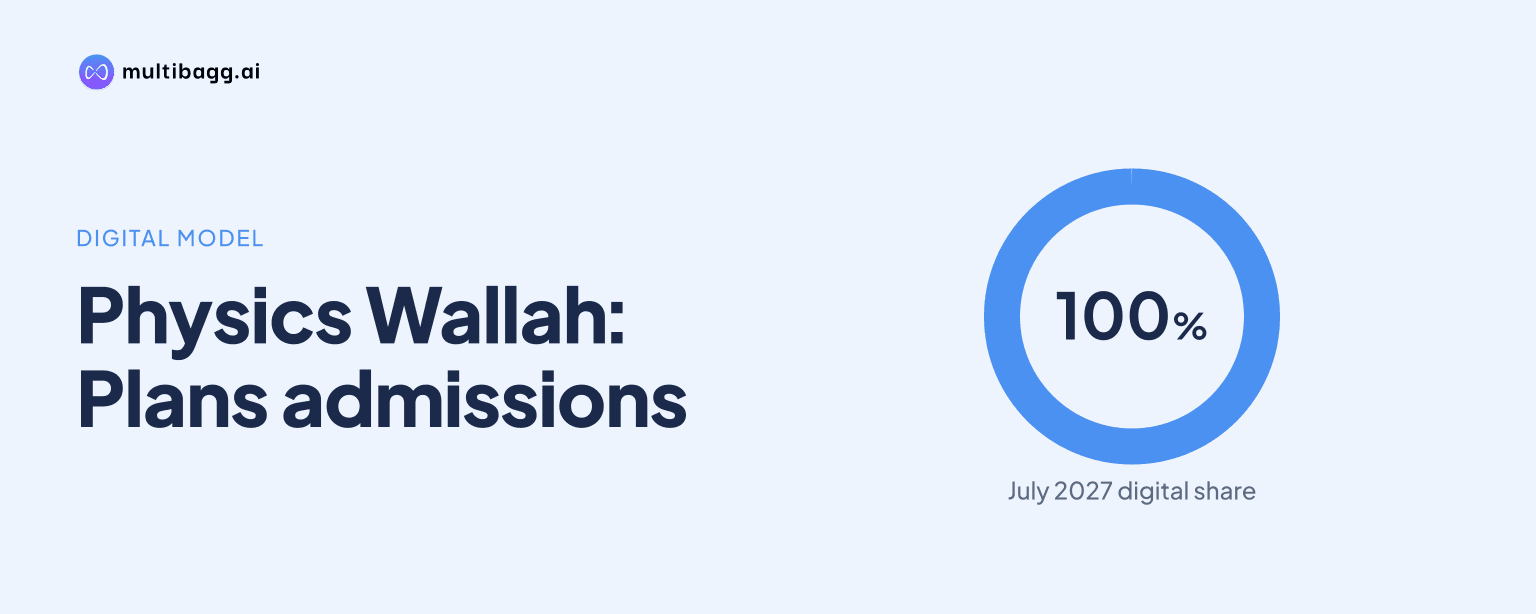
Physics Wallah plans to begin PW Digital University admissions in July 2027, combining online degrees with test-preparation courses such as BCom-CA and BA-UPSC. Management said the 100% digital delivery model should require near-zero capital allocation, while PW has more than 6 million paid learners annually and distribution reaching more than 100 million learners.
Know Physicswallah inside out
Results, valuation, peers and who's buying, in one view.
What will PW Digital University offer?
PW Digital University will offer degrees, diplomas and certificates through a fully digital model, according to management. The proposed degree portfolio includes Bachelor of Computer Applications (BCA), Bachelor of Business Administration (BBA), Bachelor of Commerce (BCom), Bachelor of Arts (BA), Master of Commerce (MCom), Master of Computer Applications (MCA) and Master of Business Administration (MBA).
Management said preparation work would begin during the current year before the July 2027 admission cycle. It described India’s online-degree business as about five years old, compared with a market in the United States that management said began 25 years ago. PW did not disclose projected enrolment, fee, revenue, margin or profitability targets for the university.
The company presented the university as a forward-integration route for learners coming through Class 12 and its Joint Entrance Examination (JEE) and National Eligibility cum Entrance Test (NEET) categories. PW said it has more than 6 million paid learners each year and distribution of more than 100 million learners, although neither figure is a forecast of degree-course admissions.
How will PW combine degree curricula and test preparation?
PW plans to integrate specific test-preparation content with degree curricula, with BCom-CA and BA-UPSC the clearest combinations disclosed on the call. Management said these integrated offerings would be long-term three-year courses, rather than separate short-duration test-preparation batches.
For BCom, PW said it would teach the CA curriculum alongside the degree curriculum. Management said PW is number one in CA Foundation and Intermediate, but did not provide enrolment data or a measurement basis for that position. For BA, it said the academic curriculum would be blended with UPSC preparation and delivered over the three-year programme.
PW also identified MBA as an option for students who do not secure seats at premium MBA institutions. Management called PW the fastest-growing player in the Common Admission Test (CAT) category, but supplied no growth rate, MBA intake target or programme fee. It said the planned university could use curriculum-design capabilities already developed in its exam-preparation operations.
Management linked the structure to the National Education Policy, saying students can pursue dual degrees. It also cited a trend in which students at Tier 1 and Tier 2 colleges pursue a secondary degree through another university. The call did not disclose which institutions would award the degrees, the required approvals, or how dual-degree arrangements would operate.
Why does PW expect low delivery capital needs?
PW expects near-zero capital allocation for course delivery because PW Digital University is intended to operate as a 100% digital university. Management said the model would use existing online capabilities rather than require a physical college network, which distinguishes it from expansion that depends on centres, leases and onsite faculty.
The company said it has 200 PhDs across the group and intends to use PW Skills to create industry-led curricula. It also cited its Earners skilling initiative, which management said is linked to employment, as a capability that could support employment-linked degrees and diplomas. PW did not quantify spending on programme content, faculty, technology, marketing or learner acquisition.
PW said its live, interactive classroom technology from test preparation would be used in degree delivery. Management also referred to an artificial intelligence-led curriculum designed to improve personalisation and adaptiveness. These are planned delivery mechanisms, not reported university outcomes, because no completion, placement or learning-outcome figures were disclosed for the proposed programmes.
The low-capital description is separate from PW’s acquisition plan. Management said Rs 300 crore of initial public offering proceeds had been earmarked for unidentified mergers and acquisitions over three years, with the acquisitions focused on online category expansion. That plan concerns external online assets rather than the stated near-zero delivery capital requirement for the university.
Got a follow-up? Ask IRIS
How does the university fit PW’s broader online strategy?
PW said the university would extend its online education relationship with students after Class 12, including learners previously preparing for JEE and NEET. The proposed undergraduate and postgraduate portfolio would sit alongside PW Skills, which management said would provide industry-led content aimed at improving employability.
The degree initiative has no separately disclosed revenue target within PW’s wider growth outlook. Management retained 30% revenue-growth guidance and said planned acquisitions would contribute less than 5% of that growth. The comparison indicates that acquisitions are expected to be a limited component of the stated growth target, while PW did not assign any contribution from the university, whose admissions are planned for July 2027.
PW is also expanding language access across its online platform. Management said Indic-language courses accounted for 10% of first-half revenue and that live batches would become available in 12 Indic languages through live-streaming video translation. It said this could reach more students without incremental academic cost, but did not say whether all degree courses would launch in those 12 languages.
The company is separately developing AI Tuto for Grades 6 to 12, JEE and NEET, with about 4,000 students working on the app. Management said tutoring cost had fallen below Rs 20 an hour and that the product’s price discovery was still underway. AI Tuto was not described as the university product, though PW said its degree plans would use AI-led personalisation and interactive learning technology.
What remains unresolved before the July 2027 admissions cycle?
PW has disclosed July 2027 as the admissions cycle and said preparatory work would start in the current year. However, the call did not provide milestones for university partnerships, regulatory approvals, applications, class commencement, course fees or initial student intake across BCA, BBA, BCom, BA, MCom, MCA and MBA.
The proposed BCom-CA and BA-UPSC courses demonstrate the intended integration model, but PW did not say that every degree would have a matching test-preparation bundle. It also did not disclose whether the three-year format would apply to all undergraduate offerings, or how postgraduate courses such as MCA and MBA would be structured.
PW’s learner base provides a potential distribution channel, but conversion into paid degree enrolments remains unquantified. The company cited more than 6 million annual paid learners and over 100 million learners in distribution, yet gave no conversion objective. Similarly, management described employment-linked degrees as an aim without reporting employer partnerships or placement targets.
Conclusion
PW’s planned July 2027 university admissions represent an extension from test preparation into digital degree delivery, using BCom-CA and BA-UPSC as the most detailed examples. The model is designed to apply PW’s existing online distribution, 200 PhDs, PW Skills capability and interactive teaching technology while avoiding the physical infrastructure associated with campus-based delivery.
The next disclosures to watch are the preparatory steps management said would begin in the current year, particularly degree-awarding arrangements, programme approvals, fees, intake plans and course formats. Investors can also monitor whether PW specifies the role of Indic-language delivery, employment-linked curricula and AI-led personalisation before the July 2027 admissions cycle.