










Physics Wallah Targets AI Tuto Price at Twice Batch ACPU
Key highlights
- PW said AI Tuto could be priced at about 2 times the ACPU of its online batches.
- PW reduced AI Tuto tutoring delivery cost to less than Rs 20 an hour.
- AI Tuto had 4,000 students, while PW said current-year monetisation would be very limited.
- PW plans to demonstrate AI Tuto's 3 learning modes at its Investor Day on 18 November.
powered by IRIS
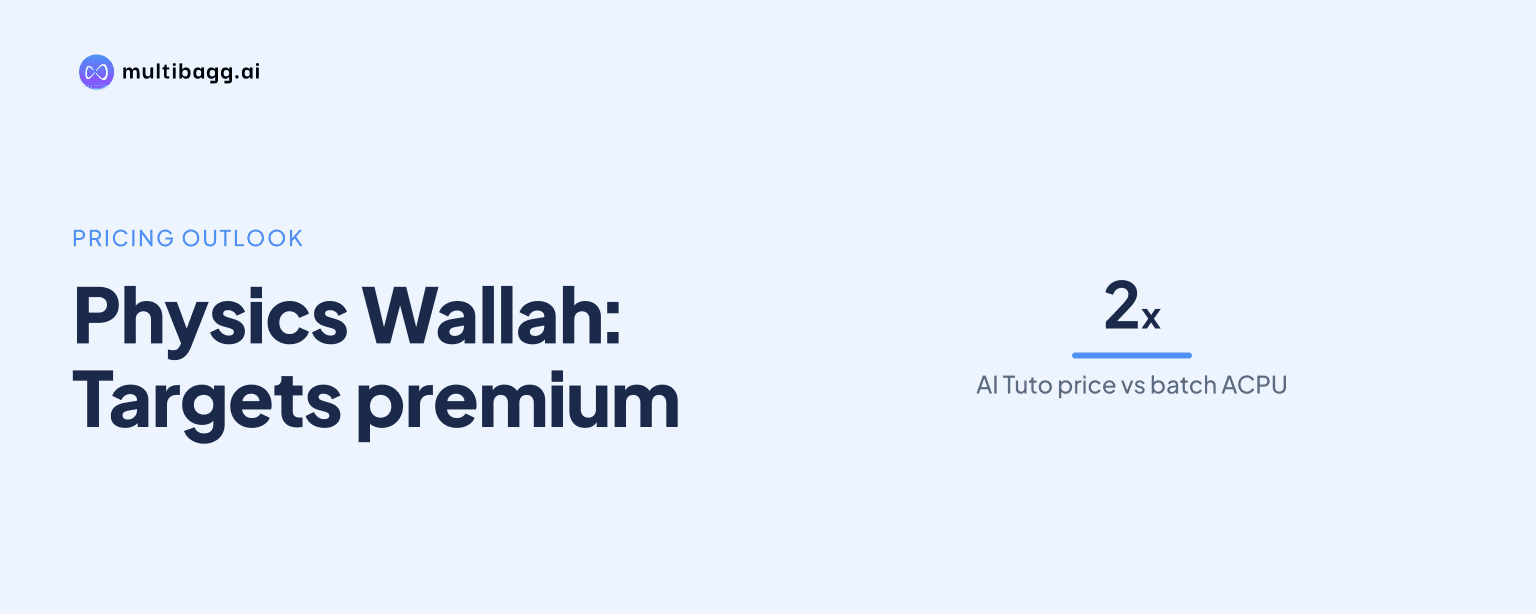
Physics Wallah said its experimental AI Tuto could be priced at about twice the ACPU, its undisclosed online-batch pricing metric, after reducing tutoring delivery cost below Rs 20 an hour. The app had 4,000 students, but management said price discovery was unfinished and current-year monetisation would be very limited.
Know Physicswallah inside out
Results, valuation, peers and who's buying, in one view.
How will PW price AI Tuto?
PW's disclosed initial pricing benchmark is about twice the ACPU of its online batches, but it has not set a final rupee tariff. Prateek Boob said price discovery for Tuto was still to happen, so the twice-ACPU indication is broad guidance rather than a confirmed subscription price.
The proposed pricing would place Tuto above a standard online-batch ACPU, but the transcript does not disclose that ACPU or the expected revenue per Tuto student. Management described the product as its best observed experience for learning outcomes and engagement, but did not provide conversion, retention or assessment data to quantify that view.
PW also said monetisation in the current year would be very limited and the product would remain primarily experimental. That means the twice-ACPU benchmark is not presented as a material contributor to the group’s current-year collections, revenue guidance or earnings before interest, taxes, depreciation and amortisation, or EBITDA.
What does AI Tuto cost PW to deliver?
PW said it had reduced AI Tuto's tutoring delivery cost to less than Rs 20 an hour and expects a significant further decline within one or two quarters. This is the only specific unit-cost disclosure management provided for the tutor during the call.
Management did not disclose the prior cost per hour, the cost target after one or two quarters, or which expenses are included in the measure. As a result, the sub-Rs 20 figure cannot show gross profit because the transcript does not specify model costs, engineering, content, support, marketing or student acquisition costs.
PW said the immediate focus was not cost, revenue or average revenue per user, but student experience. Boob said the development priority was to make Tuto fully interactive and adaptive to each student’s needs, which indicates that product work is continuing alongside the cost-reduction effort.
How far has PW rolled out AI Tuto?
PW said 4,000 students were studying on Tuto, which was available on the Play Store and live at tuto.pw.live. Alakh Pandey said the early product included live batches and had received promising feedback and higher engagement within those batches.
The 4,000-student figure does not establish paid adoption because PW did not disclose paid users, student hours, completion rates, retention or revenue. Management separately said the paid launch might take time and would be synchronised with its academic-cycle product launches.
PW said its first category launch would cover grades 6 to 12, Joint Entrance Examination, or JEE, and National Eligibility cum Entrance Test, or NEET. Management said these are areas where PW has brand distribution and students, while the product is intended to be available in 20 Indic languages and scalable into other categories.
The 20-language ambition is broader than a separate comment on AI live streaming, where PW said teachers could teach in 12 Indic languages in a real-time setting. The transcript does not say which Tuto languages are already available, when all 20 would launch, or whether each initial category would be offered in every language.
Got a follow-up? Ask IRIS
How does AI Tuto fit PW's online business?
PW said all Tuto investment is included in its online business, with the core online and innovation teams developing the product. Prateek Boob said the spending can be seen in increased artificial-intelligence costs, rather than in a separately reported Tuto segment or standalone profit and loss account.
The AI investment is being made while the online business remains a key growth source. Amit Sachdeva said online business grew 29% in the first half, while core online growth was 34%, a 5-percentage-point difference that reflects the company’s distinction between the overall and core measures.
Management said NEET accounted for 15% of online contribution and had been affected, while other offerings were helping offset that impact. PW cited crash courses, K-12 programmes, Chartered Accountancy and Common Law Admission Test categories, plus short-term skilling courses, as areas supporting the online business.
PW said it had no aggressive plan to redirect online margins into marketing after an analyst asked about reinvestment. Management instead said it was investing in the AI tutor team, while maintaining group guidance for 100% EBITDA growth and saying online growth was compensating for pressure in offline operations.
When will PW provide more detail on AI Tuto?
PW said it would demonstrate AI Tuto at its Investor Day on 18 November, including three different learning modes. Pandey said the demonstration would show the product experience, following management’s emphasis on interactivity and adaptive learning rather than near-term monetisation.
Management identified Vishwas Diwas as the time for an official student launch, but did not give a date in the transcript. It distinguished that planned launch from the app’s existing availability to 4,000 students and from the later paid launch tied to academic-cycle product releases.
PW also said it believed Tuto could support its international aspirations, but this was management’s stated view rather than a disclosed rollout plan. The call provided no country targets, international launch date, overseas investment amount or revenue objective for Tuto.
Conclusion
PW is testing AI Tuto with a price indication of about twice its online-batch ACPU and a delivery-cost benchmark below Rs 20 an hour. The commercial case remains unproven in the transcript because management disclosed 4,000 students and qualitative engagement feedback, but no final price, paid-user count, conversion rate or Tuto revenue.
The next disclosed milestone is PW's 18 November Investor Day demonstration, followed by the planned official launch around Vishwas Diwas and a paid launch aligned with the academic cycle. Management also expects tutoring delivery cost to fall significantly in one or two quarters, making future price discovery and cost detail key unresolved matters.