










PhysicsWallah’s PW Talk exceeds Rs 18 crore ARR, leads AI suite
Key highlights
- PW Talk has more than Rs 18 crore in ARR and more than 70,000 active paid subscribers.
- Ask AI has solved more than 32 million queries and served more than 1.5 million unique students.
- AI Grader has evaluated more than 1.75 million copies, with an approximate 4.3/5 quality satisfaction score.
- PW Books generated Rs 3.9 crore after its July 2026 paid-books launch.
powered by IRIS
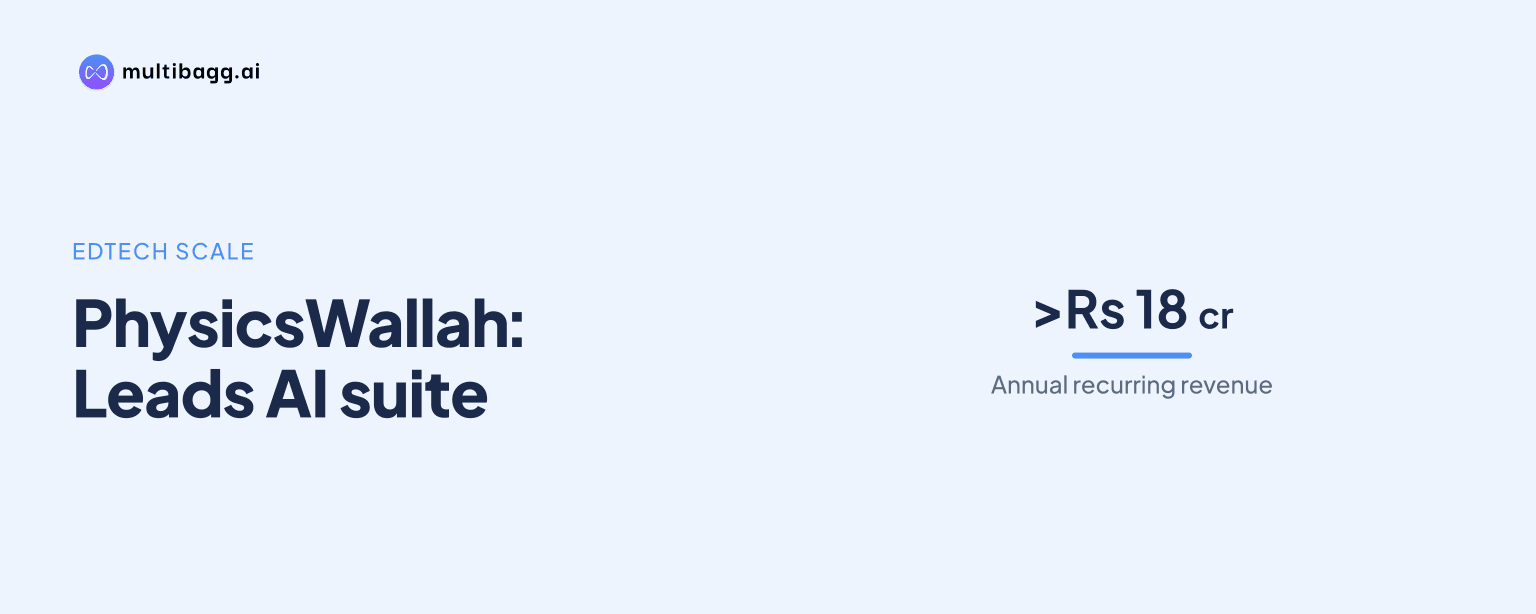
PhysicsWallah’s PW Talk reported more than Rs 18 crore of annual recurring revenue (ARR) in the presentation, alongside more than 70,000 active paid subscribers, as PW described six student-facing AI products spanning doubt resolution, guided practice, grading, books, YouTube learning and spoken-English practice.
Know Physicswallah inside out
Results, valuation, peers and who's buying, in one view.
How broad is PW’s AI product portfolio?
PW’s AI portfolio covers six products: Ask AI for lecture doubts, AI Guru for guided question solving, AI Grader for handwritten-copy evaluation, Pi Lens for YouTube learning, PW Books for digital study materials, and PW Talk for spoken-English practice. Each product addresses a different stage of the student journey, from watching lectures and practising questions to receiving evaluations and building English-speaking skills.
Ask AI is positioned inside lectures, while AI Guru is live in practice sets in the PW Books app. AI Grader is designed for evaluation, Pi Lens adds learning resources to YouTube videos, PW Books combines reading and practice, and PW Talk offers speaking exercises, interview preparation and office-English learning paths.
The disclosed measures are product-specific and cannot be added into a portfolio-wide user total. Ask AI has served more than 1.5 million unique students, PW Books has more than 2.9 million downloads, Pi Lens has more than 500,000 organic downloads in less than eight months, and PW Talk has more than 3.5 million downloads.
What evidence does PW provide for AI doubt solving?
PW says Ask AI has resolved more than 32 million queries without human involvement, serving more than 1.5 million unique students with 88.8% overall customer satisfaction (CSAT). The product provides instant one-to-one doubt resolution through voice or text during lectures, which PW says avoids interrupting teaching flow or relying on human experts.
The 32 million-plus query total exceeds the reported unique-student count, indicating repeated usage, although PW does not disclose a query-per-student measure, paid-user count, revenue or launch date for Ask AI on these pages. PW separately lists Ask AI in its 2025 product timeline and states that it answered 14 million in-class doubts a quarter.
AI Guru uses a different mechanism from Ask AI: it breaks practice questions into steps and uses Socratic prompts to guide students toward an answer. PW says practice-set questions are known in advance, allowing each tutoring session to be generated ahead of time rather than waiting for a response after a student submits a question.
In PW Books practice sets where AI Guru is live, PW says more than 20% of students use the feature and 70% finish the session. Ask AI therefore reports query volume, reach and CSAT for lecture doubts, while AI Guru reports adoption and completion in practice sets; PW provides no common reporting period or user base for a direct comparison.
How far has PW scaled AI grading and learning materials?
PW says AI Grader has graded more than 1.75 million handwritten copies to date, with an approximate 4.3/5 satisfaction score for evaluation quality. The tool provides question-level results and feedback for a grading process that PW says has traditionally been expensive, inconsistent or time-consuming.
PW has also launched AI Grader as a software-as-a-service (SaaS) solution for its offline centres, grading about 100,000 copies in three months. That three-month measure is separate from the cumulative 1.75 million-plus copies, and PW does not disclose SaaS revenue, the number of centres using it or a per-copy grading price.
PW Books is PW’s AI-enabled study companion for National Council of Educational Research and Training (NCERT) and PW books. It combines AI explanations with previous years’ questions, videos and quizzes, while its Solve with AI feature guides a student through a question step by step instead of simply displaying an answer.
PW Books has more than 2.9 million downloads, more than 350,000 weekly learners and a 4.7 Play Store rating. Since paid books launched in July 2026, PW says 49,000 students have paid and generated Rs 3.9 crore in revenue, unlike AI Grader and Ask AI, for which the presentation reports operating scale but no product revenue.
Got a follow-up? Ask IRIS
Can Pi Lens and PW Talk convert engagement into paid use?
Pi Lens is PW’s AI layer on YouTube, providing lecture notes, previous years’ questions, quizzes and polls without requiring users to leave a video. PW says Pi Lens achieved more than 500,000 organic downloads in less than eight months after launch and intends to use it to lift app sign-ups from new monthly YouTube users with zero customer-acquisition cost (CAC).
PW does not disclose Pi Lens revenue, paid subscribers, conversion rates or the number of YouTube users exposed to the overlay. Its more than 500,000-download figure is therefore an adoption measure, while the potential to lift app sign-ups is a stated opportunity rather than a reported conversion outcome.
PW Talk provides the clearest subscription data in the presentation. PW says the spoken-English app has more than 70,000 active paid subscribers, more than 3.5 million downloads, a content rating above 4.5, and more than Rs 18 crore in ARR.
PW Talk uses an AI speaking partner and guided role-plays, with instant feedback and correction exercises. Its AI-generated learning path covers grammar, interview preparation and office English, while its assessment uses Common European Framework of Reference for Languages (CEFR) standards to score fluency, pronunciation, vocabulary and grammar.
What does the disclosed data say about PW’s AI monetisation?
PW’s reported AI monetisation is concentrated in PW Talk and paid books rather than disclosed across all six products. PW Talk’s more than Rs 18 crore ARR exceeds the Rs 3.9 crore revenue reported for PW Books since July 2026, but the figures are not directly comparable because ARR is annualised recurring revenue and PW Books revenue covers a stated post-launch period.
PW Talk also reports more than 70,000 active paid subscribers, whereas PW Books reports 49,000 students who have paid since its July 2026 launch. Pi Lens has 500,000-plus organic downloads but no disclosed paid-user metric, while Ask AI and AI Grader disclose usage scale rather than subscriber or revenue measures.
PW says more than 93% of PW Talk learners felt an improvement in confidence within a week. This is a learner-reported confidence measure, distinct from the commercial data of ARR and active paid subscribers, and PW does not disclose retention, churn or the methodology behind the confidence result in these pages.
PW links its AI tools to existing education content and distribution: Ask AI appears in lectures, AI Guru in practice sets, and PW Books combines reading with videos, quizzes and previous years’ questions. The presentation says the digital products have near-zero marginal cost because PW already has brand, content and distribution, but it does not quantify product-level cost, margin or incremental profit.
Conclusion
PW’s disclosures show an AI offering extending beyond a single tutoring feature: lecture doubts, guided problem solving, copy evaluation, digital books, YouTube overlays and spoken-English practice each have distinct product mechanisms and usage measures. PW Talk supplies the largest stated commercial measure at more than Rs 18 crore ARR, while PW Books reports Rs 3.9 crore in revenue since its July 2026 paid-books launch.
The next disclosed matters to watch are whether Pi Lens converts more than 500,000 organic downloads into app sign-ups, whether PW Books grows beyond 49,000 paying students, and whether AI Grader’s SaaS rollout expands beyond about 100,000 copies graded in three months. PW has not disclosed portfolio-wide AI revenue, conversion rates, churn or product-level profitability.