










PhysicsWallah says AI cuts doubt-solving cost to one-fourth
Key highlights
- PW says Ask AI handles 14 million doubts per quarter at one-fourth of the cost of a human expert.
- Ask AI reported 88.8% customer satisfaction across 14 million quarterly doubts.
- PW reports 4.69 billion annual question interactions and 108.8 million AI Guru queries from 6.09 million students.
- PW says Aryabhata costs 10 times less than Gemini 2.5 Flash and 7 times less than GPT-5 mini.
powered by IRIS
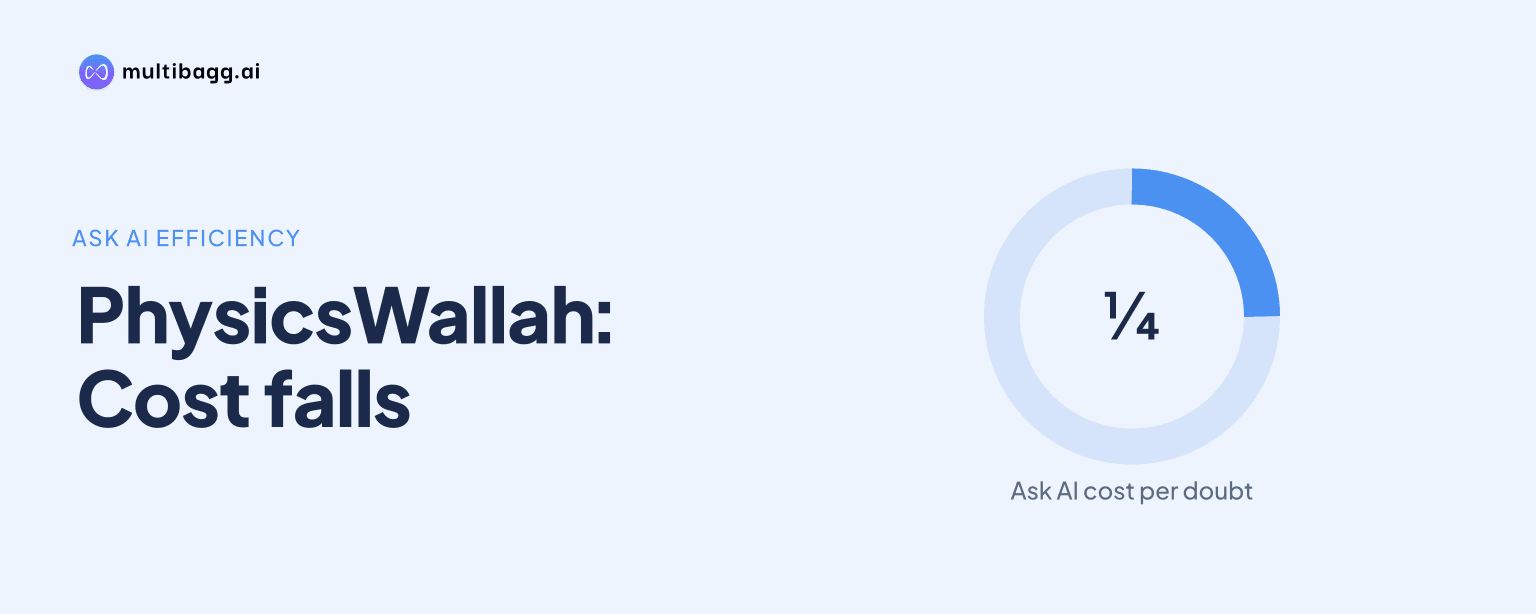
For its 2025 Ask AI product, PhysicsWallah says it handles 14 million student doubts each quarter at one-fourth of the cost of a human expert, with 88.8% customer satisfaction. PW attributes the stated economics to proprietary education data, specialist agents and routing between its own models and frontier large language models.
Know Physicswallah inside out
Results, valuation, peers and who's buying, in one view.
How does PW cut doubt-solving cost?
PW says it cuts doubt-solving cost to one-fourth of a human expert’s cost by splitting each query across specialist agents and selecting models for accuracy, latency and cost. A student submits a voice or text doubt, and the system classifies its intent, routes it to an appropriate agent and combines text, audio, canvas and feedback into a response.
PW describes four layers around the underlying model: experience, context, orchestration and performance. The experience layer places AI in its app, live classes and YouTube, while the context layer draws on PW books, lectures, question bank, batch, syllabus and student history. Its performance layer routes work between in-house models and frontier large language models, or LLMs, according to the task.
Ask AI recorded 88.8% customer satisfaction across its stated workload of 14 million doubts a quarter. PW also reports about 95% accuracy and a hallucination rate below 1% when responses are grounded in its content, although the presentation does not set out the measurement period, test method or benchmark for those two metrics.
What proprietary data supports PW’s AI products?
PW says its AI stack draws on 4.69 billion question interactions a year from tests and practice activity, alongside an exam-aligned question bank of more than 15 million questions. It also reports 108.8 million AI Guru queries from 6.09 million students, creating records of student questions and the explanations they receive.
The reported data pool extends to 37 million tests submitted annually, 2 million hours of video streamed daily, 2.1 million hours of faculty lectures and 3.4 million video solutions. PW says this combination gives its models access to exam-specific content and recurring learner difficulties, rather than relying only on general textbook material.
Newer AI products add further interaction data. Ask AI contributes 14 million doubts per quarter, AI Mentor has logged 6.85 million interactions, and AI Grader has assessed 1.75 million copies. PW says more usage produces more data to fine-tune its models, but the presentation does not quantify how much of each dataset is used in training or how frequently models are updated.
Which agents operate in PW’s AI stack?
PW’s orchestration layer uses specialist agents that classify a request by intent, subject, category or severity, route it to an agent and model, and hand work between agents before producing an answer. Its listed agent functions cover doubt-solving, grading, feedback, well-being, teaching and visual-canvas explanations.
For Ask AI, an intent agent labels the doubt, answer agents handle different question types, a transliteration agent converts script for voice use, and a voice agent speaks the result. This multi-agent design is the system PW links to its 14 million quarterly doubts and 88.8% customer-satisfaction result.
The same approach is used in other products, but at different scales. AI Grader uses classifier, subject and annotation agents to provide handwritten-style feedback across 1.75 million copies for 248,000 students, while AI Mentor uses severity and well-being agents across 6.85 million interactions involving 760,000 students. Tuto, PW’s voice-led one-to-one tutoring pilot, had about 1,500 students and a reported 4.8 out of 5 rating.
Got a follow-up? Ask IRIS
How do PW’s models compare with general models?
PW says its task-specific models operate at lower reported cost than named general-model alternatives. Aryabhata, its physics, chemistry and mathematics model, is a 20-billion-parameter sparse LLM with 3 billion active parameters; PW says it achieves more than 90% accuracy across multi-subject sets.
PW says xlit leaves below 0.1% of Hindi words unconverted, compared with up to 20% for GPT or Gemini, while EquNorm reads equations with 99% precision. The presentation does not disclose pricing dates, technical settings or workloads behind these model comparisons, so the figures are management-reported product metrics.
What does the AI stack mean for PW’s tutoring products?
PW is applying the stack to Tuto, a voice-first one-to-one tutor that guides students, asks questions and checks understanding rather than only supplying an answer. Tuto is grounded in more than 1,200 lectures, 329 topics and over 1 million questions, and PW reports response times of 1.8 to 2.2 seconds, about 95% accuracy and below-1% error.
PW contrasts Tuto with recorded learning and live classes, saying the one-to-one format can adapt to each student and check understanding every few minutes. It identifies cost as the historic barrier to human tutoring, citing human-tutor charges of Rs 300 to Rs 1,000 an hour; evidence disclosed for Tuto so far is limited to its roughly 1,500-student pilot and 4.8 out of 5 rating.
Conclusion
PW’s central claim is that its AI economics depend on the systems around the model, including educational context, specialist agents and model routing. The company’s stated evidence combines Ask AI’s 14 million quarterly doubts, one-fourth human-expert cost and 88.8% customer satisfaction with a data pool that includes 4.69 billion annual question interactions and 108.8 million AI Guru queries.
The next matter to watch is whether PW discloses Tuto’s progress beyond its roughly 1,500-student pilot while maintaining its reported 1.8-to-2.2-second response time. Further detail on the test methods, workloads and pricing assumptions behind PW’s accuracy, hallucination and cost comparisons would also clarify the reported operating economics.