










PhysicsWallah identifies ₹25 crore in recurring AI savings
Key highlights
- PW identifies ₹25 crore a year in recurring savings from six AI and automation initiatives.
- PW says AI writes 92% of its code.
- PW projects about ₹10 crore of annual savings from its in-house CRM from 2028.
- Vibecraft supports more than 80 live internal apps and more than 1.5 million weekly requests.
powered by IRIS
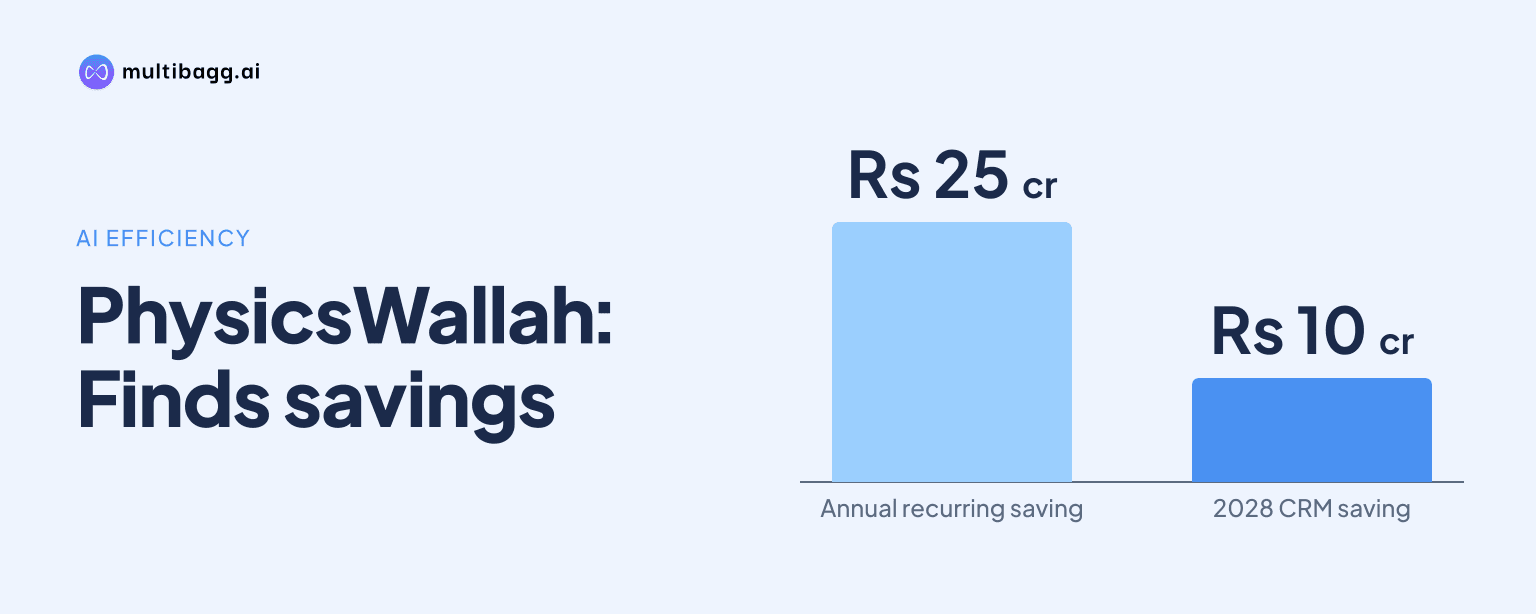
PhysicsWallah says it has identified ₹25 crore a year in recurring savings from artificial intelligence (AI) and automation, while reporting that AI writes 92% of its code. Its largest stated item is projected savings of about ₹10 crore a year from an in-house customer relationship management (CRM) platform replacing a vendor system from 2028.
Know Physicswallah inside out
Results, valuation, peers and who's buying, in one view.
How much annual saving has PW identified from AI and automation?
PW has identified ₹25 crore a year in recurring savings across six AI and automation initiatives. The individual estimates displayed in the presentation add to about ₹25.4 crore a year, while PW presents the overall identified recurring-savings figure as ₹25 crore a year.
The projected in-house CRM is the largest item at about ₹10 crore a year, compared with about ₹6 crore for Smart Ops automation and about ₹4.4 crore for migrating from Zoom to Agora. PW says the CRM will replace a vendor platform and be 80% cheaper from 2028, while the video migration will reduce live-class video costs to one-sixth.
The remaining initiatives use different operating mechanisms. Smart Ops shifts batch operations from managers to software, Studio Audits AI automates 95% of studio checks, and the Academic PPT portal is intended to make lecture-slide creation 30% faster. PW assigns about ₹1.5 crore each to the PPT portal and Real Test Pass, which brings registration, admit cards and results in-house.
What does PW say AI changed in software development?
PW says AI writes 92% of its code. The presentation does not state the measurement period, coding tools, calculation method, or the share of AI-generated code subsequently modified by engineers.
PW illustrates its development approach through an in-house CRM built by one engineer using AI agents in about three months. According to PW, the same build would have taken 10 engineers over a year without AI, which is a comparison of stated staffing and delivery time rather than a separately disclosed financial saving.
The CRM has 620,000 lines of code, 57 feature areas and 757 routes, according to PW. It also has 1,545 automated test files, which the presentation describes as comprehensive automated test coverage.
These engineering metrics are separate from the CRM’s projected savings estimate. PW links the about ₹10 crore annual figure to replacing a vendor CRM from 2028, while the three-month build, 620,000 lines of code and 1,545 test files describe the scope of the internally developed platform.
Got a follow-up? Ask IRIS
How does PW’s in-house CRM track operating activity?
PW presents its in-house CRM as a live product-analytics platform that tracks calls, enrolments, call outcomes, lead sources and stage conversion. The presentation’s example dashboard shows a comparison between current activity and prior-period reference points rather than a company-wide operating result.
For the 11 am to 12 pm interval shown, the dashboard records seven dialled calls today against a four-week average of six. A separate call metric shows 42 today against a four-week average of 45, indicating that the example’s current count was three below the displayed average.
The enrolment view shows 11 enrolments in October month to date, compared with 21 in September and a target of 20. PW’s dashboard labels the October result as behind the prior month by two on the same day, although the presentation does not provide the calendar date for that comparison.
In the last-seven-days call-outcome view, 177 calls were connected, representing 43% of dialled calls. No-answer calls totalled 107, or 26%, compared with 49 busy calls, or 12%; callback requests were 37, or 9%, and switched-off calls were 25, or 6%.
The lead-source view for the last 30 days lists 412 website-form leads, or 40% of the displayed total, ahead of 268 Power Batch page leads, or 26%. Missed calls contributed 151 leads, or 15%, while referrals contributed 96, or 9%; the presentation does not disclose adoption rates for the CRM or its revenue effect.
Where else is PW using AI and automation internally?
PW says non-technology teams have shipped more than 80 internal applications through Vibecraft, an internal platform that generates user interface and logic from plain-language descriptions. Vibecraft handles more than 1.5 million weekly requests and provides one-click deployment, according to PW.
PW says Vibecraft includes built-in security and control and keeps data in-house. Its stated process has users describe an application in plain language, after which Vibecraft generates the interface and logic before deployment.
The applications shown include CounselUp, a training tool in go-to-market phase that is being trialled across teams. PW Vaani is described as an AI calling platform for automated communication, while AI Grader is an automated evaluation tool for Gurukulam schools.
PW does not attach separate savings figures to Vibecraft, CounselUp, PW Vaani or AI Grader. By contrast, Studio Audits AI has an identified saving of about ₹2 crore and automates 95% of studio checks, while the Academic PPT portal has an identified saving of about ₹1.5 crore and is intended to speed lecture-slide creation by 30%.
Conclusion
PW’s presentation links AI-assisted development and workflow automation to ₹25 crore a year of identified recurring savings. The company’s reported 92% AI-written-code figure, its three-month CRM build by one engineer using AI agents, and Vibecraft’s more than 80 live internal applications show that the programme spans engineering, batch operations, live-class video, studio checks and content preparation.
The central item to watch is the in-house CRM, which PW says is projected to replace a vendor system from 2028, be 80% cheaper and generate about ₹10 crore in annual savings. PW also identifies about ₹6 crore from Smart Ops automation and about ₹4.4 crore from the Zoom-to-Agora migration, but it provides no implementation timetable for those initiatives in the presentation.