










PhysicsWallah pilots Tuto targeting 2–6% human tutor cost
Key highlights
- PW’s two-week Tuto Class 8 pilot involved about 1,500 voluntary users and received a 4.8/5 student rating.
- PW targets one-to-one Tuto tutoring at 2–6% of a human tutor’s cost within two to three years.
- PW reports Tuto response times of 1.8–2.2 seconds, about 95% accuracy and less than 1% error.
- PW says Tuto is grounded in more than 1,200 lectures, 329 topics and more than 1 million questions.
powered by IRIS
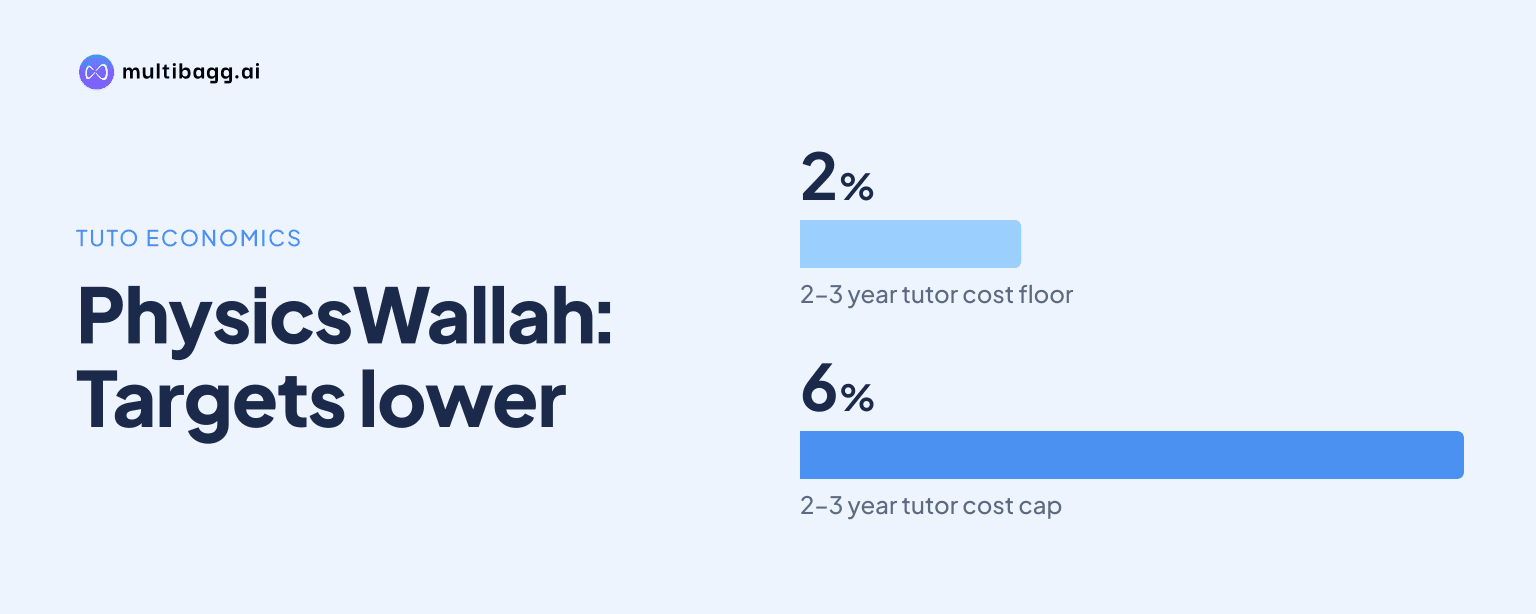
PhysicsWallah (PW) is piloting Tuto, a voice-first one-to-one artificial intelligence tutor, with about 1,500 Class 8 students who gave it a 4.8/5 rating; PW’s two-to-three-year plan targets a Tuto for every PW student at 2–6% of a human tutor’s cost.
Know Physicswallah inside out
Results, valuation, peers and who's buying, in one view.
What is PW Tuto and how does it differ from classes?
PW Tuto is a voice-first one-to-one tutor designed to guide a student, ask questions and check understanding rather than simply answer a doubt. Its multi-agent setup includes an interrupt agent for student cut-ins, a teaching agent that guides lessons and tests comprehension, a canvas agent that draws diagrams, and a voice agent that speaks the lesson.
PW positions Tuto differently from recorded lessons and live classes. Recorded content is one-way and follows the same pace for all students, while live classes are teacher-led and typically handle questions through chat; Tuto is intended to be two-way, change pace for an individual learner and check understanding every few minutes.
PW links the format to the cost constraint of conventional one-to-one tutoring. Its presentation says a human tutor costs Rs 300–1,000 an hour, while describing individual tutoring as a learning format that has historically been limited by its cost rather than its instructional approach.
How large was the PW Tuto pilot compared with other AI products?
PW’s Tuto Class 8 pilot involved about 1,500 students over two weeks, with voluntary use among the Umang Mega Batch and CuriousJr students. Participants gave the product a 4.8/5 student rating, although the presentation does not disclose the number of ratings submitted or the methodology behind that score.
The pilot was smaller than PW’s established AI product deployments, but it tested a different format: live one-to-one teaching. Ask AI handles 14 million doubts a quarter and reports customer satisfaction, or CSAT, of 88.8%, while AI Grader has processed 1.75 million copies for 248,000 students and AI Mentor has logged 6.85 million interactions for 760,000 students.
The comparison shows that PW has already deployed AI across doubt-solving, grading and well-being support at larger volumes than Tuto’s pilot. Tuto adds a teaching interaction that combines voice, questioning, lesson pacing and diagram support, rather than focusing on one task such as marking a copy or answering a doubt.
What is PW’s cost target for Tuto?
PW’s stated target is to provide one-to-one Tuto tutoring at 2–6% of a human tutor’s cost within two to three years. The target appears in the company’s roadmap for a Tuto for every PW student, covering K–12 through GATE, regional languages and the study desk.
PW does not disclose a current Tuto price, its unit cost, a revenue model or a commercial launch date. The 2–6% figure is therefore a management plan rather than a reported result from the two-week Class 8 pilot.
The company contrasts the planned model with recorded lessons and live classes, which it describes as low-cost at scale. PW’s intended distinction is that Tuto would retain one-to-one adaptation while operating at a lower cost than a human tutor, but the presentation provides no projected student volumes or economics for that wider rollout.
Got a follow-up? Ask IRIS
How does PW say Tuto delivers teaching responses?
PW reports that Tuto has about 95% accuracy, less than 1% error and a response time of 1.8–2.2 seconds. The tutor supports voice interactions in Hindi, English and Hinglish, the commonly used blend of Hindi and English, giving it three language formats in the pilot design.
The product is grounded in PW content comprising more than 1,200 lectures, 329 topics and more than 1 million questions. PW says this content is used to support grounded answers, reduce hallucinations and select examples aligned with its teaching method.
PW also draws on learning signals from products including AI Guru, Books, Pi and Mentor. These products provide information on student questions, points where learners get stuck and engagement patterns, while Tuto’s teaching agent is designed to use questions and checks of understanding during a live lesson.
What AI stack and roadmap support the PW Tuto plan?
PW’s AI stack accepts voice and text doubts, handwritten copies, well-being chats and one-to-one tutor requests. An orchestration layer classifies the intent, subject, category or severity; routes work to an agent and model; passes work between agents; and combines text, audio, canvas and feedback into one response.
The company says its proprietary data includes more than 4.69 billion question interactions, 108.8 million AI Guru queries, 2.1 million hours of faculty lectures, 6.85 million mentor interactions and 1.75 million graded copies. Tuto is built on the same specialist-agent and agent-to-agent handoff approach that PW presents for Ask AI, AI Grader and AI Mentor.
PW identifies Awaaz, its text-to-speech model, and in-house routing as part of Tuto’s model layer. Awaaz supports 12 Indic languages plus English with code-mixing and was trained on more than 1,000 hours of teacher voice data; PW says the model is 20 times cheaper than ElevenLabs text-to-speech, without disclosing Tuto’s total model cost.
Conclusion
PW’s Tuto pilot combines a voice-led teaching format with the company’s existing content, models and multi-agent systems. The two-week Class 8 test reached about 1,500 voluntary users and produced a 4.8/5 student rating, while the reported 1.8–2.2-second response time and more than 1 million-question content base indicate how PW is seeking to support a live teaching interaction.
The next disclosed milestone is PW’s two-to-three-year plan to make Tuto available to every PW student across K–12 through GATE, regional languages and the study desk. The unresolved matters are the commercial rollout date, price, unit economics, learning-outcome data and whether PW can meet its stated target of one-to-one tutoring at 2–6% of human tutor cost.