










PhysicsWallah plans offline business near break-even in FY27
Key highlights
- PW plans for total offline operations to be close to break-even in FY27.
- Offline enrolments rose 44% to 467,000 in FY26 from 325,000 in FY25.
- PW says its 2022, 2023 and 2024 centre cohorts were profitable in FY26.
- PW operated 257 core offline centres in AY26, compared with 10 in AY21.
powered by IRIS
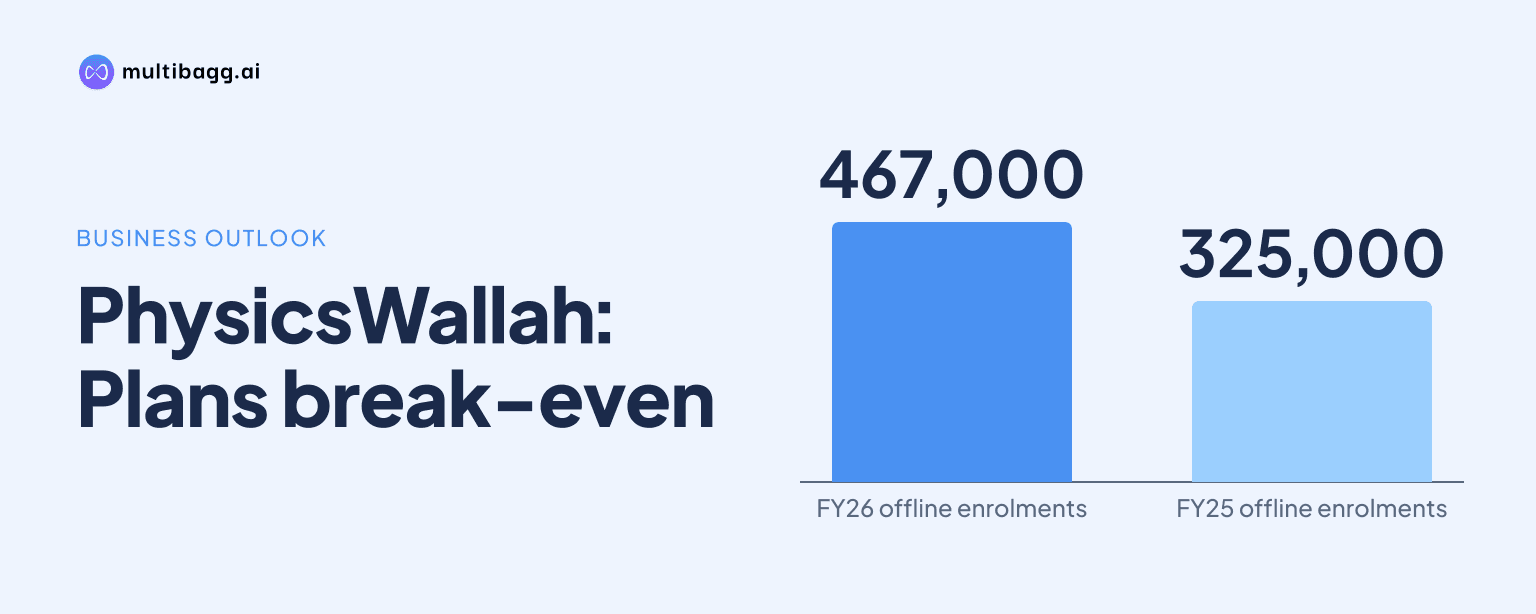
PhysicsWallah plans for total offline operations to be close to break-even in FY27 after FY26 offline enrolments rose 44% to 467,000 and the 2022, 2023 and 2024 centre cohorts became profitable, according to its Investor Day 2026 presentation. The plan depends on maturing centres offsetting continuing launch costs.
Know Physicswallah inside out
Results, valuation, peers and who's buying, in one view.
Why does PW plan to approach offline break-even in FY27?
PW plans to be close to offline break-even in FY27 because Vidyapeeth, identified as its largest contributor, is planned to turn positive while older centre cohorts continue to mature. The presentation says operating centres were profitable before expansion costs in FY26, distinguishing existing-centre economics from the expense of opening new locations.
The FY27 improvement is a plan rather than a reported outcome. PW attributes it to maturing Vidyapeeth classes and pricing steps, tighter costs at Xylem and Utkarsh, scaling from a small base in other centres, and steady improvement at Pathshala. Management’s stated steady-state objective is a low-to-mid-teens margin as the mix shifts towards mature centres, without providing a timing target or a consolidated margin figure.
PW describes a centre’s first year as a launch-and-fill phase, when seats are partly filled, minimum faculty provisioning raises academic cost and launch marketing is higher. In year two, batches approach optimal capacity, student-teacher ratio improves, marketing declines as a share of revenue and carry-forward student revenue is added. In year three and beyond, PW expects filled seats, multiple shifts, better faculty utilisation and average revenue per user growth.
Which PW centre cohorts are profitable?
PW says the 2022, 2023 and 2024 centre cohorts were profitable in FY26, while the 2025 cohort remained loss-making and the 2026 cohort was in launch mode. Under PW’s FY27 plan, the 2025 cohort is expected to break even, leaving the 2026 cohort as the only loss-making vintage.
The change from FY25 to FY26 is that all three older cohorts shown were profitable by FY26, rather than loss-making. PW says the 2022 to 2024 cohorts began with marginal losses, but does not disclose cohort-level revenue, profit or margin. Therefore, FY27 break-even for the 2025 cohort remains management’s expectation.
PW also says it has moved from large mega-centres towards smaller hyperlocal centres. The presentation says older centres became profitable in year three, while newer centres can reach break-even or profitability in year two, about a year sooner. It does not disclose capital spending, payback amounts or separate margins for either format.
How quickly has PW expanded its offline network?
PW expanded its core offline-centre network to 257 centres in AY26 from 10 in AY21, although year-on-year growth slowed to 6% from 93% in AY25. This core measure includes Vidyapeeth, Pathshala and Tuition Centres, while excluding other centres and subsidiaries.
PW’s 467,000-enrolment total uses a wider footprint than its 257 core-centre count. As of 31 March 2026, PW reported 353 centres across 178 cities, including other centres and subsidiaries. Other-centre enrolments rose to 48,078 in FY26 from 16,855 in FY25, while subsidiary enrolments increased to 119,835 from 100,322.
Southern expansion contributed to this wider network. PW grew from one Vidyapeeth or Pathshala centre in the South in AY23 to 32 in AY26, excluding Kerala: 14 were in Karnataka, 11 in Telangana, five in Tamil Nadu and two in Andhra Pradesh. Through Xylem in Kerala, centres increased from 18 in March 2025 to 30 in March 2026, while enrolments rose from 51,000 to 65,000.
Got a follow-up? Ask IRIS
What evidence does PW give on classroom demand and outcomes?
PW points to growth in Vidyapeeth enrolments, student satisfaction and admissions outcomes. Vidyapeeth enrolments increased to 256,670 in FY26 from 180,255 in FY25, while its Net Promoter Score, or NPS, rose to 41 in FY26 from 32 in FY25 and 19 in FY24.
Faculty ratings at Vidyapeeth rose to 4.3 out of five in FY26 from 4.1 in FY25 and 3.9 in FY24. PW reported 2,773 admissions to Indian Institutes of Technology, National Institutes of Technology and government medical colleges in 2026, up 35% from 2,049 in 2025. This included 413 Indian Institutes of Technology admissions, up 61% from 257, and 1,635 medical admissions, up 28% from 1,274.
PW is also planning a greater share of Foundation admissions. Foundation represented 10.84% of admissions in FY26, compared with 8.44% in FY25, and PW estimates 15.22% for FY27. Management said the delayed NEET 2026 result mainly affected dropper-NEET admissions in the season and described the delay as a one-time event; it plans a more balanced mix of Foundation and Class 11 cohorts to support internal retention.
How is PW controlling expansion risk?
PW says each centre launch must pass six checks: local demand and competition, the existing online learner base in the catchment, faculty availability, rent economics, payback thresholds and socio-economic indicators. The company does not disclose the required payback threshold or a planned number of FY27 centre openings.
PW’s conversion-first approach changes a Pathshala to a Vidyapeeth when admissions cross about 800. The company had completed 29 such conversions through AY26, including 10 in AY26, three in AY25, one in AY24, 14 in AY23 and one in AY22. PW also says a conversion may occur when a competitor expands offline into a market with rising demand.
In Kota, PW says student inflow fell for macro reasons as students increasingly chose to study closer to home. Following faculty redeployment to lower-utilisation categories, Kota students per teacher rose to 105 in AY26-27 year to date from 73 in AY23-24. The FTP blend, which the presentation does not define, increased to 9.8% of faculty from 7.2% over the same period.
Conclusion
PW’s presentation shows a maturing offline network rather than a reported profitable offline business: it had 257 core centres in AY26, 467,000 offline enrolments in FY26 and three profitable older centre cohorts. Its central claim is that mature operating centres are profitable before the cost of opening new centres.
The next disclosed milestones are PW’s FY27 plan for Vidyapeeth to turn positive, total offline operations to be close to break-even and the 2025 cohort to break even. Investors can also watch whether Foundation reaches PW’s estimated 15.22% FY27 admission share and whether new launches continue to meet its six stated screening checks.