










LAPL targets 40% FY27 growth on Rs 15 crore monthly indents
Key highlights
- LAPL targets 40% FY27 growth after discussing around Rs 44 crore of H1 revenue.
- LAPL plans approximately Rs 15 crore of monthly H2 indents, equivalent to about Rs 90 crore over six months.
- LAPL management expects H2 EBITDA margin of about 14.5% to 15.5%.
- LAPL said mirror order-book volume reached 75,000 units in the current month, versus initial volumes of 15,000 to 20,000 units.
powered by IRIS
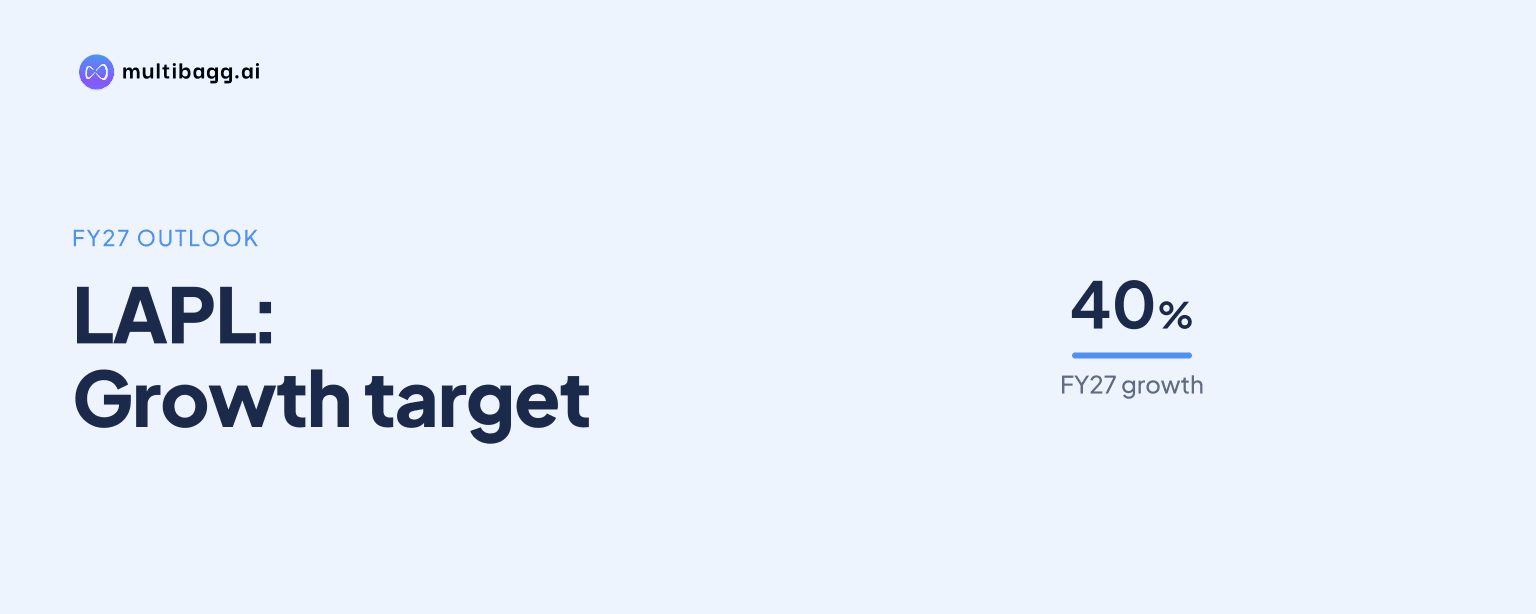
LAPL Automotive Limited targets 40% FY27 growth after around Rs 44 crore of first-half revenue, with management planning about Rs 15 crore of monthly indents in H2. The plan amounts to roughly Rs 90 crore across six months, above the approximately Rs 86 crore implied by the roughly Rs 130 crore full-year outcome discussed on the call.
Know LAPL Automotive inside out
Results, valuation, peers and who's buying, in one view.
How does LAPL plan to achieve 40% FY27 growth?
LAPL plans to achieve 40% FY27 growth through about Rs 15 crore of monthly indents in the second half. An analyst said 40% growth would imply roughly Rs 130 crore of full-year revenue after about Rs 44 crore in H1, and management replied, “Almost yes.” Management called the 40% expectation a “decent conservative growth” outlook.
The arithmetic requires a marked change in H2. Revenue of about Rs 44 crore in H1 leaves roughly Rs 86 crore to reach Rs 130 crore for FY27, while six months of Rs 15 crore indents totals about Rs 90 crore. Indents are planned orders rather than reported sales, so the outcome depends on production, dispatches and customer releases.
Management also outlined growth of almost 80% and 120% in coming years once its core unit is operational, but did not provide a date, revenue base or plant-specific sales estimate for those figures. The nearer-term FY27 plan is instead tied to the Rs 15 crore monthly indent schedule and machinery already in transit.
Why was LAPL’s first-half growth limited?
LAPL said delayed customer orders and the status of Unit 4 limited first-half growth. Management said it had been waiting for a purchase order under a new vendor code, but a mishap at the customer end delayed that customer’s order book. It said the expected order book remained in place and was expected to be taken in the coming months.
Product development also makes revenue timing uneven, according to management. LAPL said research and development projects can create a sudden sales increase once productionised. In mirrors, management cited initial volumes of 15,000 to 20,000 units and said the order book had reached 75,000 units in the current month.
Unit 4 will cater to original equipment manufacturer, or OEM, products rather than the replacement market, management said. The call did not provide a production-start date for Unit 4, but management said its machines were in transit and expected revenue to increase sharply in H2 once they arrived.
Which capacity additions could support LAPL’s H2 ramp?
LAPL is directing its new capacity towards lighting, where management cited a gross difference of about 28% to 30%, compared with about 18% to 20% for motors and mirrors. Management said four major OEMs had entered its industrial area and that state policy requires those OEMs to develop 50% of vendors locally.
The new plant is planned to house another 14 moulding machines with higher tonnage, compared with 14 existing machines ranging from 80 tonnes to 200 tonnes. Management did not provide a revenue estimate because output value depends on product mix. It said existing plastic-moulded products are priced at about Rs 20 to Rs 80, while new products could start at about Rs 200 and reach Rs 800.
Management said the higher-ticket products should retain similar percentage margins but generate more value per part. The new facility is planned to add an in-house tool room, plastic moulding, a central research and development laboratory, pick-and-place equipment and surface-mount technology lines for printed circuit board manufacturing. Management said tooling accounts for almost 80% of development cost.
Got a follow-up? Ask IRIS
What demand sources are behind LAPL’s planned indents?
LAPL is relying on delayed orders, new vendor approvals and product programmes to support its planned Rs 15 crore monthly H2 indents. Management said it had received three vendor codes from companies with global operations and revenue above Rs 20,000 crore, although it did not identify them or disclose a rupee contribution from each customer.
Management expects each of the three new customers to use at least one month of production capacity during the first year. For motors, it gave a volume illustration: if LAPL produces 15,000 motors each month for existing customers, the three additions together are expected to buy 50,000 motors within a year. Management also said motors are a new segment for those customers, so traction will take time.
LAPL also said customer concentration may not decline proportionately even as it adds customers. Management illustrated this with Rs 75 crore from Varroc and Rs 25 crore from other customers, noting that an additional Rs 10 crore from other customers could coincide with growth in Varroc revenue. The company did not provide a target share for its top customers in FY27, FY28 or FY29.
What margins and working-capital factors will affect LAPL’s delivery?
LAPL expects H2 earnings before interest, tax, depreciation and amortisation, or EBITDA, margin of about 14.5% to 15.5%, according to management. Management said first-half EBITDA margin had declined slightly after machinery additions, which it linked to higher depreciation, and said margins should sustain at the prior-year level once volumes catch up.
Working-capital movements will be relevant to the H2 ramp. Management said inventory days rose to 94 from 60 because raw materials had been procured for H2. It also said debtor days rose to about 76 from 26, while average debtor recovery was about 45 days and expected working-capital days were 50 to 60 days.
LAPL reported Rs 15.45 crore of bank debt, including about Rs 2.10 crore of long-term debt, with the balance described as working-capital borrowing. Management put the borrowing rate at 8.25% and said it could increase its cash-credit limit if funds are required, linking H2 execution to both order conversion and working-capital availability.
Conclusion
LAPL’s 40% FY27 growth expectation requires a substantial H2 step-up from about Rs 44 crore of H1 revenue. Management’s planned Rs 15 crore of monthly indents is mathematically sufficient to cover the roughly Rs 86 crore implied H2 requirement, but the projection depends on delayed orders being released, machinery being installed and new programmes entering production.
The next disclosures to watch are the timing of machinery in transit, the conversion of planned indents into dispatches and the release of the delayed customer order book. Management has also set an H2 EBITDA margin expectation of 14.5% to 15.5%, working-capital days of 50 to 60 days and indicated that it may raise bank cash-credit limits if needed.