










Lead Reclaim outlines 4,200 MT monthly recycling capacity
Key highlights
- Lead Reclaim’s four recycling verticals total 4,200 MT of monthly targeted or stated total capacity.
- Kheda’s tyre-crumb configuration rises from 960 MT currently to a stated 1,800 MT total.
- TPO and RCB each carry a 750-MT monthly target at Mundra.
- Chhatral’s recycled-EPDM facility is ready, with a 900-MT monthly target and Rs 2.5 crore stated investment.
powered by IRIS
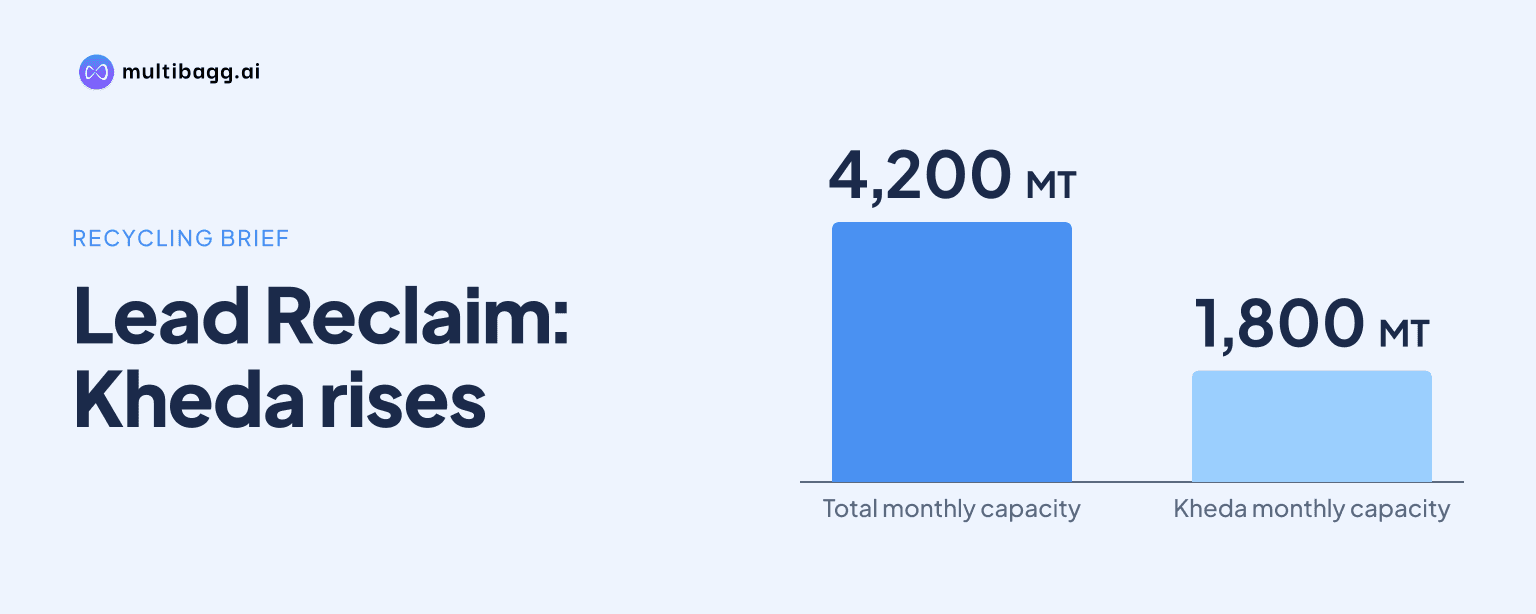
Lead Reclaim and Rubber Products Ltd has outlined four recycling verticals with 4,200 metric tonnes (MT) of combined monthly targeted or stated total capacity: tyre pyrolysis oil, recovered carbon black, recycled EPDM and tyre crumbs. The 1,800-MT Kheda configuration is the largest disclosed figure, versus 900 MT at Chhatral and 750 MT each for two Mundra lines.
Know Lead Reclaim and Rubber Products inside out
Results, valuation, peers and who's buying, in one view.
What are Lead Reclaim’s four new recycling verticals?
Lead Reclaim’s four new verticals are tyre pyrolysis oil (TPO), recovered carbon black (RCB), recycled ethylene propylene diene monomer rubber (EPDM), and tyre crumbs, also called rubber granules. The presentation describes TPO and RCB as waste-tyre outputs, while recycled EPDM is recovered from used rubber products and tyre crumbs are made from waste tyres.
The four disclosed figures aggregate to 4,200 MT a month: 750 MT for TPO, 750 MT for RCB, 900 MT for recycled EPDM and 1,800 MT for tyre crumbs. This is not reported output. The presentation labels the first three figures as monthly targets, while the Kheda figure is a stated total capacity configuration.
TPO and RCB are each associated with a Mundra facility on 2.40 acres of shared land, and each slide lists investment of Rs 12 crore. The source does not clarify whether these are separate investments or overlapping figures for the shared location. The TPO slide also identifies Rs 4 crore of construction expenditure.
How do TPO and RCB fit Lead Reclaim’s plan?
Lead Reclaim positions TPO as an alternative industrial fuel with a 750-MT monthly target and a stated calorific value of 98% to 99% of furnace oil. Management says TPO is Rs 10 to Rs 15 per litre cheaper than furnace oil and identifies cement kilns, steel mills and brick kilns as intended end markets.
The stated TPO process begins with waste tyres, uses pyrolysis and produces oil for cement kilns, steel mills and industrial furnaces. Lead Reclaim cites Central Pollution Control Board mandates and Extended Producer Responsibility (EPR) policy support, but the presentation gives no commissioning date, utilisation assumption, selling price or customer contract for the 750-MT Mundra target.
RCB is the second Mundra line, also with a 750-MT monthly target and listed investment of Rs 12 crore. It is recovered from waste tyres and is intended for tyres, plastics, conveyor belts and inks. Lead Reclaim compares a stated RCB price range of Rs 30 to Rs 70 per kilogram with Rs 95 to Rs 130 per kilogram for virgin carbon black.
Management says RCB can provide 40% to 60% savings for end users and have 90% lower emissions than virgin carbon black. It also says Bureau of Indian Standards standardisation is underway. The presentation’s global-industry series for RCB rises from $210 million in 2022 to an estimated $522 million in 2028; this is a market estimate presented by Lead Reclaim, not a company revenue forecast.
Got a follow-up? Ask IRIS
What capacity changes are disclosed for EPDM and tyre crumbs?
Lead Reclaim says its Chhatral recycled-EPDM facility is ready and targets 900 MT per month from 0.40 acres, with stated investment of Rs 2.5 crore. The process listed is size reduction and granulation, grinding and powdering, followed by blending and quality checks to produce recycled EPDM.
The company identifies flooring, playgrounds, sports surfaces and industrial applications for recycled EPDM, as well as auto hoses, roofing and waterproofing. Management says recycled EPDM is 70% cheaper than virgin EPDM and links demand to electric-vehicle adoption and smart-city infrastructure. The slide provides no sales volume, realised price or margin figure for this 900-MT target.
At Kheda, Lead Reclaim shows current capacity of 960 MT, enhanced capacity of 1,100 MT and an additional 700 MT of crumbs, resulting in a stated 1,800-MT total. The move from 960 MT currently to 1,800 MT is a net increase of 840 MT, while the added crumb capacity accounts for 700 MT of the stated total change.
The tyre-crumb process comprises shredding, cryogenic or ambient granulation, screening and size separation. Lead Reclaim says the material can be used in sports surfaces, playgrounds, construction, roads and moulded rubber products. It compares crumb prices of Rs 25 to Rs 35 per kilogram with Rs 150 to Rs 200 per kilogram for virgin rubber, and says crumb-rubber-modified bitumen can improve road life by 50% to 75%.
What market and EPR mechanisms support the expansion?
Lead Reclaim’s presentation identifies industrial fuel substitution, rubber-product applications, roads and construction as the demand base for the four lines. The company reports that domestic sales represented 94% of revenue and exports 6%, so the cited Indian uses, including kilns and road construction, are particularly relevant to the proposed capacity additions.
The market series differ by vertical. The presentation shows TPO global industry increasing from $361 million in 2022 to an estimated $527 million in 2028, compared with recycled EPDM rising from $0.88 billion to $1.45 billion and tyre crumbs from $1.68 billion to $2.27 billion. These source figures place the proposed products in both fuel and recycled-material markets.
EPR is a policy mechanism under which producers can operate their own recycling facilities or purchase credits from authorised recyclers. Lead Reclaim reports total EPR generation of 24,767.691, sales of 15,778 and a balance of Rs 4.20 crore as of March 31, 2026. It names CEAT, JK Tyres and TVS as key clients.
The source says EPR targets were 35% in FY23, 70% in FY24 and 100% in FY25. Its table assigns a weight allocation of 1.25 to RCB, 1.00 to crumb rubber, 0.80 to continuous-method pyrolysis oil and char, and 0.50 to batch-method pyrolysis oil and char. Management presents the framework as an opportunity for recycling-related revenue and longer-term supply agreements.
Conclusion
Lead Reclaim is setting out a broader recycling portfolio alongside reclaimed rubber, with 4,200 MT of combined monthly targeted or stated total capacity across Mundra, Chhatral and Kheda. The proposed mix spans industrial fuel, carbon-black recovery, recycled EPDM and tyre granules, while Kheda’s stated configuration changes most visibly, from 960 MT currently to 1,800 MT.
The next items to watch are commissioning and utilisation of the two 750-MT Mundra targets and the ready 900-MT Chhatral facility. Management’s plan depends on the disclosed EPR framework, industrial offtake and product-price differentials, but the presentation does not disclose start dates, customer commitments, revenue contribution or whether the two Rs 12 crore Mundra investment figures are separate.