










Liotech Shapar expansion targets capacity above 5,000 tonnes
Key highlights
- Liotech expects Shapar capacity to rise above 5,000 metric tonnes from 2,458 metric tonnes per annum.
- Liotech reported Rs 33.64 crore of revenue and Rs 6.21 crore of EBITDA in H1 FY27.
- The Shapar project is expected to nearly double built-up area to 12,632 square feet.
- Liotech said its existing Shapar plant was operating at about 88% capacity utilisation.
powered by IRIS
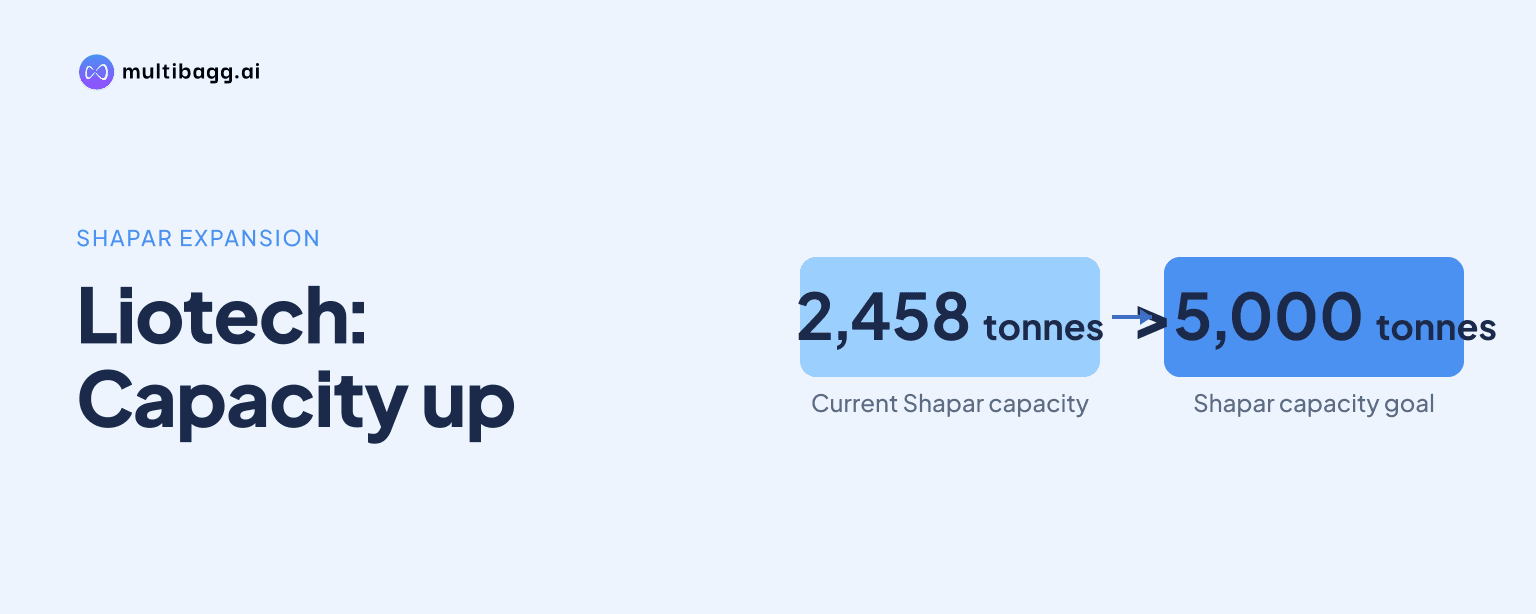
Liotech Industries Limited expects its Shapar expansion to take hardware production capacity above 5,000 metric tonnes from 2,458 metric tonnes per annum on an eight-hour shift, management said on November 12, 2026. The project follows utilisation of about 88% at the existing facility and is expected to deliver phased benefits in FY28.
Know Liotech Industries inside out
Results, valuation, peers and who's buying, in one view.
How much capacity will Liotech add at Shapar?
Liotech expects the Shapar project to more than double its stated capacity of 2,458 metric tonnes per annum to above 5,000 metric tonnes. Management said the 2,458-tonne figure is calculated on an eight-hour shift, while the factory currently operates on a 12-hour shift and is using more than 80% of its capacity, at about 88% according to the call.
The project is intended to remove a production constraint as Liotech broadens its market coverage. The company currently serves nine states and Union Territories, while management cited 36 states and Union Territories as the wider addressable geography. Management said adding more dealers, distributors and customers would be difficult while the existing plant remains near 88% utilisation.
Liotech also described its earlier capacity additions in daily terms. Management said capacity was 4 metric tonnes per day in 2023, subsequently rose from 4 to 6 tonnes and then from 6 to 8 tonnes per day on a 12-hour shift. It added that the existing site could manufacture about 16 tonnes daily on a 24-hour shift, while the new project would lift capacity by more than 200% from the present level.
What will Liotech build and install at Shapar?
Liotech is adding two floors at Shapar, which management expects to nearly double built-up area to approximately 12,632 square feet. The company also plans to install computer numerical control fibre-laser cutting and bending machines, pipe-cutting machines, injection-moulding machines and automated packaging equipment to increase automation and product capability.
The machinery programme is also intended to support more complex and higher-margin products, management said. Liotech has more than 150 product specifications across nine categories, including hinges, door kits, tower bolts, aldropes, gate hooks, door stoppers, locks and handles. Management said stock-keeping units, or SKUs, are being expanded continuously through research and development work.
The work remained in progress when management spoke on November 12, 2026. It estimated construction would be completed in one to two months and capital expenditure would be deployed in two to three months, with utilisation in the last quarter. In prepared remarks, Liotech said larger capabilities would be commissioned in phases and benefits were expected in FY28.
How is Liotech financing the Shapar project?
Liotech is financing machinery and related initiatives partly from its June 2026 initial public offering, which raised Rs 36.02 crore in aggregate. That amount comprised a Rs 28.89 crore fresh issue and a Rs 7.13 crore offer for sale, meaning only the fresh-issue component went to the company for its stated uses.
As of September 30, 2026, Liotech had used Rs 24.25 crore of net fresh-issue proceeds of Rs 24.28 crore for machinery purchases, borrowings repayment, working capital and general corporate purposes. The remaining Rs 3.24 lakh was held in escrow and current accounts, and the company said there had been no deviation from the stated objects of the issue.
Management also addressed a Rs 10 crore current investment on the H1 FY27 balance sheet. It said the sum was held as a fixed deposit because modernization of the manufacturing plant was under way, and would be used to purchase machinery after that work was completed. Management said machinery-related utilisation should be completed within two months.
Got a follow-up? Ask IRIS
What sales opportunities will Liotech pursue with capacity?
Liotech plans to use additional production capacity to add distribution partners, enter more states and explore exports to South Africa and Gulf regions. Its present business model is centred on wholesalers, dealers, distributors and stockists rather than direct retail sales. Management said it does not currently plan to pursue original equipment manufacturer business because its priority is building Liotech as a national-level brand.
The company cited a domestic purchase order of about Rs 6.46 crore for architectural hardware products secured in June 2026, with an execution timeline of around 30 days. Management said demand and product preferences vary across regions, so production planning is shaped by those regional requirements. The order does not constitute a disclosed forecast for revenue from the expanded plant.
Capacity growth is paired with a product-mix objective. Management said new equipment should enable higher-margin and complex products that allow Liotech to compete with larger players. It also identified distribution expansion, a wider portfolio, operational efficiency and export exploration as strategic priorities, but disclosed no export order, export revenue target or date for overseas sales.
How does the expansion relate to Liotech’s H1 FY27 results?
Liotech reported total revenue of Rs 33.64 crore in H1 FY27, earnings before interest, tax, depreciation and amortisation, or EBITDA, of Rs 6.21 crore, and an EBITDA margin of 18.46%. Profit before tax was Rs 4.72 crore, or 14.04% of revenue, while profit after tax was Rs 3.54 crore, producing a margin of 10.51%.
The reported H1 EBITDA margin was above management’s stated forward ranges. In prepared remarks, management referred to a targeted EBITDA margin range of 15% to 16%; in the question-and-answer session, it committed to 14% to 15% and said excess margin could be directed to marketing, branding and national market presence. Management also said it expected a net margin of 10% to 11%.
Steel prices remained firm during H1 FY27, according to Liotech, while construction work created some manufacturing disruption. Management said price increases in steel of more than 5% would be passed through to customers, whereas smaller movements below 5% would be absorbed by the company. It did not provide a quantified estimate for FY28 utilisation, revenue or profitability from the added capacity.
Conclusion
Liotech’s expansion plan combines a more than doubling of stated capacity, additional built-up area and machinery for cutting, moulding and packaging. The project addresses a factory operating at about 88% utilisation and is intended to create room for more dealers, more geographies and a broader mix of architectural and builder’s hardware products.
The next items to watch are construction completion within management’s one-to-two-month estimate, machinery deployment within two to three months and phased benefits in FY28. Management’s ability to convert capacity into additions beyond the nine states and Union Territories it currently serves, while operating within its stated EBITDA margin ranges, remains an unresolved execution measure.