










Lloyds plans Rs 13,000 crore FY27 capex, similar FY28
Key highlights
- Lloyds incurred Rs 6,052 crore of capex in H1 FY27 against an about Rs 13,000 crore FY27 plan.
- Lloyds reported standalone net debt of Rs 9,316 crore as of September 30, 2026.
- Pellet capacity is expected to rise from 8 million tonnes to 9.6 million tonnes in three to four months.
- Management expects beneficiation benefits from FY29 while usable iron-ore volume remains at 26 million tonnes.
powered by IRIS
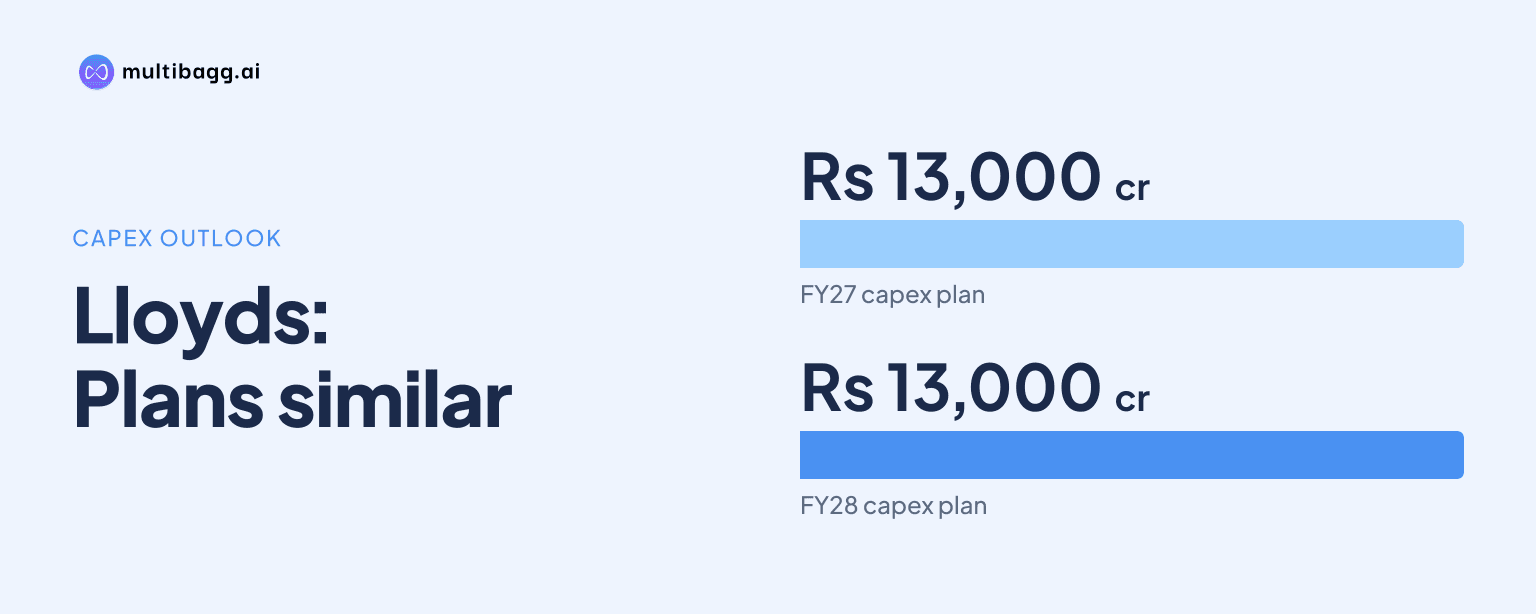
Lloyds Metals plans about Rs 13,000 crore of capital expenditure in FY27 after incurring Rs 6,052 crore in H1 FY27, and management indicated similar spending for FY28. The investment programme covers downstream steel and beneficiation projects, although the final configuration, capacity and machinery for the proposed steel complex remain under study.
Know Lloyds Metals & Energy inside out
Results, valuation, peers and who's buying, in one view.
How much is Lloyds spending in FY27 and FY28?
Lloyds plans about Rs 13,000 crore of capital expenditure in FY27 and has indicated a comparable outlay for FY28. It spent Rs 6,052 crore in H1 FY27 while building downstream steel and beneficiation projects, according to management.
The H1 outlay equals about 47% of the stated Rs 13,000 crore FY27 plan, leaving about Rs 6,948 crore if Lloyds reaches that level. Management did not provide a quarterly capex schedule, project-level allocation or a split between the steel, power, pellet and beneficiation programmes.
The investment programme follows a larger operating base in H1 FY27. Lloyds reported revenue from operations of Rs 9,545 crore, up 94% year on year, while earnings before interest, tax, depreciation and amortisation, or EBITDA, rose 126% to Rs 3,658 crore. Management attributed the increase to higher iron-ore environmental-clearance limits, a faster pellet-plant ramp-up and higher sponge-iron volumes.
How is Lloyds financing its capital programme?
Lloyds reported standalone net debt of Rs 9,316 crore as of September 30, 2026, and consolidated net debt below Rs 20,000 crore. Management did not disclose a funding mix for the Rs 13,000 crore FY27 capex plan, such as the proportions to be covered by operating cash flow, cash balances or borrowing.
H1 FY27 capex of Rs 6,052 crore exceeded H1 EBITDA of Rs 3,658 crore by Rs 2,394 crore. This comparison shows the investment outlay was larger than reported half-year EBITDA, but it does not establish how the spending was funded because the call gave no operating-cash-flow, cash-balance or project-finance figures.
Management said a significant part of consolidated debt related to the Chemaf acquisition and that it was seeking more favourable debt terms. Chemaf management said it aimed to complete the restructuring within three to four months, before the end of the financial year, and expected debt at the asset to decline over the longer term as projects are completed.
Chemaf’s two projects are targeted for completion by the end of the financial year and production in FY28. Management said both have captive mines within a 5-kilometre radius and dedicated sulphuric-acid plants, while the Surya Mines operation faces sulphuric-acid supply constraints and ore transport distances of about 70 to 75 kilometres.
What is the status of Lloyds' steel complex?
Lloyds has acquired around 1,200 acres and holds environmental clearance, or EC, for 4.5 million tonnes, but the final steel-complex configuration remains under review. Management said active work had begun only on the power plant that would supply the beneficiation and pellet plants.
The company has commissioned an overall-complex study and expects to decide the exact framework, plant capacity and machinery requirements in the next couple of months. An analyst asked about a 3 million-tonne hot-rolled-coil project, but management did not confirm that capacity as its final construction configuration.
The immediate construction sequence therefore centres on captive power rather than a completed steel-plant design. Management said the power project falls within the 4.5 million-tonne EC and will support beneficiation and pellet operations. It did not disclose the power plant’s cost or its share of the Rs 13,000 crore FY27 capex programme.
The proposed complex also sits alongside existing downstream expansion. Lloyds said it had commissioned its second pellet plant in May, producing 3.81 million tonnes of pellets in H1 FY27. Pellet realisation was Rs 11,520 per tonne in H1, with EBITDA of Rs 4,988 per tonne, according to management.
Got a follow-up? Ask IRIS
When will Lloyds' wire-rod and beneficiation projects contribute?
Lloyds expects its blast furnace and coke oven to start in Q4, followed by the steel plant and wire-rod mill in Q1 2027. Management said the steel plant was delayed by about one quarter and described it as effectively a greenfield-scale project.
Pellet expansion has a nearer timetable than the wire-rod project. Management said pellet capacity should rise 20% from 8 million tonnes to 9.6 million tonnes within three to four months, with volumes expected at about 8 million tonnes this year and around 9.5 million tonnes next year.
Beneficiation has the latest expected contribution date. Management said the benefits should begin in FY29, rather than the following year, while usable iron-ore volume is expected to remain at 26 million tonnes throughout the period. That means the investment is not expected to increase the stated usable-ore volume before FY29.
Management said banded hematite quartzite, or BHQ, was not simply being stockpiled for future beneficiation. It said BHQ also assists the mining of the 26 million tonnes of annual iron ore, linking current mining operations with the later beneficiation programme.
What operating performance is supporting Lloyds' investment cycle?
Lloyds reported an H1 FY27 EBITDA margin of 38.33%, up 542 basis points year on year, compared with a Q2 margin of 37.22%, up 419 basis points. Management cited lower iron-ore logistics and freight costs after slurry-pipeline commissioning, higher realisations and a larger contribution from value-added products.
Value-added products accounted for 61% of standalone revenue and 67% of earnings before interest and tax, or EBIT, in Q2 FY27. Those shares were 43% and 49%, respectively, a year earlier, showing a 18-percentage-point increase in revenue mix and an 18-percentage-point increase in EBIT mix.
The segment comparison also shows why pellets are central to the near-term expansion. H1 pellet EBITDA was Rs 4,988 per tonne, compared with Rs 2,239 per tonne for iron ore. These are reported segment measures with different products and operating characteristics, rather than a forecast of returns from future capacity additions.
Iron-ore production reached 10 million tonnes in H1 FY27, up 35% year on year, while direct reduced iron sales rose 104% to 343.1 kilotonnes. Management said the monthly iron-ore run rate remained above 2 million tonnes, but it also cited the rainy season as a constraint on quarterly mine production.
Conclusion
Lloyds is pursuing about Rs 13,000 crore of FY27 capex, with a similar FY28 spending indication, while its H1 FY27 outlay reached Rs 6,052 crore. The plan is phased: pellet capacity is due to increase within months, wire-rod operations are targeted after the Q4 and Q1 2027 commissioning steps, and beneficiation benefits are not expected until FY29.
The next developments to watch are management’s steel-complex capacity and machinery decision in the next couple of months, the planned Q4 start of the blast furnace and coke oven, and the targeted Q1 2027 start for the steel plant and wire-rod mill. Management also aims to complete Chemaf debt restructuring before the financial year ends.