










Lloyds Metals presentation lists 5,850-tonne FY27 copper target
Key highlights
- An analyst cited a 5,850-tonne FY27 copper figure on one Lloyds Metals presentation slide, versus an 8,000-to-10,000-tonne range on another.
- Surya Mines sources ore from third parties and hauls it about 70 to 75 kilometres to the plant.
- Chemaf’s captive mines are within five kilometres of its plants and both projects have dedicated sulphuric-acid facilities.
- Management expects Chemaf’s two projects to be completed by the end of the current financial year and enter production in FY28.
powered by IRIS
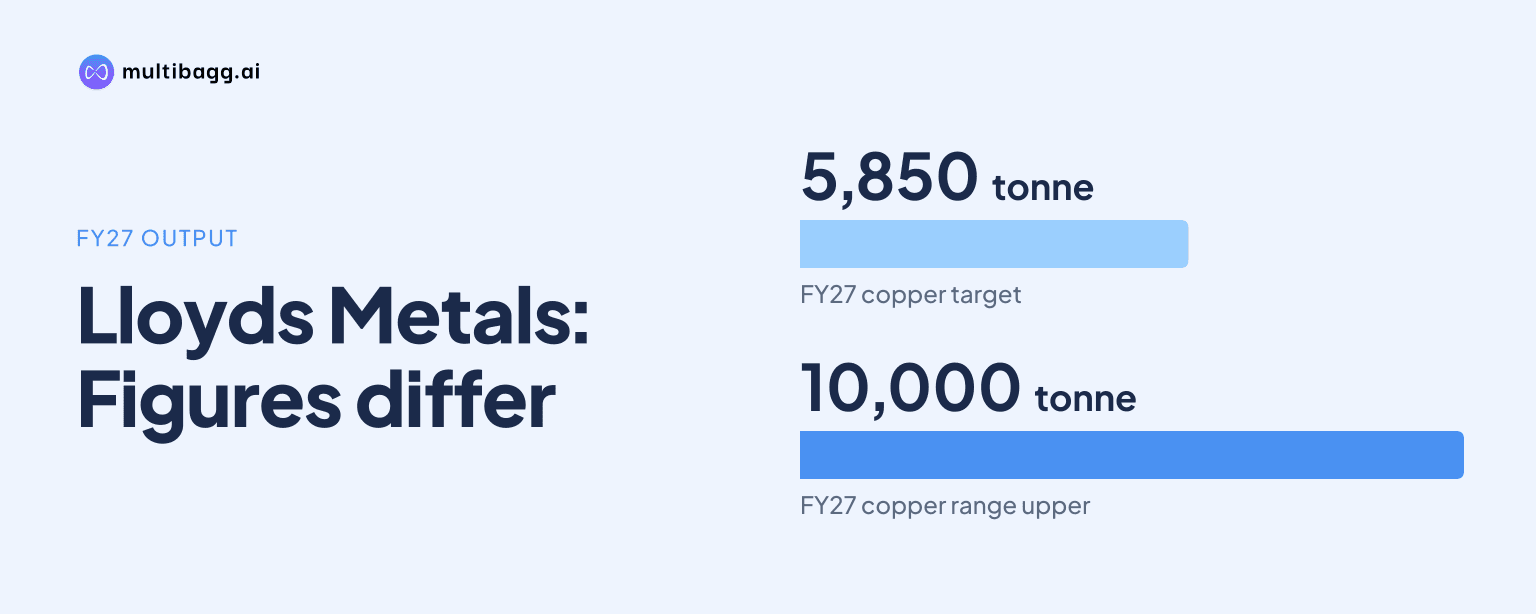
Lloyds Metals’ presentation lists FY27 copper output of 5,850 tonnes, while an analyst said another slide showed 8,000 to 10,000 tonnes; management identified Surya Mines’ third-party ore dependence, sulphuric-acid shortages and 70 to 75-kilometre ore haulage as operating constraints.
Know Lloyds Metals & Energy inside out
Results, valuation, peers and who's buying, in one view.
What is Lloyds Metals’ FY27 copper target?
Lloyds Metals’ FY27 presentation figure was 5,850 tonnes of copper, according to an analyst who compared two presentation slides during the earnings call. The analyst said slide 15 showed an 8,000-to-10,000-tonne full-year FY27 target, while slide 20’s road-to-ramp-up schedule showed 5,850 tonnes for FY27. The supplied transcript ends after that question, so it contains no management explanation of the difference.
The 5,850-tonne figure is 2,150 tonnes below the bottom of the 8,000-tonne range cited by the analyst. Management’s later comments identified operational limitations at Surya Mines, but did not directly state that those factors caused a formal change in consolidated FY27 guidance. The available record therefore establishes a discrepancy between presentation figures rather than a reconciled target revision.
Management separately referred to around 12,000 tonnes of targeted production at Surya Mines. It also described Etoile and Mutoshi as targeting around 75,000 tonnes of copper and 20,000 tonnes of cobalt. Lloyds Metals did not clarify in the supplied call whether the 5,850-tonne figure is a consolidated output expectation, a partial ramp-up measure, or a figure based on a different production definition.
What is restricting production at Surya Mines?
Surya Mines is restricted by third-party ore purchases, acid availability and transport distance, according to management. Hemankur Upadhyaya said the plant operates on ore bought from the market rather than from captive mines, meaning a large part of the mining margin remains with the mine owner. Until Surya Mines secures captive ore, its economics will remain dependent on market-sourced feed.
Sulphuric acid is a second constraint because Surya Mines does not have a dedicated acid plant. Management said sulphur converts to sulphuric acid at a one-to-three ratio and that the Democratic Republic of Congo, or DRC, has limited sulphur-to-acid plants. Chemaf supplied sulphuric acid to Surya Mines at times to address shortages, but management said availability as well as cost remained a challenge.
Freight is the third stated headwind. Management said Surya Mines receives ore from mines about 70 to 75 kilometres from the processing plant, while diesel in the DRC costs about three times the level management cited for India. The company attributed these logistics costs to the DRC’s landlocked location and the expense of moving diesel into the country, alongside the impact of the West Asia crisis.
How do Chemaf and Surya Mines differ?
Chemaf has captive ore, dedicated acid plants and closer mine-to-plant logistics, unlike Surya Mines. Management said both Chemaf projects have dedicated sulphuric-acid facilities, captive mines and power allocations from the state government. Their mines are within a five-kilometre radius of the plants, compared with Surya Mines’ 70-to-75-kilometre ore route.
Management said these arrangements lock in Chemaf’s three main operating inputs: ore, sulphuric acid and power. The company was carrying out tie-in work at the two Chemaf projects and said it was confident of completing them by the end of the current financial year. Management expects the plants to enter production in FY28, rather than during FY27.
The scale described by management also differs. Surya Mines’ approximately 12,000-tonne copper target compares with the 75,000 tonnes of copper and 20,000 tonnes of cobalt targeted at Etoile and Mutoshi. Rajesh Gupta characterised Surya as “12 out of 87” in the group’s copper production picture, indicating that management viewed the immediate operating issues as concentrated in the smaller Surya component.
Got a follow-up? Ask IRIS
When could Surya Mines obtain captive ore?
Surya Mines could obtain captive ore only after further drilling and resource work, for which Lloyds Metals gave no completion date. Management said it continues drilling across exploration licences, but that achieving Joint Ore Reserves Committee, or JORC, standard will take time because the licensed area is large and the assessment requires complete drilling results.
Management contrasted Surya Mines with Chemaf, where JORC work was completed over four to five years from 2015 to 2020 by past shareholders. Lloyds Metals said it benefits from that historical work at Chemaf, whereas Surya Mines is still progressing through the underlying drilling and evaluation process. The transcript did not disclose either a resource estimate or a timetable for a Surya Mines JORC declaration.
Management said established JORC resources support detailed grade control through separate high-grade and low-grade stockpiles and controlled blending. That process can identify the grade in individual mining areas and determine plant feed blends. At Surya Mines, however, management said the current issue is principally feed ownership and dependence on market ore, rather than a disclosed revision to the exploration licences’ ore potential.
What is Lloyds Metals planning to do at Surya Mines?
Lloyds Metals is considering its own solutions, a potential sulphuric-acid plant and intermediate-product transfers from Chemaf to address Surya Mines’ constraints. Management described these as a plan to explore possible remedies, rather than as a committed project. It did not provide capital expenditure, capacity, construction timing or commissioning guidance for a dedicated acid facility.
The interim measure already used was acid supply from Chemaf during periods of shortage at Surya Mines. A more durable solution would need to improve acid availability while lowering the operational exposure created by 70-to-75-kilometre ore transportation. Management did not say how much acid Chemaf had transferred or whether these transfers would continue after the two Chemaf plants enter FY28 production.
The path away from third-party ore is less defined than the Chemaf construction timetable. Management expects Chemaf’s two projects to be completed by the end of the current financial year and operational in FY28, but gave no matching deadline for Surya Mines’ JORC work or captive mine development. The 5,850-tonne FY27 presentation figure therefore remains unreconciled in the supplied transcript.
Conclusion
The earnings-call record shows an unresolved difference between a 5,850-tonne FY27 copper figure and an 8,000-to-10,000-tonne FY27 range cited by the analyst. Management’s explanation of Surya Mines’ purchased ore, acid shortage and long-haul freight exposure provides context for near-term constraints, while Chemaf has captive mines, dedicated acid capacity and mines located within five kilometres of its plants.
The next disclosed milestones are completion of Chemaf’s two projects by the end of the current financial year and their planned production start in FY28. Investors should also watch for management to reconcile the FY27 copper figures, disclose progress on Surya Mines drilling toward JORC standard, and specify whether a dedicated sulphuric-acid plant or further transfers from Chemaf will proceed.