










Lloyds Metals H1 EBITDA margin reaches record 38.33% level
Key highlights
- Lloyds Metals reported an H1 FY27 EBITDA margin of 38.33%, up 542 basis points year on year.
- Value-added products supplied 61% of Lloyds Metals’ Q2 FY27 stand-alone revenue, up from 43% a year earlier.
- Lloyds Metals produced 3.81 million tonnes of pellets in H1 FY27 after its second pellet plant was commissioned in May.
- Lloyds Metals reported H1 FY27 revenue of Rs 9,545 crore and EBITDA of Rs 3,658 crore, up 94% and 126% year on year.
powered by IRIS
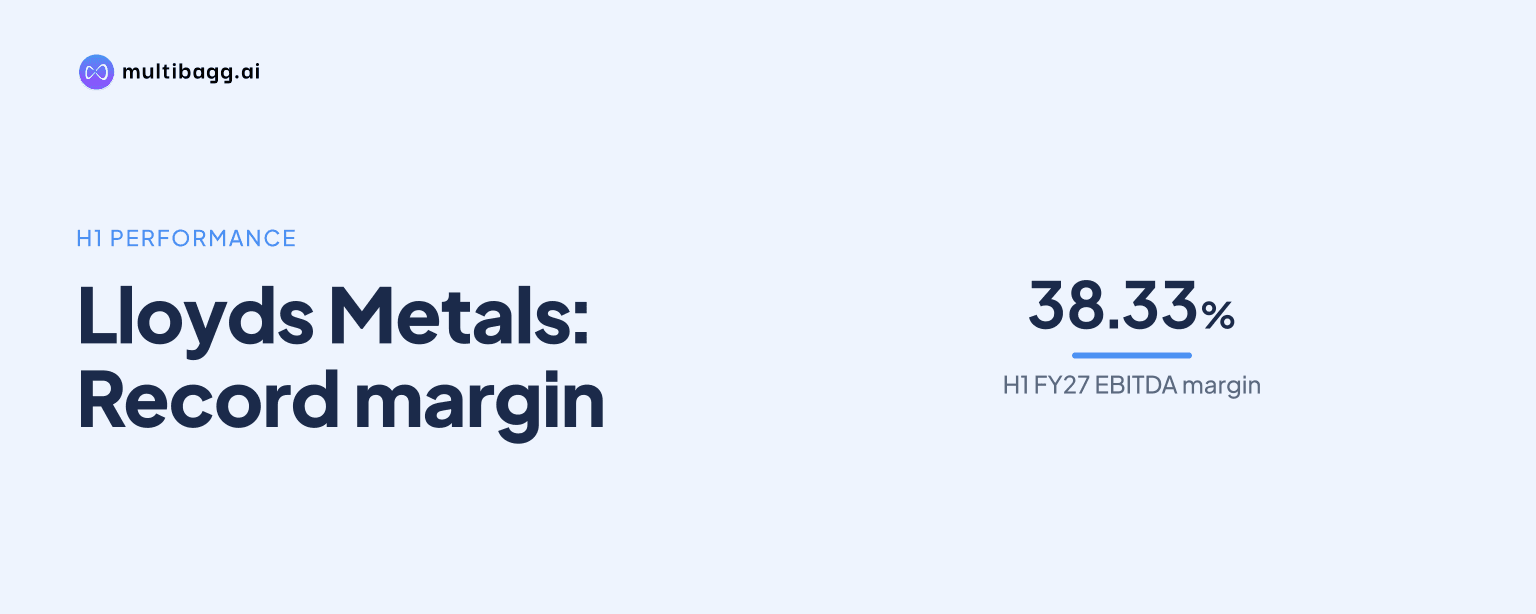
In the first half (H1) of financial year (FY) 2027, Lloyds Metals and Energy Limited reported a record earnings before interest, tax, depreciation and amortisation (EBITDA) margin of 38.33%, up 542 basis points year on year, supported by pellets, sponge iron, higher realisations and lower iron-ore freight costs. Value-added products generated 61% of second-quarter (Q2) stand-alone revenue, against 43% a year earlier.
Know Lloyds Metals & Energy inside out
Results, valuation, peers and who's buying, in one view.
How did Lloyds Metals achieve its record H1 margin?
Lloyds Metals achieved its record H1 FY27 margin through lower logistics costs from its slurry pipeline, higher product realisations and a greater contribution from pellets and other value-added products. Management reported EBITDA of Rs 3,658 crore for H1 FY27, up 126% year on year, on revenue from operations of Rs 9,545 crore, up 94%.
The 38.33% H1 EBITDA margin was Lloyds Metals’ highest for a half year, according to management, and exceeded the prior-year level by 542 basis points. A basis point is one-hundredth of a percentage point. In Q2 FY27, the EBITDA margin was 37.22%, 419 basis points above the year-earlier quarter, while EBITDA rose 83% year on year to Rs 1,538 crore on Rs 4,132 crore of revenue.
Why are value-added products important to Lloyds Metals’ earnings?
Value-added products became more important because they supplied 61% of Lloyds Metals’ stand-alone revenue and 67% of earnings before interest and tax, or EBIT, in Q2 FY27. Those shares were 43% of revenue and 49% of EBIT in Q2 FY26, showing that the mix shifted materially towards higher-processing activities over the year.
Management identified pellets as the principal value-added product supporting that mix shift. Lloyds Metals produced 2.11 million tonnes of pellets in Q2 FY27 and 3.81 million tonnes in H1 FY27 after commissioning its second pellet plant in May. The company reported H1 pellet realisation of Rs 11,520 per tonne and pellet EBITDA of Rs 4,988 per tonne, compared with Q2 levels of Rs 11,348 and Rs 4,604 per tonne, respectively.
The pellet platform comprises two plants with capacity of 4 million tonnes each, both operating above rated capacity, management said. Lloyds Metals is debottlenecking those plants and adding a third pellet plant. Pellet sales were 71% domestic and 29% export in the reported period, while the second plant’s May commissioning lifted first-half output.
What did the slurry pipeline change for Lloyds Metals?
The slurry pipeline reduced Lloyds Metals’ iron-ore logistics and freight costs after the first pipeline reached full capacity, management said. The company cited that change as the first of three drivers of H1 margin expansion, alongside higher product realisations and the rising share of value-added products.
Management said it is extending the pipeline into a longer and larger network to transport beneficiated material over longer distances and reduce fine iron-ore trucking. This plan is linked to beneficiation of banded hematite quartzite, or BHQ, a low-grade ore, and is intended to move larger material volumes by pipeline rather than road. The transcript did not quantify the freight-cost reduction or give a completion date for the expanded network.
The operating scale behind the logistics initiative increased in H1 FY27. Iron-ore production was 10 million tonnes, up 35% year on year, while sales were 7.59 million tonnes. Q2 production was 3.95 million tonnes, up 15.5%, and Q2 sales were 2.12 million tonnes. Management said its monthly iron-ore run rate remained above 2 million tonnes, despite lower production during the rainy season.
Got a follow-up? Ask IRIS
Which products drove Lloyds Metals’ H1 FY27 growth?
Iron ore, direct reduced iron (DRI) and pellets drove Lloyds Metals’ H1 FY27 growth, with management specifically citing higher iron-ore environmental-clearance limits, a faster-than-planned pellet-plant ramp-up and improved sponge-iron volumes. Stand-alone PAT rose 113% year on year to Rs 2,639 crore in H1 FY27, following an 84% rise to Rs 1,112 crore in Q2.
DRI sales reached 343.1 kilotonnes in H1 FY27, a 104% year-on-year increase, including 160.6 kilotonnes in Q2, up 81%. Q2 DRI realisation was Rs 31,040 per tonne and EBITDA was Rs 9,231 per tonne. Power volumes increased 85% year on year in H1 and 82% in Q2, although management did not disclose absolute power-volume figures in the call.
Iron ore provided a lower per-tonne earnings figure than DRI and pellets, based on the reported Q2 measures. Iron-ore realisation was about Rs 6,700 per tonne, with EBITDA of Rs 2,082 per tonne in Q2 and Rs 2,239 per tonne in H1. By comparison, pellet H1 EBITDA was Rs 4,988 per tonne, illustrating why the growing contribution of pellet production affected the overall earnings mix.
What spending and debt did Lloyds Metals report?
Lloyds Metals spent Rs 6,052 crore on capital expenditure in H1 FY27 as it built downstream steel and beneficiation projects. Stand-alone net debt was Rs 9,316 crore on September 30, 2026, while management said consolidated net debt remained below Rs 20,000 crore without providing an exact consolidated figure.
Management said a significant share of group debt came with the Chemaf acquisition and was being renegotiated on more favourable terms. It said a successful renegotiation would reduce group net debt meaningfully, but gave neither a timetable nor an expected revised debt amount. That makes the debt outcome a disclosed management objective rather than a reported financial result.
The capital programme includes a 1.2-million-tonne integrated steel plant intended to produce wire rod, which management said was progressing towards commissioning. Lloyds Metals also has two planned copper and cobalt complexes at Etoile and Mutoshi in the Democratic Republic of the Congo through Chemaf operations. At full potential, management said those operations would produce 74,000 tonnes of copper and 20,000 tonnes of cobalt annually.
Conclusion
Lloyds Metals’ H1 FY27 result combined fast revenue growth with a 542-basis-point margin expansion, producing Rs 3,658 crore of EBITDA and a 38.33% EBITDA margin. The reported improvement was tied to operational mechanisms: 10 million tonnes of H1 iron-ore production, the May commissioning of a second pellet plant, 3.81 million tonnes of pellet output and a higher 61% share of Q2 revenue from value-added products.
Next, investors can watch whether the extended slurry-pipeline and BHQ beneficiation plans further lower logistics costs, and whether pellet debottlenecking raises output from the existing 4-million-tonne plants. Management also plans to decide the capacity and machinery framework for its wider steel complex in the next couple of months, while its Chemaf debt renegotiation remains unresolved.